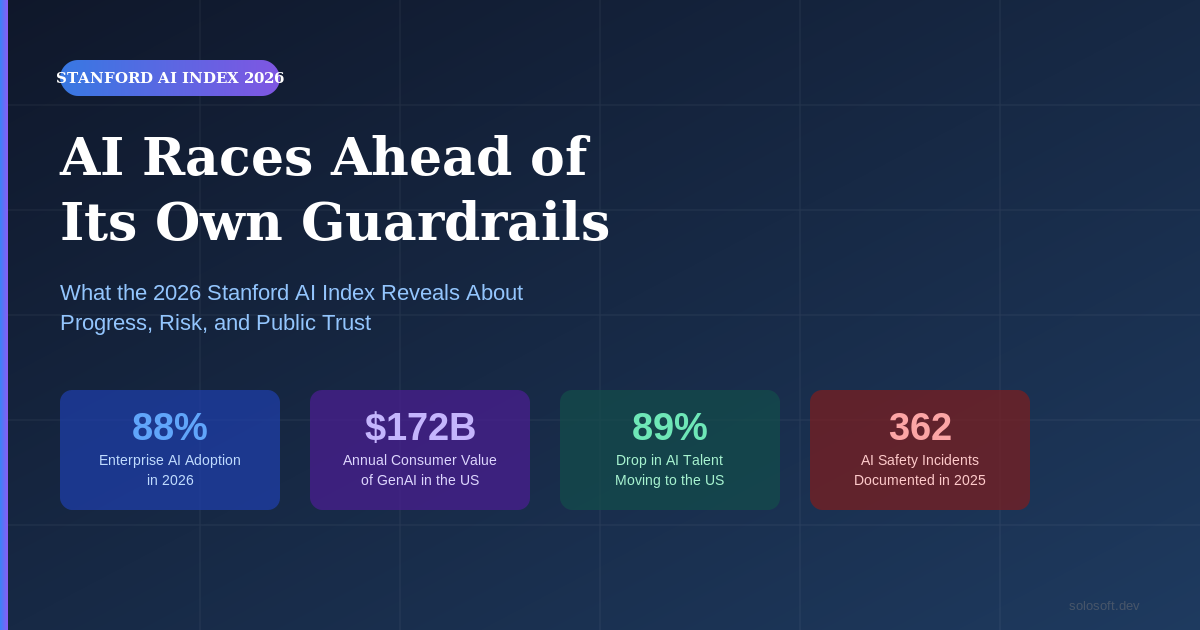
Every year, Stanford University’s Institute for Human-Centered Artificial Intelligence publishes the AI Index — a comprehensive, data-driven accounting of where artificial intelligence actually stands. Not where press releases say it stands, not where venture pitch decks project it will go, but where the measurable evidence puts it. The 2026 edition, released on April 13, arrives at an inflection point that is difficult to overstate. Frontier models are now solving problems that were confidently labeled beyond near-term reach just 18 months ago — resolving nearly 100% of real-world software engineering tickets on the SWE-bench Verified test, exceeding 50% on Humanity’s Last Exam, and meeting or surpassing human baselines on PhD-level science questions across multiple domains. The same report finds that 88% of organizations have adopted AI in some form, and generative AI tools are generating an estimated $172 billion in annual consumer value in the United States alone. And yet: documented AI safety incidents rose to 362 in 2025, up from 233 the year before. Transparency scores from leading AI developers dropped by 18 points in a single year. The number of AI researchers migrating to the US fell 89% since 2017. A 50-point chasm separates expert optimism and public pessimism on what AI means for jobs. This is the definitive picture of a technology racing ahead of its own guardrails, and the 2026 AI Index is the most important document in the field for understanding what it means.
What Has AI Actually Achieved in 2026?
The capability gains documented in the 2026 AI Index are not incremental improvements on existing benchmarks — they represent qualitative threshold crossings that were considered years away by most researchers.
On SWE-bench Verified, which tests whether AI systems can autonomously resolve real GitHub issues in production-quality codebases, performance rose from 60% to near 100% in a single year. This is not a benchmark game: resolving production software issues requires understanding codebases, diagnosing failures, writing correct patches, and passing test suites. At near-100% performance, the benchmark has effectively been saturated — meaning the industry must now find harder tests to measure continued progress.
On Humanity’s Last Exam — a test designed by academics specifically to resist AI gaming, drawing on graduate-level knowledge across 100+ disciplines — top frontier models now exceed 50% accuracy. When the benchmark was introduced, 50% was considered a multi-year horizon. The pace of improvement has made that horizon obsolete in months.
| Benchmark | 2024 Performance | 2026 Performance | Human Baseline |
|---|---|---|---|
| SWE-bench Verified (coding) | ~25% | ~100% | 100% (professionals) |
| Humanity’s Last Exam | ~15% | 50%+ | ~85% (PhD-level experts) |
| MATH (competition math) | 60–70% | Gold-medal level | Gold-medal level |
| Multimodal reasoning | Below human | Matches human | Established baseline |
| Analog clock reading | N/A | 50.1% | 100% |
The last row is not a typo. The same models that achieve gold-medal performance on the International Mathematical Olympiad read analog clocks correctly only 50.1% of the time — barely above chance. This illustrates what the Stanford report emphasizes as the persistent “jaggedness” of AI capability: extraordinary performance on formal reasoning tasks, near-random performance on tasks requiring grounded physical intuition. Understanding where the jagged edges are is critical for anyone deploying AI in production environments.
How Is AI Adoption Reshaping Organizations?
Organizational adoption has crossed from early-adopter territory into mainstream infrastructure. At 88% adoption, AI is no longer a technology organizations are evaluating — it is a technology they are operating and trying to govern.
timeline
    title AI Adoption Wave 2020–2026
    2020 : 35% organizational adoption
    2021 : AI chatbots and NLP widely deployed
    2022 : ChatGPT launches — mass consumer awareness
    2023 : 55% organizational adoption
    2024 : 72% organizational adoption — GenAI tools mainstream
    2025 : Agentic AI pilots begin across enterprises
    2026 : 88% organizational adoption
The $172 billion annual consumer value figure requires context to appreciate. This is not revenue generated by AI companies — it is the estimated economic surplus accruing to US consumers from their use of generative AI tools, measured by willingness-to-pay surveys and time-savings analyses. For comparison, the entire US video game industry generates approximately $65 billion in annual revenue. Generative AI’s consumer value is nearly three times that figure, and the industry is three years old.
The 4-in-5 university student figure is equally significant. Generative AI has become the dominant productivity tool for the next generation of knowledge workers before those workers have entered the workforce. The implications for workplace expectations, hiring, and skills development are not yet fully legible — but organizations that assume “AI-native” means something exotic are about to discover it is the baseline.
| Adoption Metric | 2026 Statistic | Significance |
|---|---|---|
| Organizational adoption | 88% | Mainstream infrastructure, not experiment |
| University student usage | 4 in 5 | Next workforce generation is AI-native |
| Global population on GenAI | 53% within 3 years | Fastest technology diffusion in history |
| US consumer surplus from GenAI | $172B annually | Exceeds entire US video game industry |
| AI companies newly funded in US 2025 | 1,953 | 10x nearest country |
Is the US Winning the AI Race Against China?
The investment data says yes, by a wide margin. The interpretation requires caution.
US private AI investment reached $285.9 billion in 2025 — more than 23 times China’s $12.4 billion in tracked private investment. The US created 1,953 newly funded AI companies in 2025, more than ten times the next closest country. On capability benchmarks, US and Chinese models have traded the lead multiple times since early 2025, but US models currently hold the top positions across most major evaluations.
The caveat the Stanford report explicitly raises: China’s government-directed AI spending through guidance funds and state-linked institutions is not captured in private investment figures. China’s total AI expenditure — public and private combined — is almost certainly significantly higher than $12.4 billion. The structural comparison between a privately-dominated US AI ecosystem and a state-directed Chinese AI ecosystem requires more than private investment figures to assess accurately.
graph LR
    subgraph US AI Ecosystem
        UV[Private VC and Corporate<br>$285.9B 2025]
        UC[1953 New AI Companies]
        UM[Frontier Model Lead<br>Multiple Categories]
    end
    subgraph China AI Ecosystem
        CP[Private Investment<br>$12.4B Tracked]
        CG[Government Guidance Funds<br>Untracked — Substantial]
        CM[Competitive Models<br>Multiple Benchmark Wins]
    end
    UV --> UM
    CG --> CM
    CP --> CM
    UC --> UM
    style UV fill:#dbeafe
    style CG fill:#fef3c7
The talent data complicates the US lead narrative significantly. AI researchers and developers moving to the United States have declined 89% since 2017, with 80% of that decline occurring in just the last year. This is not a gradual drift — it is an accelerating reversal. Capital cannot substitute for concentrated human expertise in AI research; the field advances through the compounding work of researchers who work in proximity to each other. A sustained talent migration decline of this magnitude, if it continues, is the most significant structural threat to US AI dominance identified in the report.
What Are the Real Safety and Transparency Numbers?
The safety data in the 2026 AI Index should be required reading for every enterprise AI governance team.
Documented AI incidents rose to 362 in 2025, up from 233 in 2024 — a 55% increase year over year. These are not theoretical failures. They include real deployments where AI systems caused measurable harm, behaved unexpectedly, or were exploited by adversaries. The incident taxonomy spans misinformation generation, discriminatory outputs, security exploits, privacy violations, and autonomous system failures.
The Foundation Model Transparency Index decline is arguably more alarming. Average scores dropped from 58 to 40 — a 31% decline — in a single year. This means the AI systems that are being deployed at the highest scale are becoming less transparent about how they work, not more. In a period of rapid capability scaling, declining transparency is a compounding risk: systems are becoming more capable while simultaneously becoming harder to audit.
flowchart TD
    A[AI Capability Gains<br>Near-100% on SWE-bench] --> B[Wider Enterprise Deployment<br>88% Organizational Adoption]
    B --> C[Higher Stakes Failure Modes<br>362 Incidents in 2025]
    D[Transparency Index Decline<br>58 to 40 points] --> E[Harder to Audit Systems]
    E --> C
    C --> F[Growing Security Concerns<br>62% of Orgs Cite as Top Blocker]
    F --> G[Agentic AI Deployment Stalled<br>Awaiting Governance Frameworks]
    style A fill:#d1fae5
    style C fill:#fee2e2
    style G fill:#fef3c7
The 62% of organizations citing security as the primary barrier to agentic AI deployment is the most actionable finding in the report for enterprise technology buyers. Agentic AI — systems that take sequences of real-world actions autonomously — represents the next frontier of enterprise value creation. It also represents a qualitatively different risk profile than single-turn AI assistants. The gap between current security posture and what agentic deployment requires is the primary brake on what should otherwise be a straightforward value capture.
| Safety Metric | 2024 | 2025 / 2026 | Direction |
|---|---|---|---|
| Documented AI incidents | 233 | 362 | ↑ 55% |
| Foundation Model Transparency Index avg | 58 pts | 40 pts | ↓ 31% |
| Orgs citing security as top agentic AI blocker | N/A | 62% | New data |
| AI safety bills introduced (US states) | Baseline | 150 enacted | Accelerating |
California’s SB 53 — which the report highlights as landmark legislation — mandates safety disclosures and whistleblower protections for developers of large AI models. It is the most substantive US AI safety legislation to date, and its passage signals that state-level AI regulation is arriving faster than federal action. Enterprises with operations in California have 2026 compliance implications to assess.
Why Is Public Trust in AI Falling While Expert Optimism Rises?
The 50-point divide between expert and public sentiment on AI’s job market impact — 73% positive among experts versus 23% among the general public — is the single most important communications finding in the 2026 AI Index.
It is not primarily an information problem. The public is not simply uninformed about AI’s economic benefits. The divergence reflects fundamentally different relationships to AI’s impact. Experts — who are predominantly employed in research, policy, and technology roles — are concentrated in sectors where AI is a productivity amplifier for their own work. The general public encompasses workers in logistics, customer service, administrative roles, and other sectors where AI displacement is a real, near-term risk rather than an abstract possibility.
The expert-public divide should be read as a leading indicator of political and regulatory pressure. In democracies, public sentiment shapes policy in the medium term regardless of expert consensus. An AI governance environment shaped by 23%-positive public opinion looks very different from one shaped by 73%-positive expert opinion — and enterprise AI deployment strategies that do not account for that divergence are underestimating their regulatory risk.
FAQ
What are the headline findings of the Stanford AI Index 2026? The 2026 AI Index found that frontier models now match or exceed human performance on PhD-level science tasks, organizational AI adoption reached 88%, generative AI is worth $172 billion annually to US consumers, and safety incidents climbed to 362 — up from 233 the year before. Public trust in AI’s economic impact remains sharply divided: 73% of experts are optimistic versus only 23% of the general public.
How fast are AI coding benchmarks improving? Remarkably fast. On SWE-bench Verified — a test measuring whether AI can autonomously resolve real GitHub software engineering issues — scores rose from 60% to near 100% in a single year. On Humanity’s Last Exam, a graduate-level knowledge test, top models now exceed 50% accuracy, a threshold considered unreachable just 18 months ago.
How much has the US invested in AI compared to China in 2025? US private AI investment reached $285.9 billion in 2025, more than 23 times China’s $12.4 billion in recorded private investment. The US also created 1,953 newly funded AI companies in 2025, more than 10 times the nearest country. However, the report notes that China’s total AI spending is likely understated because government guidance funds are not captured in private investment figures.
Why is AI talent migration to the US declining? The number of AI researchers and developers moving to the United States has dropped 89% since 2017, with an 80% decline in the last year alone. The report identifies immigration policy uncertainty, increased competition from other countries for global talent, and growing AI research hubs in Asia and Europe as contributing factors. This represents a structural risk to US AI leadership that capital alone cannot address.
What is blocking enterprise adoption of agentic AI? According to the 2026 AI Index, 62% of organizations cite security and risk as the primary blocker for deploying agentic AI at scale — ranking it above technical limitations at 38%, regulatory uncertainty at 38%, and gaps in responsible AI tooling at 32%. Agentic systems, which operate autonomously across multi-step tasks, require significantly more robust governance frameworks than single-turn AI interactions.
How has AI transparency changed in 2026? It has gotten worse. The Foundation Model Transparency Index dropped from an average of 58 points in 2025 to 40 points in 2026. This decline comes despite growing regulatory pressure for disclosure, suggesting that competitive dynamics are overriding transparency incentives among leading AI developers.
What does the 50-point public trust gap in AI mean for businesses? The gap between expert optimism (73%) and public skepticism (23%) on AI’s job market impact creates a significant deployment challenge for enterprises. Consumer-facing AI products must navigate a public that largely distrusts AI’s economic implications. The gap also signals that AI communications strategies focused on capability benchmarks are failing to address the concerns that matter most to non-expert stakeholders.