Why Six-Minute Fast Charging Is Not a Gimmick, But an Industry Inflection Point?
This means the practicality threshold for electric vehicles has been completely flattened. Over the past decade, the industry has worked to extend range from 300 km to 700 km, but refueling time has always been a hidden pain point. CATL’s push of LFP (Lithium Iron Phosphate) battery charging speed to its physical limit is not only a victory in materials and electrochemistry but also a precise strike in business strategy. It directly targets the most intuitive pain point in consumer experience and transfers the pressure entirely to automakers, charging operators, and even grid companies. When refueling time becomes nearly equivalent to refueling a gasoline car, the slope of the EV adoption curve will steepen dramatically.
In This Battery Race, Who Is Being Left Behind?
The answer is not only CATL’s competitors but also all traditional automakers whose transformation pace is not fast enough. While BYD’s Blade Battery leads in structural innovation and cost, it has fallen behind in peak charging rate. South Korea’s LG Energy Solution and Samsung SDI have advantages in high-end NCM (Nickel Cobalt Manganese) batteries, but cost and safety issues remain burdens in markets pursuing mass adoption. The most awkward position is held by traditional brands reliant on external battery suppliers while making slow progress in software-defined vehicles and electronic/electrical architecture. The leap in battery performance will make the integration capability of the “three-electric system” (battery, motor, electronic control) a more core competitiveness, which is precisely the weakness of many traditional automakers.
| Battery Manufacturer | Technology Route | Current Fast-Charging Highlight (10-80%) | Mass Production Timeline | Major Partner Automakers |
|---|---|---|---|---|
| CATL | Shenxing LFP | ~6 minutes (10-98%) | End of 2026 | Tesla, NIO, Li Auto, BMW, Volkswagen, etc. |
| BYD | Blade LFP | ~15 minutes | Already in mass production | BYD’s own brands, Tesla, Toyota, etc. |
| LG Energy Solution | NCMA NCM | ~18 minutes | Already in mass production | Tesla, GM, Ford, Hyundai |
| Panasonic | 4680 NCM | ~15 minutes (target) | Gradual mass production | Tesla |
| Samsung SDI | PRiMX NCM | ~18 minutes | Already in mass production | BMW, Ford, Rivian |
This table clearly shows that CATL has established a temporary “time gap” advantage in the fast-charging race. This time gap is sufficient for its partner automakers to play a decisive marketing card in the 2027-2028 product cycle.
mindmap
  root(CATL's Six-Minute Fast Charging<br>Industry Shockwave)
    (Automaker Competitive Landscape Reshuffle)
      Premium brands forced to follow<br>or lose technological halo
      Mid-market value proposition redefined<br>(fast charging becomes standard)
      Software & battery management system<br>weight increases sharply
    (Charging Infrastructure Revolution)
      Existing supercharging stations face<br>"obsolete before completion" pressure
      Grid side: requires pairing with<br>large-scale energy storage for buffering
      Station operation model changes<br>(shorter dwell time, higher turnover rate)
    (Upstream Materials & Technology Routes)
      Lithium Manganese Iron Phosphate (LMFP)<br>and other materials gain attention
      Silicon-based anodes, super-conductive electrolytes<br>industry chain investment heats up
      Thermal management systems become<br>a new core component battleground
    (Consumer Behavior & Market)
      "Range anxiety" substantially alleviated
      Usage habits converge with gasoline cars<br>(charge as needed)
      Used EV resale value<br>new key metric: "fast-charging capability"
The “Moore’s Law” for Charging Infrastructure Has Arrived, Can We Keep Up?
The power race for charging piles will enter a white-hot stage. Achieving six-minute refueling imposes nearly brutal requirements on the output power, thermal management, and grid interaction capabilities of charging piles. This is not only a challenge for charging pile manufacturers but also the ultimate test for urban grid resilience.
Will Supercharging Stations Become “Power Black Holes”?
In the short term, yes. A supercharging station supporting this technology, if several vehicles charge at peak simultaneously, could have an instantaneous load exceeding several megawatts (MW), equivalent to the electricity consumption of a small community. This will catalyze two development paths: first, “solar-storage-charging integrated” sites become the absolute mainstream, smoothing output and shaving peaks through solar and energy storage batteries; second, grid companies must deeply participate, establishing dedicated fast-charging networks and dynamic pricing mechanisms, turning charging loads into dispatchable resources. The smart energy management system behind this will become a more critical asset than the charging pile hardware itself.
| Charging Scenario | Current Mainstream Power | Estimated Power Required for Six-Minute Fast Charging | Key Challenges | Potential Solutions |
|---|---|---|---|---|
| Public Supercharging Station | 150-350 kW | 500 kW - 1 MW+ | Grid capacity, transformer upgrades, thermal management | Paired with 1-2 MWh energy storage cabinets, dynamic load balancing |
| Highway Service Area | 120-250 kW | 500 kW - 1.5 MW+ | Concentrated peak electricity demand, land and power capacity expansion | Reservation-based charging, independent substation construction |
| Mall/Retail Parking Lot | 50-120 kW | 200-350 kW | Distribution line retrofitting, cost sharing | Integration with site power management systems, time-of-use pricing |
| Residential Slow Charging | 7-22 kW | Not applicable (not primary scenario) | No upgrade needed for this purpose | Maintain as primary overnight replenishment method |
This means the investment threshold and technical complexity of infrastructure will increase exponentially. Charging operators without strong financial resources and energy management technology may be eliminated in this round of upgrades.
For Apple and Tech Giants’ EV Dreams, Is This an Assist or a Death Knell?
This heightens the professional barriers to “car-making,” making it harder for cross-border entrants. Apple’s electric vehicle project, Titan, has faced twists and turns, with one core challenge being how to define differentiation in an already crowded field. When leading battery suppliers elevate foundational performance to a new height, latecomers who cannot surpass in battery or refueling experience are left with only brand, design, and software ecosystem to focus on. This is precisely Apple’s strength, yet it appears insufficient.
Should Tech Companies Make Their Own Batteries or Become “Integration Masters”?
For companies like Apple with ample cash flow, pursuing ultimate experience and hardware-software integration, CATL’s breakthrough may prompt a strategic rethink. One path is to deeply invest in or even self-develop next-generation battery technology (e.g., all-solid-state batteries) like Tesla did early on, seeking disruptive breakthroughs. A more pragmatic path is to become an “integrator of top-tier technology,” leveraging strengths in chips (e.g., Apple Silicon), software systems, and supply chain management to seamlessly integrate top batteries like CATL’s with unique vehicle architecture, thermal management systems, and energy management software, creating the smoothest, “smartest” EV experience. The latter still has an extremely high barrier but may be a more feasible path.
timeline
    title Evolution of EV Fast-Charging Technology and Industry Impact
    section 2020-2023
        Popularization Phase : Mainstream fast charging advances to 15-30 minutes (10-80%)<br>Supercharging network initial construction
        Impact : Range anxiety alleviated,<br>high-end EV acceptance increases
    section 2024-2026
        Breakthrough Phase : CATL launches<br>six-minute fast-charging Shenxing battery
        Impact : Refueling experience approaches gasoline cars,<br>charging infrastructure faces upgrade pressure
    section 2027-2030
        Shakeout Phase : Technology diffusion and cost reduction,<br>megawatt-level charging becomes high-end standard
        Impact : Models and brands unable to offer fast refueling<br>face marginalization
    section Post-2030
        New Normal Phase : Ultra-fast charging coexists with<br>battery swapping, wireless charging, and other modes
        Impact : EVs become fully mainstream,<br>energy network and transportation network deeply coupled
Where Are the Opportunities and Risks for Taiwan’s Tech Supply Chain?
Opportunities lie in “subsystems” and “key materials,” risks lie in “path dependency.” Taiwan has deep accumulation in semiconductors, electronic components, precision manufacturing, and thermal management. The proliferation of six-minute fast-charging batteries will significantly increase demand and performance requirements for the following components:
- High-power charging connectors and wiring harnesses: Must withstand higher current and thermal loads, requiring superior materials and design.
- Battery Management System (BMS) chips and modules: Require more precise cell monitoring, faster algorithms, and greater computing power.
- Thermal management systems: Including liquid cooling plates, pumps, valves, piping, and control units, their importance will be on par with the battery itself.
- Upstream materials: Such as high-purity electrolyte additives, high-performance separators, conductive agents, etc.
However, the risk is that if Taiwanese manufacturers remain content with being suppliers of standard specification components, without proactively investing in co-development with next-generation battery technology or entering higher value-added integrated hardware-software solutions like energy management systems, they may remain in lower-margin segments in the new round of industry value distribution.
According to BloombergNEF forecasts, cumulative global investment in EV fast-charging infrastructure will exceed $300 billion by 2030. Among this, power electronics, thermal management, and smart dispatch systems related to high-power charging will occupy an increasingly large share. This is a market that cannot be ignored.
Conclusion: This Is Not Just a Battery, But a Key to Rewriting the Rules
The significance of CATL’s six-minute fast-charging battery far exceeds a product launch. It is a starting gun, declaring the EV industry competition has entered the second half. The first half competed on “availability” and “range,” the second half will battle on “experience” and “ecosystem.” The core of this experience is eliminating all inconveniences compared to gasoline cars. When the refueling time gap is erased, EVs’ advantages in cost (usage and maintenance), performance (acceleration, quietness), and intelligence will be magnified infinitely.
Moving forward, we will see:
- Deep restructuring of automakers: Forming deep cooperative ties with top battery makers or being forced to invest heavily in self-research, with barriers rising sharply.
- Accelerated fusion of energy networks and transportation networks: Charging stations will evolve into smart energy nodes integrating storage, photovoltaics, and V2G (vehicle-to-grid).
- A new wave of material and engineering innovation: New technology tracks have opened around safety, lifespan, and cost under extreme fast charging.
This storm triggered by a single battery has just begun. It poses a critical question to every participant in the industry chain: When the rules change, are you the one ready to surf the wave, or the one who will be swallowed by it?
FAQ
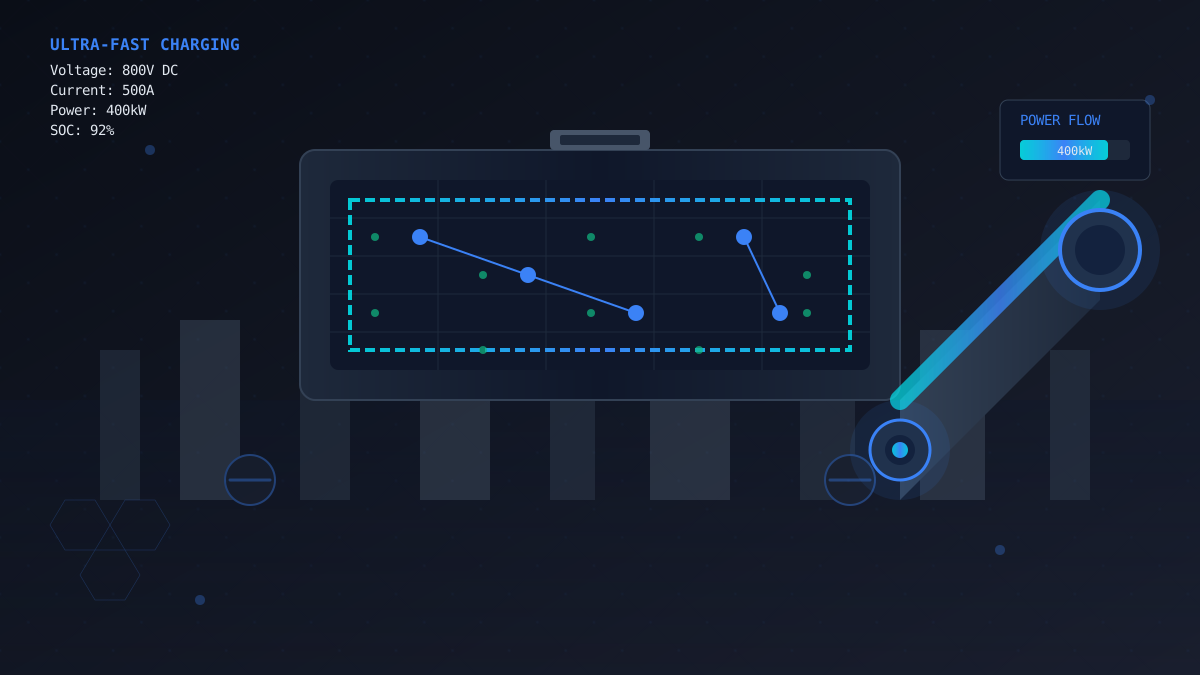
Can CATL’s new battery really be fully charged in six minutes? According to the release information, the new-generation Shenxing battery can replenish from 10% to 98% in six minutes, referring to peak charging speed under ideal conditions. Actual experience will be affected by charging pile power, battery temperature management system, and grid load.
What impact will six-minute fast-charging technology have on existing charging stations? This technology will force existing 350kW+ supercharging stations to upgrade power, potentially moving towards 500kW or even megawatt-level (MW) development, while imposing higher demands on grid stability and energy storage buffering systems, accelerating the adoption of solar-storage-charging integrated sites.
How will this breakthrough affect other EV makers like Tesla? Automakers like Tesla that self-develop batteries will face immense pressure to accelerate their own supercharging technology R&D or seek cooperation with CATL. Vehicle competition will rapidly shift from a focus on range to comprehensive experience competition centered on “refueling convenience.”
With such fast charging speeds, how are battery lifespan and safety ensured? CATL claims the new battery has passed rigorous safety tests, with its core lying in material innovation and intelligent temperature control systems. However, extreme fast charging poses significant challenges to battery chemistry and thermal management; long-term cycle life data still requires market validation.
When will this technology be available in EVs purchased by general consumers? High-end models are expected to start incorporating it by the end of 2026, but widespread adoption in mid-priced models may not occur until after 2028, depending on production ramp-up and cost reduction speed.
Further Reading
- BloombergNEF Electric Vehicle and Charging Infrastructure Long-Term Outlook Report - Authoritative data and forecasts on the global EV market and charging infrastructure investment.
- International Energy Agency (IEA) Global EV Trends Report - Analyzes policy and market drivers for EV development from an energy transition perspective.
- CATL Official Technology Innovation Page - View CATL’s official battery technology roadmap and innovation details.