Why ‘Engineer’ Ternus? What Does the Shift in Apple’s Power Core Signify?
Direct answer: Ternus’s emergence marks a formal shift in Apple’s power core from “operational efficiency master” to “product innovation engineer.” This is not accidental but a clear judgment by the board regarding the competitive landscape of the next decade: deep hardware integration and AI-native experiences will be key to victory, and these require top-tier engineering leadership to drive them.
When Tim Cook took over as CEO from Steve Jobs in 2011, his task was to transform a company full of creativity but operationally precarious into a precision machine with astonishing profitability and an impeccable supply chain. He succeeded, with Apple’s market cap surpassing $3 trillion and service revenue becoming a growth engine. However, Wall Street and industry observers have increasingly questioned in recent years: where is Apple’s “next big thing”? Vision Pro opened the curtain on spatial computing, but the path to普及 is long; in the generative AI wave, Apple has seemed relatively silent. Against this backdrop, choosing an operationally-minded successor (like previously favored COO Jeff Williams) to “maintain the status quo” clearly no longer meets the board’s expectations.
Ternus’s promotion is tantamount to announcing to the world: Apple’s next phase will return to its most fundamental基因—defining全新的 user experiences through breakthrough hardware engineering. His resume is a nearly 25-year history of Apple product evolution: from the slim design of the first iPad, to leading the iPhone toward full-screen and titanium frames, to spearheading the Mac’s “quiet revolution” transitioning from Intel processors to in-house Apple Silicon. Each involved transforming极度 complex engineering challenges into intuitive, elegant products in consumers’ hands. This ability to make technology “invisible” is precisely the leadership quality Apple needs most in the AI and mixed reality era. AI should not just be a chatbot; it should be smarter HDR in the iPhone camera, more adaptive noise cancellation in AirPods, smoother eye-tracking in Vision Pro. These require deep integration of hardware and algorithms, and Ternus is an expert at驾驭 this fusion.
From a broader industry power structure perspective, this also reflects a trend among Silicon Valley’s top tech companies: engineers are重新站上 the决策顶峰. When technology paradigms shift rapidly, leaders with deep technical intuition often make more前瞻的 bets. We’ve seen Sundar Pichai at Google (though not a pure engineer, coming from product management) lead the AI First transformation, and Satya Nadella at Microsoft drive a cloud and AI revival with his technical background. Ternus’s appointment is a clear signal that Apple is joining this “technical insight leadership” race.
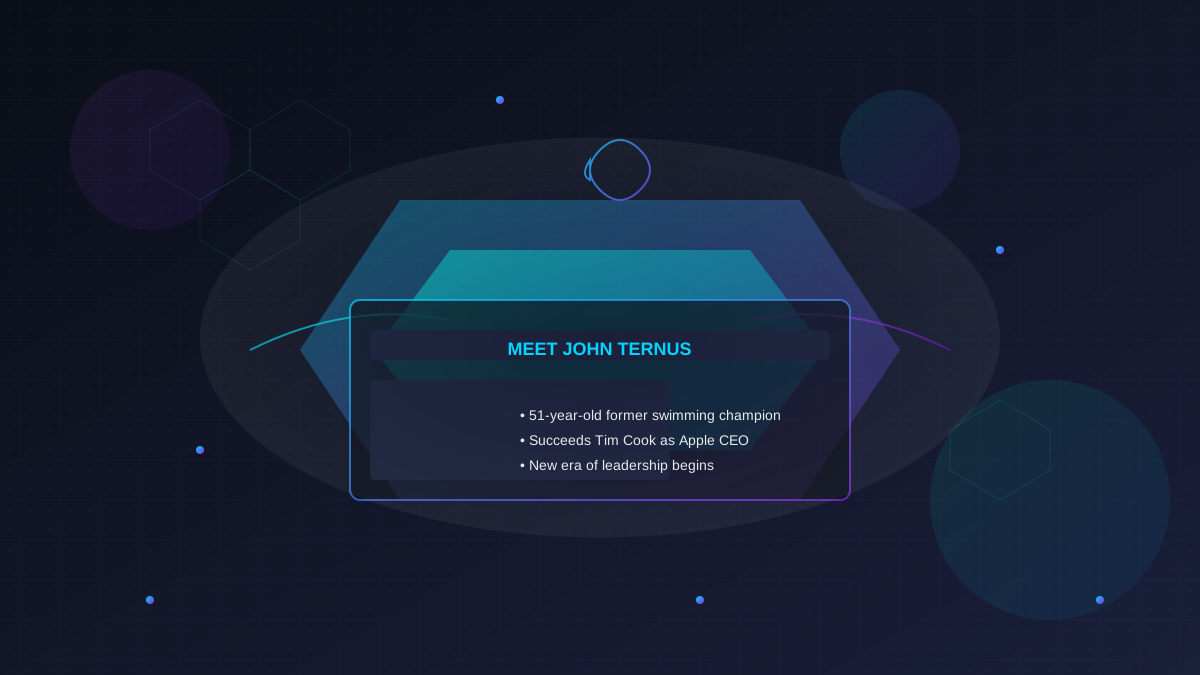
From the Pool to Cupertino: How Might Athlete Traits Shape Future Apple Leadership Style?
Direct answer: Ternus’s experience as a former collegiate competitive swimming champion is far from trivial. It shaped his pursuit of extreme efficiency, focus on team relay, and ability to remain stable under immense pressure. These athlete qualities will likely translate into a leadership philosophy emphasizing execution discipline, cross-departmental collaboration, and endurance in the marathon of long-term product R&D.
Pursuing both an engineering degree and top-level competitive swimming at the University of Pennsylvania required超凡的时间 management, discipline, and抗压性. Swimming is an极度孤独 yet极度依赖 data sport, where every stroke and turn seeks to maximize efficiency in split seconds. This mindset bears惊人的相似性 to hardware engineers optimizing circuit board layouts, reducing毫瓦级 power consumption, and争抢 millimeter-level space. Ternus will likely bring this pursuit of “毫厘之争” to the top management.
More crucially is team relay spirit. Apple’s product development is绝非一人之功; it’s a精密接力 of顶尖 teams in industrial design, software engineering, chip design, supply chain management, and more. Ternus has grown and ultimately led the hardware engineering team within such a relay system over the past 25 years. He understands how to perfectly hand off the “chip design” baton to “product assembly.” This deep understanding of cross-functional collaboration will help break down potential barriers between “hardware” and “software/services” within Apple. Especially in the AI era, algorithm teams, cloud infrastructure teams, and end-device teams must collaborate前所未有的 closely to create seamless hybrid AI experiences.
We can compare the potential different leadership emphases derived from Cook’s and Ternus’s backgrounds through the following table:
| Leadership Dimension | Tim Cook (Operations & Supply Chain Background) | John Ternus (Hardware Engineering Background) |
|---|---|---|
| Strategic Core | Scaling, efficiency, profit maximization | Technological breakthroughs, product definition, experience innovation |
| Decision-Making Style | Data-driven, risk control, consensus-building | Technical intuition, willingness to bet, pursuit of极致 |
| Innovation Focus | Business model innovation (e.g., service subscriptions), supply chain innovation | Hardware architecture innovation, materials science, software-hardware integration |
| External Image | Global business leader, corporate value advocate | Product builder, engineer’s engineer |
| Challenges Faced | Finding the next growth curve, geopolitical risks | Balancing innovation cycles with profit pressure, managing technical debt |
This is not to say Ternus doesn’t value operations, but his starting point will be “how to make amazing products,” then反向驱动 the operational system to realize them. This微妙 priority shift may bring a全新的 product气象 to Apple.
Apple’s Product Blueprint in the Ternus Era: How Will AI and Hardware Be Re-Welded?
Direct answer: Under Ternus’s leadership, Apple will accelerate its strategy of “AI as a hardware feature.” We will see more specialized neural processing units (NPUs), sensor fusion reaching new heights, and new device forms tailored for spatial computing. Product line iterations will focus more on “architectural-level innovation” rather than just cosmetic updates.
First, the AI chip war will intensify. Under Ternus’s oversight, the Apple Silicon roadmap will become more激进. Currently, NPU performance within M-series and A-series chips grows about 30-40% annually, but this may still be insufficient for running large language models (LLMs) locally. We expect Apple to launch co-processors专为 device-side AI design, or significantly expand NPU core counts and memory bandwidth, within the next two years. The goal is to enable iPhones and Macs to perform more complex generative AI tasks without relying on the cloud, which关乎 not only体验流畅度 but also core claims of privacy and security.
Second, the sensor ecosystem will迎来 an integration revolution. From iPhone’s LiDAR, Apple Watch’s blood oxygen sensor, to Vision Pro’s myriad cameras and sensors, the amount of environmental and biometric data Apple devices collect is惊人. However, most of this data is currently applied within their respective product lines. Ternus’s engineering team有望打破 these silos, establishing a unified “context-aware platform.” For example, when you’re working with Vision Pro, the iPhone’s Ultra Wideband chip could more precisely locate your desk, allowing virtual windows to “anchor” on the physical桌面; Apple Watch’s heart rate data might实时反映 your stress levels during immersive experiences and dynamically adjust content. This requires deep hardware architecture重构 and software protocol unification—precisely the systems engineering challenges Ternus excels at.
Let’s use a Mermaid mind map to outline the core product strategic pillars likely to be strengthened in the Ternus era:
mindmap
  root(Ternus Era Product Strategy)
    (AI-Native Hardware Architecture)
      Specialized/Modular NPUs
      Unified Memory Architecture Upgrades
      On-Device Large Model Inference Engines
    (Seamless Sensor Fusion)
      Cross-Device Context-Aware Network
      Biometric & Environmental Data Integration
      Ultra-Low Power Always-On Computing
    (New Materials & Manufacturing Processes)
      Lighter, Stronger Composite Materials
      Custom Chip Packaging (SiP)
      Eco-Friendly Recyclable Material Cycles
    (Deep Health Tech Integration)
      Non-Invasive Glucose/Blood Pressure Monitoring
      Mental Health Metric Quantification
      Data Interoperability with Medical Systems
Third, product lines may undergo ‘streamlining’ or ’re-categorization.’ As head of hardware, Ternus深知 product line complexity消耗 engineering resources. We might not see a骤减 in product count, but likely clearer定位区隔. For example, the iPad line’s混乱 (multiple sizes, chip generations coexisting) may need梳理; the Mac’s “Pro” vs. “non-Pro"界限 may need redefinition in the AI era—“Pro” could mean powerful local AI算力, not just more cores and memory slots.
According to Counterpoint Research predictions, by 2028, over 60% of premium smartphone shipments will be capable of running LLMs with 10B+ parameters, requiring hardware to provide at least 20 TOPS of sustained AI算力. Apple currently leads, but the advantage is narrowing. Ternus’s task is to raise this threshold significantly again through hardware innovation, building new护城河.
What Does This Leadership Change Mean for Apple’s Competitive Position and Industry Ecosystem?
Direct answer: This handover will intensify Apple’s head-on competition with Meta and Google in mixed reality and AI platforms, while also potentially changing the depth of Apple’s collaboration with supply chain partners like TSMC. For the developer ecosystem, a more engineering-oriented Apple may mean more powerful, open underlying tools but also stricter requirements for experience consistency.
Competitive Landscape Reshaped: In mixed reality, Ternus was a key driver of Vision Pro hardware. His ascension无疑宣告 Apple will double down on spatial computing. This will directly collide with Meta’s Quest line and its metaverse ambitions. The竞争焦点 will shift from “whose headset is lighter” to “whose ecosystem can attract more killer apps.” Ternus’s engineering background有助于快速迭代 hardware, reducing weight and cost for后续 Vision Pro versions—key to普及. In AI platforms, Apple has always taken a “device-side AI + privacy"差异化路径, against Google’s “cloud AI + service integration” and Microsoft’s “enterprise AI + productivity tools” strategies. Ternus needs to prove Apple’s hardware integration advantage can translate into more personalized,即时, reliable AI experiences, not just catching up to ChatGPT features.
Supply Chain Relationship Evolution: Cook is a supply chain management master, building紧密而复杂 relationships with partners like Foxconn and TSMC. Ternus interacts with these partners from a technical collaboration angle. In the future, Apple’s collaboration with TSMC may not just be “ordering the most advanced process chips” but earlier involvement, co-designing packaging technologies optimized for Apple’s AI architecture (like more advanced InFO-LSI or SoIC). This would deepen the supply chain from “contract manufacturing” toward “co-R&D,” binding more紧密 but possibly requiring more专属 investment from suppliers.
The table below analyzes the contrasting backgrounds and strategic focuses of major competitors:
| Company | Current CEO Background | Current AI/Hardware Strategic Focus | Potential Response to Ternus-Led Apple |
|---|---|---|---|
| Apple | John Ternus (Hardware Engineering) | On-device AI integration, privacy-first, spatial computing hardware | (New) Accelerate hardware iteration, deepen software-hardware integration护城河 |
| Sundar Pichai (Product Management) | Cloud AI services (Gemini), Android ecosystem integration, search foundation | Strengthen Pixel hardware integration with Gemini Nano, highlight cloud+edge协同优势 | |
| Microsoft | Satya Nadella (Cloud & Enterprise) | Enterprise Copilot, Azure OpenAI services, Windows on ARM | Deepen partnerships with Qualcomm etc., compete in PC market with AI PC concept against Mac |
| Meta | Mark Zuckerberg (Founder) | Metaverse vision, Quest hardware, open-source large models (Llama) | Continue抢占 VR/AR market with price advantage and social ecosystem, promote open-source AI hardware reference designs |
| Samsung | Roh Tae-moon (Mobile Communications) | Galaxy AI, foldable screen hardware, multi-device ecosystem (Tizen) | Increase collaboration with Google, maintain lead in form innovations like foldable devices |
Impact on Developer Ecosystem: An engineer CEO may better understand developers’ need for powerful tools to unleash hardware potential. We can expect Xcode development tools, Core ML framework, ARKit and RealityKit APIs to become more powerful and user-friendly. Ternus may推动更多底层 sensor data (with privacy protection)开放 via APIs to developers, fostering more innovative health, fitness, and spatial computing apps. However, Apple’s偏执 for experience consistency may also strengthen, with App Store review guidelines potentially becoming more detailed in规范 AI functionality privacy and performance.
Cook’s Legacy and Future Role: Can the Transition Truly Be ‘Seamless’?
Direct answer: Cook’s move to Executive Chairman provides a “stability anchor” for the power transition. He will continue to play a key role in supply chain resilience, global government relations, and long-term strategic investments like environmental commitments. However, Ternus must step out of Cook’s shadow within a reasonable timeframe and establish his own authority in product decisions to truly usher in his era.
Cook’s legacy is solid: a financially impeccable operational machine, a service empire nearing $100 billion in annual revenue, and embedding corporate values (privacy, environmentalism, inclusivity) into the brand’s core. As Executive Chairman, Cook’s likely focus areas include: first, ensuring stability in key markets like China, a支柱 of Apple’s revenue; second, overseeing the hundreds of billions in capital return program (buybacks and dividends) to稳定 investor confidence; third, continuing as the company’s public face on issues like environmentalism and supply chain human rights. These provide “logistical support” for Ternus as new CEO, allowing him to focus more on product and technology frontiers.
But潜在张力 exists. The Apple board chose an engineer,必然 hoping for bold innovation. If Cook on the board leans too much toward risk-averse operational thinking, it could摩擦 with Ternus’s desired high-risk, high-reward technology bets. A successful transition will depend on clear职权划分 and mutual trust between the two. A possible model: Cook focuses “externally” and on long-term strategic guardrails, while Ternus owns product vision and execution. The first 12-18 months will be critical for observing whether this new dual-leadership structure functions as a synergistic engine or creates决策 ambiguity.
Ultimately, for苹果, which has only had two CEOs in over 40 years, this transition is not just a change of personnel but a strategic recalibration of its core engine. From Jobs’s “reality distortion field” to Cook’s “operational excellence,” and now to Ternus’s “engineering depth,” each era has reflected the company’s adaptation to external technological waves and internal growth stages. Ternus’s test will be whether he can translate that engineering depth into products that not only wow the industry but also capture the hearts of billions of users, writing the next chapter in苹果’s传奇.