Why Can India’s Tech Industry Grow Against the Trend Amid US Tariff Barriers?
The answer lies in the rapid transformation of its industrial structure. When traditional merchandise exports were hit, India’s service exports and digital economy took over as the main growth drivers. This is no accident but the result of a decade of “Digital India” policies, a vast STEM talent pool, and a vibrant startup ecosystem working in tandem. US tariff pressure has, in fact, accelerated India’s qualitative shift from the “world’s back office” to a “global innovation hub.”
In 2025, India’s merchandise exports to the US declined by 25% due to tariffs as high as 50%, a heavy blow to any economy. However, during the same period, India’s service exports, particularly in IT services, cloud solutions, AI consulting, and R&D outsourcing, maintained double-digit growth. Behind this are two key shifts: First, companies are “localizing” supply chains. Many consumer electronics and ICT products previously manufactured in China for export to the US are now being produced in India, directly serving local and neighboring markets to circumvent tariffs. Second, Indian tech companies have upgraded from a simple “cost center” outsourcing model to “value co-creation” strategic partners, directly participating in clients’ AI model training, data platform construction, and core digital transformation projects.
timeline
    title Key Milestones in India's Tech Industry Transformation
    section Foundation Period (2015-2020)
        2015 : Launch of "Digital India" Initiative<br>Large-scale optical fiber network deployment
        2016 : Introduction of Unified Payments Interface (UPI)<br>Igniting digital finance
        2018 : Relaxation of regulations for drones<br>and other emerging technologies
    section Acceleration Period (2021-2025)
        2021 : Announcement of Production Linked Incentive (PLI) Scheme<br>Attracting electronics manufacturing
        2023 : Release of National AI Strategy<br>Establishment of three AI Centers of Excellence
        2025 : US tariff impact<br>Accelerates supply chain restructuring
    section Breakout Period (2026-2027 Forecast)
        2026 : Semiconductor pilot production line begins operation<br>AI service exports exceed 40% share
        2027 : Projected to become the third-largest<br>economy and tech consumer market
Even more noteworthy is the flow of investment. According to the UN report, against a backdrop of a 2% decline in overall Foreign Direct Investment (FDI) in the Asia-Pacific region, India still attracted a substantial $50 billion in greenfield investment commitments in the first three quarters of 2025, ranking first in the region. These funds are not flowing into traditional industries but are highly concentrated in the technology sector. We can see this trend from several key investment cases:
| Investment Area | Representative Entity/Project | Estimated Investment Scale | Strategic Significance |
|---|---|---|---|
| Semiconductor Manufacturing | Tata Group & Powerchip collaboration to establish a fab | Over $10 billion | Building a domestic ecosystem from chip design to packaging/testing, reducing import dependency. |
| Data Centers & Cloud | Google, Microsoft, Adani collaboration for expansion | Over $5 billion | Meeting domestic data sovereignty regulations and serving as a hub for South Asia and the Middle East. |
| Electric Vehicles & Batteries | Tesla Gigafactory, Taiwanese battery plant investments | Approximately $7 billion | Combining software advantages to create smart mobility solutions, not just assembly. |
| AI Startups & R&D | OpenAI expanding Bangalore team, domestic AI unicorns | Over $3 billion | Leveraging local talent for large language model localization and vertical application development. |
These investments collectively paint a blueprint: India is systematically constructing a complete tech pyramid spanning hardware (semiconductors, electronics manufacturing), infrastructure (data centers, 5G), to software and applications (AI, SaaS). This fundamentally distinguishes the quality of its economic growth from the “demographic dividend-driven” growth of a decade ago, shifting towards “technology innovation and capital intensity-driven” growth.
Will India Become the Next Core Battleground for Global AI R&D and Application?
Highly likely, and its path will be distinctly different from that of the US and China. India’s core advantage in AI development lies in the “scale and complexity of application scenarios” and the “cost and agility of talent.” While Silicon Valley focuses on the frontier race for foundational models and China concentrates on industrial AI and regulatory tech, India is deeply integrating AI into the vast and diverse fabric of its socio-economic landscape—from agricultural alerts, native language education to SME credit—each scenario is a testing ground with hundreds of millions of users.
India’s National AI Strategy, released in 2023, explicitly prioritizes healthcare, agriculture, education, smart cities, and transportation & logistics. This is not just on paper; it is driven by real capital and projects. For example, in agriculture, the government collaborates with Microsoft, Infosys, and others, using satellite imagery and AI models to provide precise sowing, irrigation, and pest/disease warning advice to tens of millions of small farmers, which holds immense value in a vast and climatically diverse country like India. In finance, AI-based credit scoring models are enabling hundreds of millions of people and micro-enterprises without traditional bank credit records to access financial services.
This large-scale, grounded AI application practice has fostered unique “Indian-style AI innovation”: focused on cost-effectiveness, capable of handling multilingual mixed environments, and operating stably under imperfect infrastructure conditions. This means Indian tech companies are no longer just exporting code but AI solution “templates” validated by hundreds of millions of users. According to NASSCOM data, India’s AI industry scale reached $12 billion in 2025, growing at over 30% annually, with a significant portion coming from global AI service outsourcing orders.
mindmap
  root(India's AI Ecosystem Competitiveness)
    (Vast Application Testing Ground)
      Agriculture (120 million farming households)
      Finance (Hundreds of millions unbanked population)
      Healthcare (Tiered diagnosis & treatment system)
      Multilingual Environment (22 official languages)
    (Cost Advantage & Talent)
      World's largest English-speaking tech talent pool
      Engineer cost approximately 1/4 of US levels
      Agile software development culture
    (Policy & Capital Support)
      National AI Strategy & data governance framework
      Venture capital focused on AI startups (2025 funding over $5 billion)
      Production Linked Incentive (PLI) scheme covering electronics manufacturing
    (Exported Solution Templates)
      Low-cost, scalable AI models
      Hybrid cloud & edge AI deployment experience
      Multilingual NLP & computer vision applications
However, challenges are equally evident. Investment in basic research is relatively weak, access to advanced chips is affected by geopolitics, and data privacy and ethical frameworks are still being refined. This also creates significant collaboration opportunities, especially for players from Taiwan and South Korea with strengths in hardware, semiconductors, and basic research.
How Should Taiwan’s Tech Industry Chain Reposition Its Competitive-Cooperative Relationship with India?
In the past, Taiwan-India relations were largely one-way investment and trade: Taiwan exported electronic components, India exported software services. In the future, this relationship must be upgraded to a “bidirectional co-creation” strategic partnership. Taiwan’s expertise in hardware manufacturing, precision engineering, and semiconductor management strongly complements India’s software development, system integration, and vast domestic market. The key is finding the right collaboration model, avoiding pure cost competition, and shifting towards value creation.
First, regarding supply chain restructuring, Taiwanese manufacturers should not view India merely as a “China+1” backup manufacturing base but as a “co-creation center for new products and new markets.” For example, combining Taiwan’s medical device manufacturing capabilities with India’s AI diagnostic software to jointly develop smart healthcare solutions suitable for emerging markets. Or leveraging Taiwan’s electric vehicle powertrain technology to collaborate with India’s connected car software teams to build smart EV platforms for right-hand drive markets.
Second, at the capital and technology cooperation level, Taiwan’s foundry and IC design services can deeply integrate with India’s burgeoning chip design startups. India has a large number of excellent VLSI design engineers but lacks hands-on experience and capacity in advanced processes. Establishing joint R&D centers or forming design service alliances (like the Powerchip-Tata model) can quickly commercialize India’s chip design capabilities and bring new clients and application directions to Taiwan.
Finally, it is essential to recognize India’s rise as an independent tech pole. It is not just a market but also a competitor. Indian tech companies, leveraging their “dimensionality reduction strike” capability honed in the domestic market—solving complex problems at extremely low costs—are actively expanding into Southeast Asia, the Middle East, Africa, and even Latin America, which are also target markets for Taiwan’s tech industry. Rather than zero-sum competition, exploring project collaboration or joint ventures in third markets, combining Taiwan’s hardware supply chain with India’s software localization and operational capabilities, is a more viable approach.
| Collaboration Area | Taiwan’s Strengths | India’s Strengths | Potential Collaboration Models & Goals |
|---|---|---|---|
| Smart Manufacturing & Industry 4.0 | Machine tools, robotics, sensors, facility management | Industrial IoT platforms, AI predictive maintenance, system integration | Jointly provide turnkey solutions for India’s domestic manufacturing and third-market (e.g., ASEAN) clients. |
| Semiconductor Ecosystem | Wafer manufacturing, packaging/testing, IC design services, materials | VLSI design talent, specific application chip demand (e.g., fintech), government subsidies | Joint ventures, technology licensing, co-establishing IC design service companies. |
| AIoT & Smart Cities | Hardware devices (surveillance, sensors), communication modules | City management software platforms, data analytics, large-scale system project management | Form alliances to bid for India’s smart city projects and export successful models to other developing countries. |
| Digital Healthcare | Medical electronic equipment, wearable devices | AI medical image analysis, telemedicine platforms, health databases | Co-develop integrated smart healthcare solutions fitting India’s price points, expanding into global primary healthcare markets. |
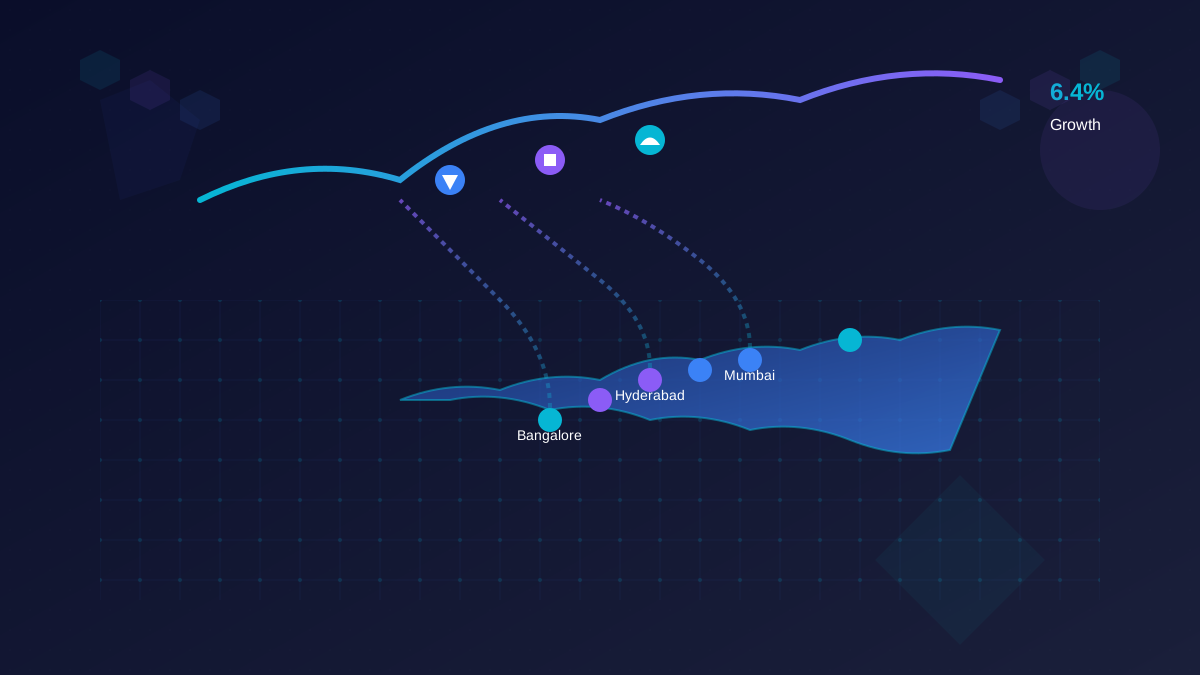
According to statistics from Taiwan’s Investment Commission, Ministry of Economic Affairs, cumulative Taiwanese investment in India had exceeded $5 billion by the end of 2025, with an annual growth rate of over 20%, and the investment scope is expanding from traditional manufacturing to electronics & IT, fintech, and R&D centers. This trend will only accelerate in the next two years under the 6.4%-6.6% economic growth forecast.
Conclusion: Embracing a Multipolar Tech World
The UN’s growth forecast not only confirms the momentum of India’s economy but also symbolizes the irreversible trend of the global tech and innovation landscape evolving from a bipolar (US-China) to a multipolar structure. Leveraging its unique demographic structure, democratic system, English proficiency, and entrepreneurial spirit, India is carving out a path of tech rise distinct from China’s—one more focused on services, software, system integration, and inclusive technology.
For global tech players, including Taiwan, this means strategies must be more flexible and deeply localized. The mindset of simple product export will gradually become ineffective, replaced by “ecosystem embedding” and “value co-creation.” The lessons from the Indian market—how to succeed under high tariffs, diverse demands, and limited infrastructure—will become valuable assets for companies entering other emerging markets.
In the next two years, we will witness more multinational tech companies establishing their “second headquarters” or “key R&D centers” in India and see Indian domestic tech giants engage in more active global mergers, acquisitions, and investments. This is a market full of dynamism and opportunity, but only those players willing to set aside preconceptions, deeply understand its complexity, and build equal partnerships can truly share the tech红利 (dividends) behind its 6.4% growth.