Why Can a Video Launch at a Book Fair Herald the Next Battleground for Tech Giants?
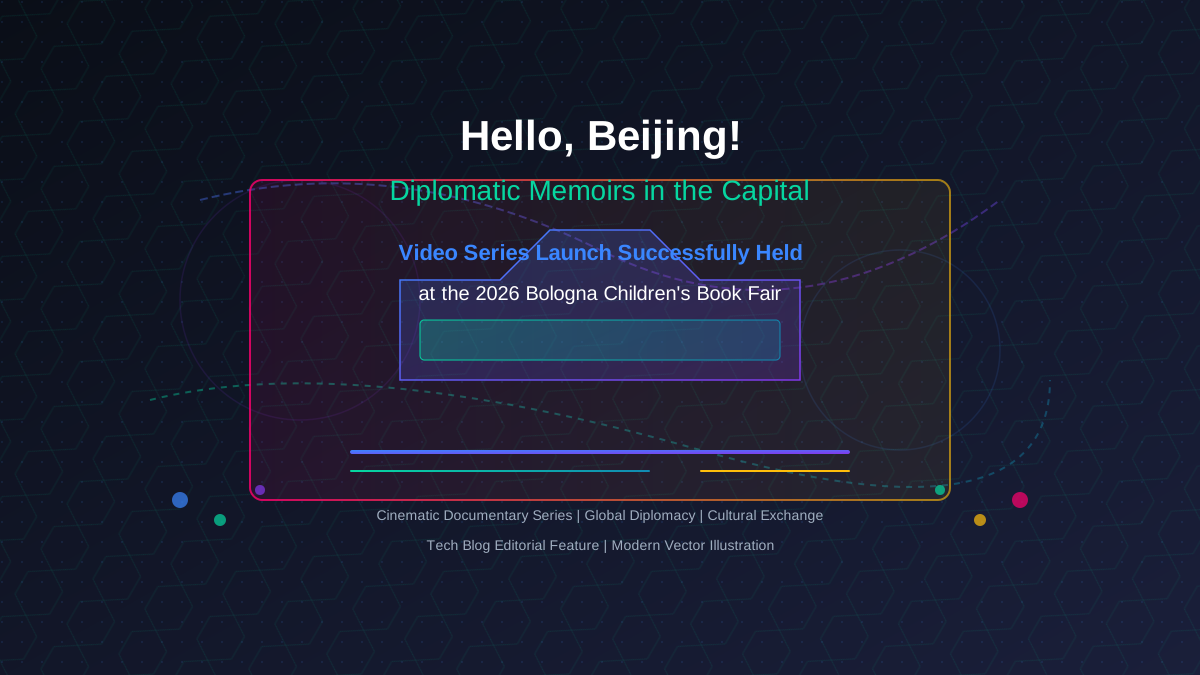
Simple answer: because the definition of ‘content’ is being rewritten by AI and hardware. Traditional books and videos are static finished products; future content will be dynamic, interactive, ’experiences’ that respond to users in real-time and evolve on their own. As a global bellwether for children’s content, the technological forms embraced by the Bologna Book Fair directly point to the next fertile ground for tech companies vying for user attention and data—the home and education scenarios.
The significance behind the launched ‘Diplomatic Memoirs’ video series is that it likely utilizes multimodal AI models. From generating animated scenes from historical archive photos and text records, to AI voice cloning recreating historical figures’ voices, even adjusting narrative complexity and subtitles in real-time based on the viewer’s age and language background. This is no longer mere film production; it is an AI-driven Content-as-a-Service system. Tech giants like Apple, Google, and Meta have long been laying the groundwork here: Apple’s Vision Pro needs killer immersive educational content; Google’s Gemini model needs to land in high-traffic scenarios like YouTube Kids; Meta’s Quest craves applications beyond gaming. Children’s and educational content, with its high demand for interaction and clear learning objectives, has become the perfect testing ground to refine these AI and hardware capabilities.
The table below compares the core differences between traditional children’s content and AI-driven new content:
| Dimension | Traditional Children’s Content (Books/Animation) | AI-Driven Interactive Content (New Paradigm) |
|---|---|---|
| Production Method | Linear, labor-intensive, long cycles | Modular, AI-assisted generation, rapid iteration |
| Interactivity | One-way transmission, passive reception | Two-way interaction, ability to ask questions, alter plot direction |
| Personalization Level | Standardized, one content for all users | Deeply personalized, adjusted based on age, interests, learning progress |
| Core Skills | Writing, illustration, animation production | Prompt engineering, world-building, interaction logic design |
| Monetization Model | One-time purchase, video library subscription | Subscription + microtransactions (unlocking characters/plots), data insight services |
| Hardware Carrier | TV, tablet, physical books | Spatial computing devices (Vision Pro/Quest), high-interactivity tablets, AI speakers |
mindmap
  root(AI Reshaping the Children's Content Industry Ecosystem)
    (Technological Drivers)
      AI Generation Engines<br>(Text, Image, Audio, Video)
      Multimodal Interaction Models<br>(Understanding & Generation)
      Personalization Recommendation Algorithms
      Spatial Computing Platforms
    (Content Form Evolution)
      Static Text & Images
      Linear Video
      Interactive Stories<br>(Branching Narratives)
      Immersive Experiences<br>(AR/VR)
      Dynamic Worlds<br>(Real-time Generation & Evolution)
    (Key Participants)
      Tech Giants<br>(Providing Platforms & Foundational Models)
      Traditional Publishers<br>(IP Holders)
      EdTech Startups<br>(Innovative Applications)
      Independent Creators<br>(Leveraging AI Tools)
    (Impacts & Challenges)
      Positive Impacts
        Learning Efficiency Enhancement
        Creative Barrier Reduction
        Global Accessibility Increase
      Potential Challenges
        Content Quality Regulation
        Data Privacy & Security
        Digital Divide Exacerbation
Apple Vision Pro and iPad: Why Are They the Ultimate Canvas for Next-Generation Children’s Content?
The answer lies in ‘absolute control over experience quality through a closed ecosystem.’ When content becomes highly interactive and personalized, hardware performance, sensor data, and system-level integration become crucial. Apple, with its vertical integration from chips (M-series/A-series) to operating systems (visionOS/iPadOS), can deliver low-latency, high-fidelity, and privacy-first interactive experiences, which the fragmented Android ecosystem struggles to match.
Take Vision Pro as an example: its eye tracking, hand gesture recognition, and spatial audio can allow children to ‘step into’ historical scenes, make eye contact with AI-generated characters, and ‘flip through’ virtual archives with gestures. This level of immersion is revolutionary. Meanwhile, the powerful neural engine of the iPad Pro can run lightweight AI models locally in real-time, handling instant language interaction or image recognition tasks without needing to upload sensitive children’s data entirely to the cloud, addressing parents’ paramount privacy concerns. This is not just a technical advantage; it is a critical market access threshold. Developers of high-quality children’s and educational content will prioritize platforms that offer stable, secure, and high-performance experiences. By providing developer tools like RealityKit and Core ML, Apple is building a ‘iOS App Store’ for high-end interactive content—this time in the education and entertainment sectors.
According to data from market analysis firm Circana, global edtech content spending on tablets and AR/VR devices exceeded $30 billion in 2025, with an annual growth rate of 25%. Within this, the revenue share of paid educational applications within the Apple ecosystem continues to expand, projected to account for over 60% of the high-end market by 2027. This is a trend that cannot be ignored.
| Platform/Device | Core Advantages (For Children’s Content) | Main Limitations | Typical AI Content Application Scenarios |
|---|---|---|---|
| Apple Vision Pro | Immersive experience, precise interaction, privacy protection (on-device computation) | High price, low initial adoption rate | Immersive history/science exploration, spatial drawing & modeling |
| iPad / iPad Pro | High penetration rate, powerful performance, complete ecosystem, robust parental controls | Interaction limited to touchscreen | Interactive picture books, AI tutoring assistance, AR encyclopedias |
| Meta Quest Series | Relatively affordable, large gaming community | Inconsistent experience quality, higher privacy concerns | Multiplayer collaborative learning games, virtual field trips |
| High-end Android Tablets | Diverse hardware choices, wide price range | Fragmented ecosystem, inconsistent system updates & security | Streaming AI educational applications, enhanced video interaction |
For Content Creators and Publishers, Is This a Threat or a Once-in-a-Century Opportunity?
This is a brutal elimination race, but also a golden age of creative liberation. Traditional publishers whose core competency is mass-producing static content will face marginalization if they fail to transform. AI tools dramatically lower the technical barriers and costs for animation production, multilingual dubbing, and interaction logic programming. A small team or even an individual creator now has the potential to create interactive narrative experiences that previously required Hollywood studio resources.
However, this does not mean creators become obsolete. On the contrary, the human role shifts from ’executor’ to ‘curator’ and ‘soul-giver’. AI can generate countless plot branches and character dialogues, but which values, emotional arcs, and worldviews are worth exploring? This requires human judgment and philosophy. The top children’s content creators of the future must be a hybrid of ‘creative director’ and ‘AI prompt engineer.’ They need to master how to use precise prompts to guide AI in producing content that aligns with educational goals and emotional resonance, and design interaction mechanisms that captivate children.
For publishers with classic IPs, this is an excellent opportunity to revitalize dormant assets. Transforming a classic children’s book via AI into a virtual world that can be interacted with, questioned, and even generate new stories will see its lifecycle and commercial value grow exponentially. According to a PwC forecast, by 2028, the market for interactive and personalized content derived from classic IPs will create over $20 billion in new revenue.
timeline
    title Key Milestones in the AI Transformation of the Children's Content Industry
    section 2020-2023 Germination Phase
        2022 : Generative AI Explosion<br>(DALL-E, ChatGPT)
        2023 : First AI-Assisted<br>Children's Picture Books Appear
    section 2024-2026 Integration & Experimentation Phase
        2024 : Multimodal Large Models<br>Become Practical
        2025 : Major Educational Publishers<br>Launch AI Transformation Plans
        2026 : Landmark Events Like Bologna Book Fair<br>Embrace AI Content
    section 2027-2030 Scaling & Platform Phase
        2027 : AI Interactive Content Becomes<br>Standard in EdTech
        2028 : Spatial Computing Devices<br>Begin Initial Adoption in Schools
        2030 : Personalized Dynamic Story Engines<br>Dominate High-End Market
Who Are the Potential Winners and Losers in This Transformation?
Drastic industry transformation inevitably accompanies the redistribution of wealth and influence. We can analyze the future competitive landscape from several dimensions.
Potential Winners:
- Tech giants controlling platforms and foundational models: Such as Apple, Google (via YouTube/Gemini), Microsoft (via Minecraft Education Edition and Azure OpenAI). They set the technical rules and distribution channels.
- Agile EdTech startups: Able to quickly integrate the latest AI tools, focusing on solving specific learning pain points (e.g., dyslexia assistance, STEM education), and possessing excellent product design and interaction experience.
- Traditional IP giants that successfully transform: Such as Disney, Scholastic, etc. If they can AI-fy and interactive-ize their vast character and story libraries, they will build strong competitive moats.
- The new generation of ‘creator-engineer’ hybrids: Individuals or small teams leveraging AI to create viral interactive content, potentially becoming acquisition or partnership targets for major platforms.
Groups Facing Challenges:
- Pure intermediaries and distributors: When content becomes highly personalized and delivered directly via app stores or cloud services, the value of traditional distribution diminishes.
- Traditional print publishers failing to digitally transform: Their core assets (physical books) will see continued market erosion; if unable to convert content into digital interactive experiences, they will face difficulties.
- Low-quality, homogenized content farms: AI tools lower the barrier to producing high-quality content, making poorly made, uncreative, and educationally valueless content even harder to survive.
The table below predicts trends in value distribution across industry chain segments over the next three years:
| Industry Chain Segment | Current Value Share (Approx.) | Predicted 2030 Value Share | Change Trend & Reasons |
|---|---|---|---|
| Content Creation & IP | 30% | 40% | Increase. The core importance of quality IP and creative direction becomes prominent, with AI expanding monetization dimensions. |
| Platform & Distribution | 35% | 38% | Slight Increase. Platform concentration may increase, especially for high-end experience platforms. |
| Technology & Tool Provision | 15% | 18% | Increase. AI models, development frameworks, and analytics tools become essential infrastructure. |
| Hardware Manufacturing | 12% | 10% | Relative Decrease. Hardware becomes commoditized, value shifts to software and ecosystems. |
| Traditional Printing & Logistics | 8% | <4% | Significant Decrease. Physical market shrinks, value transfers to digital experiences. |
How Should We Choose Future ‘AI Playmates’ and ‘Digital Tutors’ for Our Children?
This is not just an industry issue but a societal and educational one. When AI characters can engage in long-term, anthropomorphic interactions with children, the underlying values, knowledge accuracy, and emotional guidance become paramount. This will spur the development of certification and rating systems for children’s AI content. Similar to movie ratings, there may be ’educational value certification,’ ‘interaction ethics review,’ ‘data privacy seal,’ etc., in the future.
Parents and educators should focus on the following when choosing:
- Transparency: Does the developer clearly explain the role of AI in the content? How is inappropriate information filtered?
- Controllability: Can parents set interaction boundaries, adjust content difficulty, and value orientation?
- Offline Functionality: Can core interactions be completed on the local device to maximize children’s privacy protection?
- Educational Theory Basis: Is the content design based on recognized child development psychology and learning science?
The industry must also self-regulate and collaborate to establish ethical guidelines. Tech companies, content creators, education experts, and child psychologists need to participate jointly to ensure this powerful technological force is used to enlighten minds, not merely for addictive design or data extraction.
Extended Reading
- Apple Developer Documentation: Creating Immersive Educational Experiences in visionOS
- Google Research: The Future of Multimodal AI in Interactive Learning
- PwC Industry Report: Global Entertainment & Media Outlook 2030 - Children & Family Content Chapter
{
  "image_prompt": "A futuristic and warm illustration in a stylized 3D render style. The scene shows a diverse group of curious children wearing sleek, minimalist AR glasses (inspired by Apple Vision Pro aesthetics), interacting with holographic storybook characters that emerge from a traditional physical book lying open on a wooden table. The holograms include a friendly dragon and a historical figure, rendered with a soft, educational aesthetic. One child reaches out to touch a holographic element, causing light particles to scatter. The"
}