Introduction: When a Perfectionist Enters the Breakneck AI Era
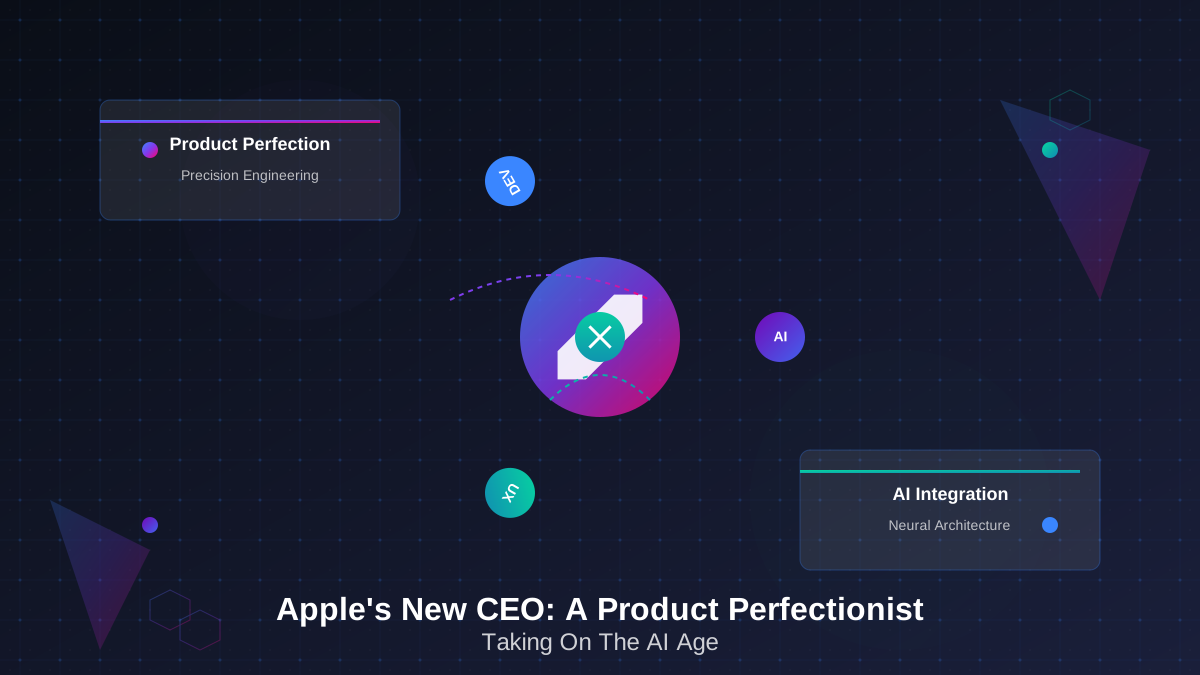
The Silicon Valley script is being rewritten. While tech headlines are dominated by AI models with trillion-parameter scales and weekly-updated chatbots, Apple chose in 2026 to pass the baton to a hardware engineer who has been with the company for 25 years, starting as a display designer—John Ternus. This is not a decision chasing trends, but a return to essence. At the historical inflection point where AI leaps from “feature” to “platform,” Ternus’s mission is not to turn Apple into another AI software company, but to prove that the “product-first” philosophy remains the highest standard for defining the next computing era.
Ternus’s Product Philosophy: Apple’s Moat or an Obstacle in the AI Era?
Answer Capsule: Ternus’s core philosophy of “finding technology for the product” is the cornerstone of Apple’s success over the past two decades. In the AI era, this ensures technology serves intuitive experiences, avoiding feature bloat for AI’s sake. However, the risk lies in that an excessive pursuit of integration perfection might miss the opportunity to define emerging AI-native interaction models, ceding platform leadership to more agile competitors.
“We never think about ‘delivering a technology.’ We always think about ‘how to use technology to deliver amazing products.’” This declaration from Ternus precisely captures the fundamental divergence between Apple and most current AI frontrunners. In an environment that celebrates “moving fast and breaking things,” Apple’s perfectionism seems like a classical insistence.
How Does Hardware Thinking Shape the AI Path?
Ternus’s career closely overlaps with Apple’s most glorious hardware innovation cycles: the astonishing leap from Intel to Apple Silicon, the M-series chips that resurrected the Mac, and the continuous refinement of the iPhone and wearables. This has convinced him that true magic happens at the intersection of silicon, metal enclosures, and software. This DNA dictates that Apple’s AI path will inevitably possess the following characteristics:
- On-Device First: A dual commitment to performance and privacy. All sensitive, real-time AI inference must be completed on the device. This drives the continuous explosive growth of the Neural Engine in the A-series and M-series chips. According to supply chain sources, the A19 chip expected in late 2026 will see its Neural Engine computing power increase by over 300% compared to the A17 Pro, optimized for on-device large language models (LLMs).
- Seamless Integration: AI is not a standalone app that needs to be “awakened” or “turned on.” It should be the algorithm that automatically optimizes the camera viewfinder, the dynamic noise cancellation of AirPods adjusting to the environment, or the warning patterns silently operating in health data. The core mission of Ternus’s hardware team is to create the best physical carriers for this “invisible” intelligence.
- Ecosystem Moats: AI’s value will be amplified through synergistic effects between devices. Context perceived by the iPhone can be seamlessly passed to the Mac or Apple Watch. This requires extremely strict hardware standards and software control, precisely Apple’s traditional strength.
However, this logic is facing challenges. As AI breakthroughs increasingly come from the “brute force aesthetics” of software and algorithms (like larger-scale pre-training, more open developer communities), will Apple’s closed, integrated, and cautious-paced model become a bottleneck?
The table below compares the core differences in AI strategy between Apple and its main competitors:
| Dimension | Apple (Ternus Path) | Google / Microsoft (Cloud Platform Path) | Startups / OpenAI (Model-Native Path) |
|---|---|---|---|
| Core Driver | Hardware product experience | Cloud service and platform market share | Algorithm breakthroughs and model capabilities |
| AI Presentation Form | Embedded in existing features | Standalone assistants (Copilot, Gemini) and APIs | Chat interfaces and developer tools |
| Key Advantage | Privacy, real-time capability, hardware-software integration | Scale, data breadth, developer ecosystem | Innovation speed, technological frontier |
| Main Risk | Slow innovation pace, closed ecosystem | Low user stickiness, privacy controversies | Commercialization path, hardware dependency |
| Business Model | High-margin hardware sales | Cloud subscriptions and enterprise services | API call fees and enterprise licensing |
mindmap
  root(Apple's AI Strategy Core in the Ternus Era)
    Hardware-Centric Experience Philosophy
      On-device computing power priority
      Privacy and security as selling points
      Seamless ecosystem integration
    External Challenges to Address
      Cloud AI platform erosion of value
        : Google Gemini<br>ecosystem expansion
        : Microsoft Copilot<br>OS penetration
      New interaction mode competition
        : AI-native hardware<br>(e.g., Rabbit R1, Humane Ai Pin)
        : Immersive AR/VR interfaces
    Key Strategic Choices
      In-house development v.s. Partnership
        : Strengthen internal<br>"Project Ajax" model
        : Deepen search AI cooperation<br>with Google
      Open v.s. Closed
        : Release more on-device AI capabilities<br>to developers
        : Maintain strict control<br>to ensure experience consistency
Siri’s Dilemma and Rebirth: The Touchstone of Apple’s AI Capability
Answer Capsule: The often-criticized Siri is a microcosm of Apple’s conservative AI strategy in the past. Its rebirth plan will be the first key battle after Ternus takes office. The key to success lies not in surpassing ChatGPT’s breadth of knowledge, but in leveraging Apple’s hardware advantages to create a more personalized, context-aware “mobile intelligence agent” that can truly execute complex tasks.
Siri’s awkward situation is a concentrated reflection of Apple’s anxiety in the AI era. While competitors’ voice assistants have made great strides in comprehension and continuous dialogue, Siri seems stuck in the simple command set defined a decade ago. Analysis by The Information reports that in the accuracy rate of understanding complex multi-turn conversations, Siri lags behind Google Assistant and Alexa by over 15 percentage points. More worryingly, Apple even relies on Google to provide the backend support for its generative AI search, exposing a potential weakness in its core AI technology stack.
Ternus will not treat Siri as a standalone software product to revamp. He will inevitably rethink it from a system level:
- Chip-Level Restructuring: Future Siri-specific processing blocks (similar to the Secure Enclave) might be integrated into the SoC, enabling ultra-low-power continuous listening and intent prediction.
- Sensor Data Fusion: Combining the iPhone’s UWB, LiDAR, camera, and motion sensors to make Siri not only “hear words” but also “see the context.” For example, when you pick up your phone and walk towards the garage, Siri automatically suggests navigation home; when you read at night, it automatically dims the screen and turns on reading mode.
- Balance of Personalization and Privacy: Utilizing on-device learning to let Siri deeply understand user habits, with all personal data never leaving the device. This will be Apple’s core value proposition against cloud AI giants.
Siri’s upgrade is not a feature catch-up race, but a redefinition of the essence of an “intelligent assistant.” Apple’s answer will likely be an “invisible assistant” that operates in the background, serving users through prediction and automation, not just responding when awakened.
The Platform War: Will Apple Build Its Own “AI Operating System”?
Answer Capsule: Apple will not launch a standalone platform called “Apple AI OS.” Instead, it is deeply weaving AI into the existing iOS, macOS, and watchOS, making it the “new foundational layer” of the operating system. The essence of this competition is a showdown between the “device intelligence ecosystem” and the “cloud service ecosystem.”
Microsoft embeds Copilot into Windows, Google permeates Gemini into Android, Workspace, and even Search. Their goal is to create an omnipresent AI layer, becoming the new gateway for users to access all digital services. This is a classic platform war.
Apple’s approach is completely different. Its platform is the hardware matrix itself: “iPhone + Mac + Watch + iPad.” AI’s task is to make collaboration within this matrix smarter and more automated. Therefore, the trends we will observe are:
- Shift in Developer Tools: Apple will provide more powerful on-device AI frameworks (like the next generation of Core ML), encouraging developers to create AI applications that fully utilize local computing power and can collaborate across Apple devices, rather than simply calling cloud APIs. According to previews from Apple’s 2025 WWDC, new developer tools will increase on-device model runtime efficiency by up to 5 times.
- AI-Driven Reshaping of Services: Recommendations in Apple Music, summaries in Apple News, personalized training plans in Fitness+, and even navigation in Apple Maps will be driven by more powerful on-device AI models, offering more real-time and personalized experiences.
- Privacy as a Feature Selling Point: In an era of heightened concerns about data misuse, “Your AI works only for you, data never leaves your device” will become an extremely attractive market message. This requires strong hardware backing, precisely Ternus’s area of expertise.
timeline
    title Key Milestones and Future Predictions for Apple's AI Strategy
    section Foundation Period (2023-2025)
        2023 : M3 chip release<br>strengthens Neural Engine
        2024 : iOS 18 previews<br>on-device LLM capabilities
        2025 : Deepens generative search<br>cooperation with Google
    section Ternus Transition Period (2026)
        2026 Q3 : Ternus officially assumes CEO role
        2026 Q4 : iPhone 18 series launch<br>with new Siri experience
    section Platform Deepening Period (2027-)
        2027 : Cross-device AI collaboration<br>reaches new level
        2028 : AR glasses launch<br>becoming new AI entry point
        2029 : On-device AI ecosystem<br>becomes primary differentiator
Strategy Behind the Numbers: Investment, Acquisitions, and the Talent War
Discussing strategy cannot be separated from resource allocation. Although Apple is tight-lipped about specific AI investment amounts, clues can be gleaned from its actions:
- R&D Investment Curve: Apple’s annual R&D expenditure has climbed from about $16 billion in 2019 to over $30 billion in fiscal 2025. Although this covers all projects, CEO Tim Cook has repeatedly stated that AI and machine learning are “fundamental technologies across all products,” meaning their proportion is rising sharply. In contrast, Microsoft’s and Google’s annual AI-related capital expenditures (primarily for data centers) each exceeded $50 billion in 2025. Apple’s investment leans more towards “intangible” chip design, algorithm research, and talent.
- Precise Acquisition Strategy: Unlike Google’s and Microsoft’s large-scale acquisitions worth tens of billions (like DeepMind, Nuance), Apple prefers acquiring small, specialized AI startups and rapidly integrating their technology. Over the past five years, Apple has acquired over 25 AI-related companies, covering areas like music recommendation (AI Music), video compression (WaveOne), and conversational AI (Voysis). This is a “product-feature-oriented” acquisition map.
- Talent War: The battle for AI talent in Silicon Valley is white-hot. To attract top researchers, Apple not only offers high salaries but also promotes the vision of “impacting billions of users with real products” and “pushing the limits of on-device AI.” The internal team for the next-generation large language model, codenamed “Project Ajax,” is rumored to have recruited key leaders from Google Brain, OpenAI, and others.
The table below shows the different emphases of Apple and its competitors in AI resource allocation:
| Company | Investment Focus | Typical Acquisition Type | Talent Attraction Proposition |
|---|---|---|---|
| Apple | Custom silicon, on-device frameworks, product integration teams | Small, technology-specialized, product-complementary | Building physical products impacting billions, challenging hardware limits |
| Cloud infrastructure, large-scale model training, fundamental research | Large, platform-ecosystem type (e.g., DeepMind) | Solving fundamental AI problems, accessing massive data, open research culture | |
| Microsoft | Cloud computing power (Azure), enterprise AI toolchain, OpenAI alliance | Vertical application type (e.g., Nuance) | Empowering global enterprise transformation, combining cloud and productivity suites |
| Meta | Fundamental AI research, open-source models (Llama), AR/VR metaverse | AI research labs and infrastructure | Building future social interaction and virtual-physical interfaces |
Conclusion: A Long-Term War Over “Experience Sovereignty”
John Ternus taking the helm at Apple is not to launch a blitzkrieg to reclaim lost ground in AI. He is preparing for a protracted war over “experience sovereignty.” The victory criterion for this war is not whose model has the most parameters, nor whose chatbot is the wittiest, but who can provide users with a smoother, more private, more intuitive, and more indispensable intelligent life experience.
For consumers, the Apple of the Ternus era means: the device in your hand will become more “understanding,” but not more “chatty.” AI progress will be reflected in how many problems it silently solves for you, not in how many new commands it requires you to learn.
For the industry, this represents a significant fork in the AI development path. One leads towards cloud centralization and ubiquitous services; the other towards device intelligence and deeply integrated experiences. Apple is betting heavily on the latter. If successful, it will prove that in a software-defined world, hardware excellence and closed ecosystem coordination remain the most reliable path to creating extraordinary value. If it fails, Apple may face an unprecedented challenge in its history: being demoted from the center of users’ digital lives to a premium “terminal device supplier.”
Ternus’s product perfectionism is Apple’s sturdiest shield. Now, he must forge this shield into a spear to attack the AI era. In the autumn of 2026, with his official assumption of office and the launch of a new generation of products, the curtain is just rising on this grand drama.
FAQ
How will John Ternus’s product philosophy influence Apple’s AI development? Ternus insists on ‘finding technology for the product, not making products for technology,’ meaning Apple’s AI features will be more deeply integrated into the hardware experience, pursuing seamless, intuitive, and privacy-first applications, not chasing technological showmanship or standalone AI services.
Is Apple lagging behind in the AI race? Judging by the public progress and model scale in generative AI, Apple appears to be behind competitors like Google and Microsoft. However, Apple’s strategy is fundamentally different, focusing on on-device AI, privacy, and deep hardware-software integration rather than competing directly in cloud-based large models. Its true test will be whether this integrated approach can deliver a superior user experience.