The Curtain Falls on the Cook Era: Assets and Challenges Left by an Operations Master
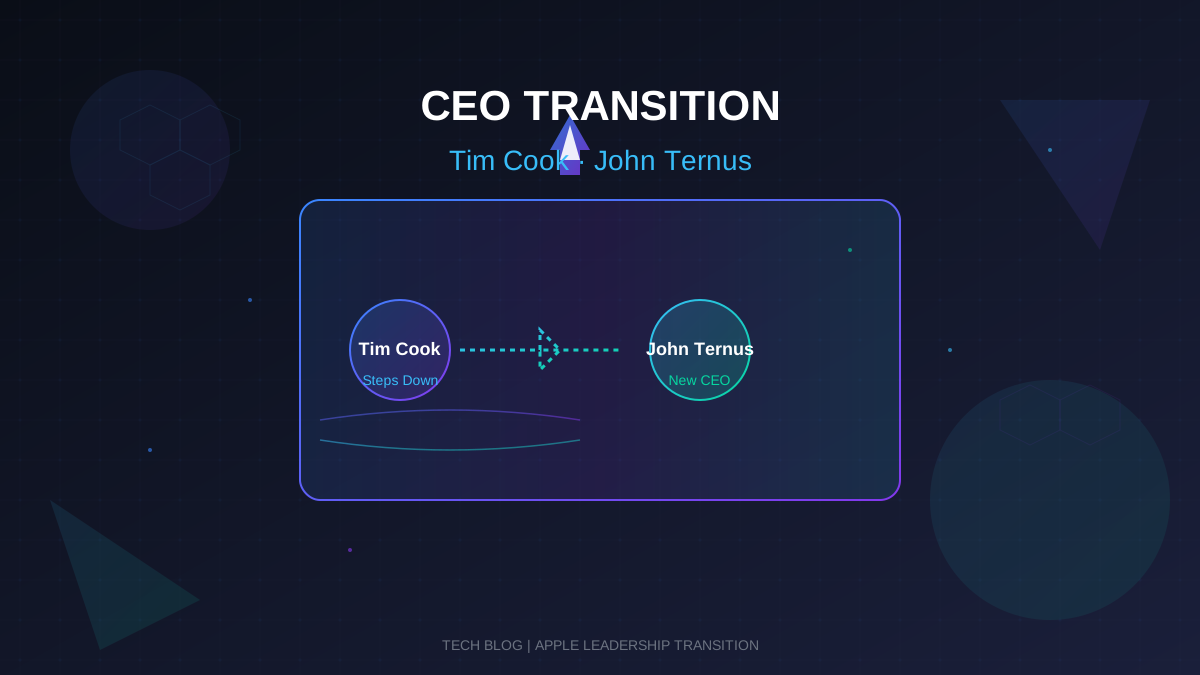
This April 2026 announcement marks a definitive end to Tim Cook’s 15-year tenure as Apple’s CEO. Cook will step down on September 1, transitioning to the role of Executive Chairman. This is not a sudden storm but a meticulously orchestrated transfer of power. Under Cook’s leadership, Apple’s market capitalization soared from around $350 billion to over $3 trillion, making it the first publicly traded company to reach this milestone. He transformed Apple into an astonishing profit machine, with iPhone revenue still accounting for 52% of total revenue in fiscal 2025, while services revenue broke through the $100 billion mark, becoming a robust second growth engine.
However, the Cook era also left a clear list of challenges: in the generative AI wave, Apple is perceived by outsiders as “starting slightly late”; hardware innovation has been criticized for entering a phase of “iterative optimization” rather than “revolutionary breakthroughs”; and most crucially—finding the next trillion-dollar product after the iPhone. Cook’s strengths lie in supply chain management, financial discipline, and ecosystem expansion, but facing an era where AI is redefining the boundaries between software and hardware, Apple’s board evidently believes a leader closer to the core of “creation” itself is needed to steer the ship.
Why John Ternus? The Strategic Intent Behind the Hardware Engineer Becoming Apple’s Helmsman
John Ternus’s selection directly addresses these challenges. This 50-year-old Senior Vice President of Hardware Engineering has spent over 25 years of his career at Apple. He is not a public star but is internally recognized as a “product builder.” From the early Power Mac G4, to leading the Mac’s transition to Apple Silicon, to the hardware design of all recent iPhones and iPads, Ternus’s fingerprints are on almost every significant Apple hardware product.
This appointment conveys three strategic intentions that cannot be ignored:
- The Future of AI Lies in Hardware: The competition in generative AI will ultimately be decided by on-device computing power and energy efficiency. Ternus’s background implies that Apple’s future AI strategy will be more deeply tied to in-house chips (like the M-series and A-series), making AI the DNA of hardware design, not just a feature package in software updates.
- Recalibrating the Innovation Pace: During the Cook era, product release cycles were stable, but the “sense of surprise” diminished. Choosing a top engineer as CEO may signal Apple’s willingness to take more technical risks in its product roadmap, accelerating the commercialization of “high-difficulty hardware” like foldable devices and AR glasses.
- Continuing the “Integration” Philosophy: Ternus deeply understands Apple’s approach to software-hardware integration. This integration capability is crucial in the AI era. Future AI experiences require seamless collaboration between chips, sensors, operating systems, and cloud services, and there is no one better suited to organize internal engineering teams to achieve this goal.
The table below compares the backgrounds and potential leadership styles of Cook and Ternus:
| Dimension | Tim Cook (Outgoing) | John Ternus (Incoming) |
|---|---|---|
| Core Background | Operations, Supply Chain Management, Finance | Hardware Engineering, Product Design |
| Leadership Label | Excellent Executor, Business Expander | Product Builder, Technology Integrator |
| Primary Challenges Faced | Commercializing iPhone Success, Expanding Service Ecosystem | Integrating AI with Hardware, Pioneering the Next Mainstream Product Form |
| Decision-Making Likely Leans Towards | Data-Driven, Risk Control, Ecosystem Profit Maximization | Technology Feasibility-Driven, Pursuit of Experience Breakthroughs, May Tolerate Higher R&D Risk |
| Public Image | Global Business Leader, Supply Chain Master | Low-Profile Engineer, Key Figure Behind Products |
Ternus’s Three Frontlines Upon Taking Office: AI, Foldable Devices, and the China Market
What Ternus will officially take over in September is an Apple at a critical crossroads. On his to-do list, three tasks are most urgent.
Frontline One: Turning AI from a “Catch-Up Project” into a “Core Advantage”
Apple has appeared cautious in its public deployment of generative AI, but internal efforts have never stopped. The next-generation operating systems (expected to be iOS 20, macOS 15, etc.) set to be unveiled at WWDC 2026 are reportedly set to be fully infused with AI capabilities, particularly an enhanced Siri in collaboration with Google Gemini. However, Ternus’s task goes far beyond launching a smart voice assistant.
The real battlefield is “on-device AI.” With its unified hardware architecture (Apple Silicon), Apple has an inherent advantage in running AI models locally. What Ternus needs to drive is the transformation of AI from a “software feature” into a “hardware selling point.” This means future A-series or M-series chips might have dedicated neural engine blocks designed for AI inference; the iPhone’s camera module might reserve new sensors for AI image generation; even the Mac’s memory architecture might be redesigned for the partial operation of large language models.
timeline
    title Apple's AI Strategy Evolution and Expectations for the Ternus Era
    section Late Cook Era (2023-2026)
        2023 : Cautiously Observes Generative AI Wave<br>Internal R&D Accelerates
        2024 : Releases MLX Framework<br>Strengthens Core ML Capabilities
        2025 : Launches Some Generative AI<br>Features On-Device
        2026 Q2 : WWDC Unveils<br>AI-Integrated OS and New Siri
    section Ternus Era (Starting Q4 2026)
        2026 Q4 : First iPhone with Deeply<br>Integrated AI Hardware Launches
        2027 : AI Becomes a Core Metric<br>in Chip Design
        2028 : Full Product Line Completes<br>"AI Hardware" Transformation
Frontline Two: Bringing the Foldable iPhone from Rumor to Reality
The long-rumored foldable iPhone is expected to debut in late 2026 or early 2027. This task seems almost “tailor-made” for Ternus. As head of hardware engineering, the team he leads has undoubtedly been tackling this project for years. Foldable devices are not just a change in form; they are the ultimate test of hinge engineering, screen durability, software interface adaptability, and battery layout.
After Ternus takes office, the foldable iPhone project will transition from the “technology R&D” phase to the critical stage of “cost control and mass production scaling.” He will need to leverage his deep engineering experience to solve yield issues and successfully introduce this high-cost technology into Apple’s pricing system. Success or failure will directly test his ability to continue the iPhone’s glory and open up a new premium market. According to DSCC reports, the foldable phone market is expected to exceed 50 million units shipped by 2027, and Apple’s entry will fundamentally reshape the market landscape.
Frontline Three: Stabilizing the Largest Overseas Market Amid Complex Geopolitics
The China market contributes nearly 20% of Apple’s revenue but is also the region with the fiercest competition and highest geopolitical risk. Huawei’s strong comeback and the squeeze from local Chinese brands in the premium segment have put pressure on Apple’s market share in China. As a leader with a technical background, Ternus has relatively less experience in handling such complex political and market relations.
He will likely need to heavily rely on Cook’s experience and connections as Executive Chairman and strengthen Apple’s local team in China. Furthermore, from a hardware perspective, launching specific features or service integrations for the Chinese market might become one of his strategic options. How to flexibly address regional challenges while maintaining a globally unified product line will be a major test of his business leadership.
Ripple Effects Across the Industry Chain: Who Benefits? Who Should Be Nervous?
Leadership changes at Apple are never just about Apple. They are like a stone thrown into a pond, with ripples affecting the entire technology industry chain.
Beneficiaries:
- Advanced Semiconductor and Component Suppliers: An Apple led by Ternus might pursue cutting-edge hardware technology more aggressively. This is positive news for TSMC (3nm, 2nm processes), Samsung Display (foldable screens), and new material suppliers.
- AI Software-Hardware Integration Service Providers: If Apple accelerates its on-device AI deployment, it will drive demand for related technologies like edge computing and miniaturized neural network models.
- Specific Equipment Manufacturers: Producing foldable devices requires new precision assembly equipment and inspection tools, potentially leading to a wave of orders for related equipment makers.
Those Who Should Be Nervous:
- Pure Software AI Giants (e.g., OpenAI, some cloud AI service providers): If Apple successfully embeds powerful AI capabilities into devices, it could weaken user reliance on pure cloud AI services, altering the AI value chain distribution.
- High-End Android Brands (e.g., Samsung, Google): An Apple more focused on hardware breakthroughs and possessing a complete ecosystem will bring greater pressure in high-end battlefields like foldable devices and AI phones. Ternus’s grasp of supply chains and engineering details might make Apple’s products more differentiated.
- Current Foldable Phone Market Players: Apple’s entry will significantly educate the market and increase the adoption of foldable devices, but it will also capture most of the profits with its brand and ecosystem advantages.
The table below estimates the potential impact of Ternus’s appointment on Apple’s key business metrics:
| Business Metric | Short-Term Impact (1-2 Years) | Long-Term Potential Impact (3-5 Years) | Key Driving Factors |
|---|---|---|---|
| Hardware Gross Margin | May Face Slight Pressure | Potential to Increase or Maintain High Level | High initial costs for foldable devices, but success could raise average selling prices; AI chip in-house development enhances value. |
| R&D Expense Ratio | Significantly Increases | Maintains at a Relatively High Level | Increased investment in new technologies like AI, foldable, AR/VR. |
| iPhone Replacement Cycle | High Uncertainty | May Shorten | If hardware innovations (foldable, AI) are sufficiently attractive, they will stimulate replacement demand. |
| Services Revenue Growth Rate | Continues Steady Growth | Deeply Tied to Hardware Innovation | AI services, new application scenarios for foldable devices may spawn new service subscriptions. |
| Capital Market Valuation (P/E Ratio) | Observation Period, Potential Volatility | Depends on Success of New Products | The market will reassess whether Apple’s “growth story” is hardware-driven or services-driven. |
The Future Apple: An Engineer-Led “Silent Revolution”
What we are about to witness may not be a noisy strategic U-turn, but a “silent revolution” from the inside out, starting from the underlying hardware. Ternus will not be another Jobs or Cook; he represents the direct ascension of Apple’s core engineering culture.
This means that at future Apple product launches, dazzling marketing rhetoric might decrease, but the depth and credibility of technical details might increase. Product iterations may no longer be just about “faster, thinner, brighter screens,” but will revolve around fundamental questions like “how to make AI seamless yet omnipresent” and “how to break the physical limits of device form.”
mindmap
  root(John Ternus's Leadership Core)
    (Hardware Engineering Mindset)
      On-Device AI Priority
      Deep Integration of In-House Chips
      Breakthrough Form Innovation (Foldable/AR)
      Supply Chain and Engineering Synergy
    (Potential Challenges)
      Software Ecosystem and AI Service Strategy
      Geopolitics and Market Relations
      Maintaining Apple's "Magic" Experience
      Balancing Innovation and Profit Rhythm
    (Expected External Impact)
      Semiconductor and Material Demand Upgrade
      AI Competition Moves Towards Hardware Integration
      Consumer Electronics Innovation Threshold Rises
      Ecosystem Competition Barriers Further Solidify
Ultimately, the success of the Ternus era will depend on a simple question: Can he successfully transform an engineer’s “exploration of possibilities” into an “indispensable experience” that hundreds of millions of consumers are willing to pay for? Apple’s stock price and market capitalization reached astonishing heights under Cook’s tenure, and Ternus’s task is to inject new, sustainable growth momentum into Apple from this high baseline. This is a more difficult endeavor than starting from scratch.
FAQ
What will Tim Cook’s role at Apple be after stepping down? Cook will transition to the role of Executive Chairman of the board, continuing to participate in major company decisions, ensuring a smooth leadership transition, and using his experience to assist the new CEO, Ternus.
Why was John Ternus chosen as the successor? Ternus has over 25 years of tenure at Apple and has led hardware engineering for core products like the iPhone, iPad, and Mac over the past five years. His deep product development background is seen as key to leading Apple in integrating AI with hardware.
How will this leadership change affect Apple’s AI strategy? Ternus’s appointment is expected to accelerate Apple’s “AI hardware” process, with future AI features being more deeply integrated into chip design and user experience, not just as add-on software services.
Is the rumor about Apple’s first foldable iPhone related to this transition? The timing highly coincides. Ternus’s succession as hardware head is interpreted as Apple placing more aggressive bets on breakthrough hardware forms like foldable screens to create new growth curves.
How should investors interpret this CEO transition? The initial market reaction should be viewed as neutral to slightly positive. This is a planned generational handover, not a crisis response. The long-term focus is on whether Ternus can successfully initiate the next hardware innovation cycle while maintaining profitability.
Further Reading
- Apple Newsroom - Official Press Release: Apple Announces Leadership Transition (Please follow for subsequent updates)
- Display Supply Chain Consultants (DSCC) Report: Foldable Display Market Forecast - Understand foldable screen market trends and forecasts.
- The Wall Street Journal Interview with Tim Cook (Early 2026): Tim Cook on Apple’s Future and AI - Offers insights into Cook’s thoughts and plans before the handover.
{
  "image_prompt": "A photorealistic and symbolic image depicting the transition of leadership at Apple. On the left, a clean, minimalist desk with a Tim Cook-style pair of glasses resting on an annual financial report, symbolizing operational excellence and business acumen. From the right, a sleek, partially visible blueprint of a foldable iPhone or a chip design schematic overlays the scene, merging with the report. In the center, a subtle, glowing Apple logo is split between a polished metallic finish (past) and a circuit"
}