Behind the $8.78 Billion Market: Is it Technological Maturity or Demand Explosion?
The answer is a resonance of both. Technologically, the maturity of uncooled microbolometer technology, declining cost curves, and breakthroughs in AI image analysis software have transformed thermal imaging from expensive professional equipment into affordable solutions. On the demand side, it is ignited by the post-pandemic emphasis on non-contact detection, rising defense spending due to global geopolitical tensions, and the rigid demand for predictive maintenance in manufacturing. This is not a boom for a single industry but the penetration and reshaping of all industries after a foundational sensing technology reaches its ’tipping point'.
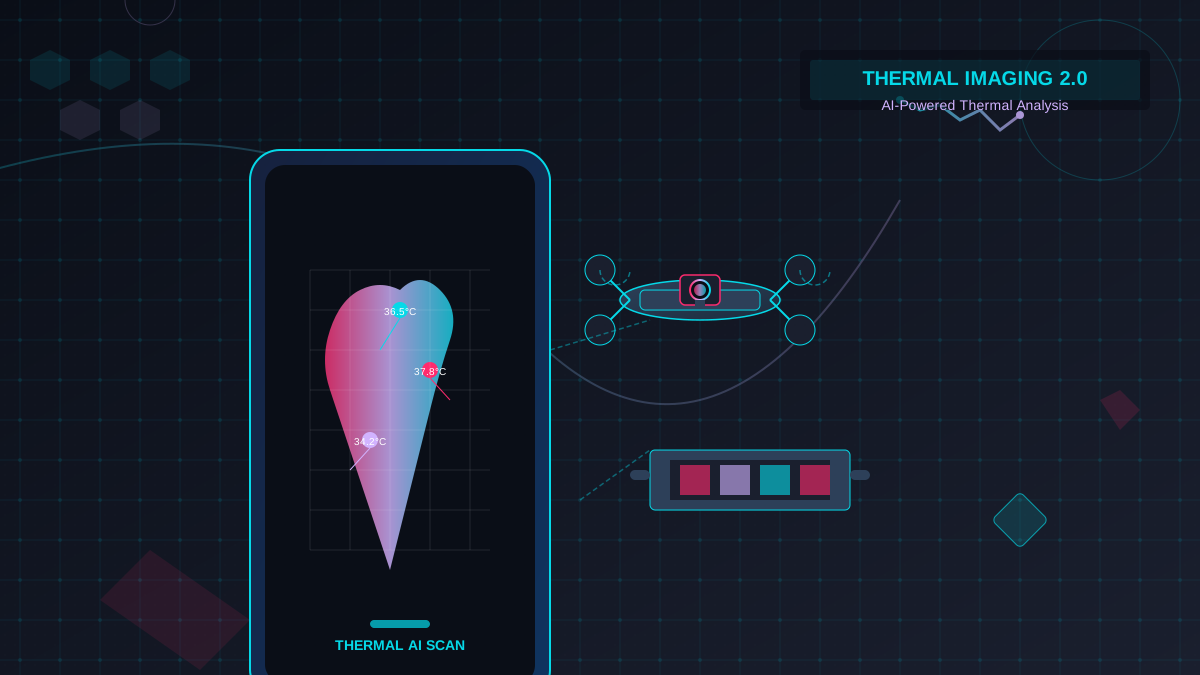
In the past, thermal imaging cameras were specialized tools in the hands of firefighters, military personnel, or high-end equipment maintenance engineers. Today, they are quietly embedding themselves into our production lines, hospitals, border outposts, and even future smart cars. The $8.78 billion market size predicted by The Insight Partners only depicts the tip of the iceberg in hardware sales; the larger underlying markets for software services, system integration, and data analysis are where the real value lies. The core of this transformation is that thermal imaging no longer just ‘sees’ heat but ‘understands’ the meaning behind temperature distributions through AI—whether it’s the precursor to thermal runaway in a battery, the inflammatory response in human tissue, or energy leakage points in buildings.
Defense Orders Are Just the Beginning: How Does Military Demand Pave the Way for the Civilian Market?
Military specifications have always been the crucible for cutting-edge technology and the catalyst for cost reduction. The contract awarded to Teledyne FLIR at the end of 2024 to provide Hadron 640R+ thermal imaging modules for the U.S. Army’s new short-range reconnaissance drones is a classic case. Such orders not only bring stable revenue to manufacturers but, more importantly, drive reliability verification of technology in extreme environments, expansion of production scale, and maturation of the supply chain. When military-grade long-wave infrared camera modules can be stably produced and integrated into small drones, the diffusion of the same technology into industrial inspection drones or security patrol robots is merely a matter of time and cost.
Data from the Stockholm International Peace Research Institute shows that global military spending surged in 2024 due to war and geopolitical tensions. This budget is flowing directly into ‘military vehicle modernization’ and ’new technology procurement.’ Thermal imaging, as a key component for night combat, target identification, and situational awareness, is naturally a priority. This creates a virtuous cycle: defense demand ensures R&D investment in upstream sensors and optical components; scaled production reduces the unit cost of core components; ultimately, these technology spillovers enable civilian products to acquire performance that belonged only to top-tier military equipment a decade ago, at more competitive prices.
| Military Application Area | Specific Function | Spillover Benefit to Civilian Technology |
|---|---|---|
| Drone Reconnaissance | Night-time target identification, battlefield surveillance | Drives development of miniaturized, low-power thermal imaging modules, benefiting industrial and security drones |
| Vehicle Vision Systems | Enhanced driver visibility for armored vehicles, threat detection | Accelerates reliability verification of vehicle-mounted thermal imagers, paving the way for sensor fusion in autonomous vehicles |
| Individual Soldier Equipment | Weapon sights, handheld reconnaissance devices | Promotes lighter, more rugged designs suitable for professional fields like firefighting and search & rescue |
| Base Security | Perimeter intrusion monitoring | Develops long-range, wide-area temperature monitoring algorithms applicable to critical infrastructure protection |
mindmap
  root(Military Thermal Imaging Demand Drives Technology Chain)
    (Core Technology Breakthroughs)
      Uncooled sensor mass production
      Low-power image processing ASIC
      Rugged optical design
    (Manufacturing Cost Reduction)
      Supply chain scaling
      Yield improvement
      Standardized testing processes
    (Civilian Market Application Diffusion)
      Industrial Inspection
        Predictive maintenance
        Process monitoring
      Smart Security
        Perimeter intrusion detection
        Crowd temperature screening
      Consumer Electronics
        Smart home energy management
        Advanced driver assistance systems
From Camera to ‘Vision System’: How is AI Redefining the Value of Thermal Imaging?
The key shift is that the core value of the device is moving from the ‘sensor’ to the ‘algorithm.’ Traditional thermal imagers output temperature matrices or heat distribution maps, requiring experienced engineers or doctors to interpret. Today, smart thermal imaging systems integrated with edge AI computing units output structured diagnostic suggestions or warning signals: ‘Temperature anomaly detected in bearing No. 5, Zone B, estimated potential failure within 48 hours, recommend priority inspection’; ‘Abnormal heat zone detected in patient’s left knee joint area, temperature difference from right side reaches 2.3°C, recommend further imaging examination.’
The hardware foundation for this shift is the ASIC-ISP chip (Application-Specific Integrated Circuit - Image Signal Processor) built into thermal imaging modules. It not only processes raw infrared signals but can also execute lightweight neural network models for real-time analysis. On the software side, it relies on large amounts of annotated thermal image data (e.g., thermal characteristics of various equipment before failure, body surface temperature patterns of different diseases) to train models. This transforms thermal imaging from a ‘visual extension tool’ into a ‘decision support system,’ or even an ‘automated diagnostic node.’
Taking healthcare as an example, research and application of thermal imaging in breast cancer screening, diabetic foot ulcer risk assessment, and monitoring rheumatoid arthritis activity are increasing. Its advantages lie in being non-invasive, radiation-free, and capable of displaying blood flow and inflammation. When AI models can extract subtle temperature patterns and symmetry differences from thermal images that are difficult for the human eye to discern, their value in assisting diagnosis increases significantly. This is not just adding a new examination item but creating a new, continuously monitorable dimension of physiological data.
Who Are the Winners? Market Landscape Shifting from Vertical Integration to Ecosystem Competition
The axes of market competition are being redrawn. In the past, it was the domain of sensor and complete system manufacturers like FLIR (now part of Teledyne), Seek Thermal, and Lynred. Now, the battlefield includes semiconductor giants (e.g., Sony actively developing infrared sensors), consumer electronics brands (exploring mobile integration applications), and countless AI software and vertical solution providers. The key to competition is shifting partly from ‘who can make more sensitive sensors’ to ‘who can provide smarter scenario-based solutions’ and ‘who can build a more open developer ecosystem.’
For instance, one company might focus on developing high-performance thermal imaging modules and providing comprehensive SDKs and pre-trained models, enabling system integrators to quickly develop specialized solutions for power line inspection, photovoltaic panel inspection, or livestock health monitoring in aquaculture. Another model is like some startups that directly provide thermal image analysis services in a SaaS format, where users only need to upload thermal images, and cloud AI returns analysis reports. This means market value distribution will lean more towards software and services.
For Taiwan’s industry, this is a track full of opportunities. Our advantage lies in world-class semiconductor manufacturing and packaging capabilities, which are the foundation for producing infrared sensor chips. Additionally, deep accumulation in optical lens modules, precision machinery, and electronics manufacturing can play a key role in manufacturing thermal imaging modules. The challenge is the need to extend from the role of component supplier to upstream sensor design or downstream AI algorithms and system integration to capture higher added value.
| Market Participant Type | Representative Players/Fields | Core Competitiveness | Challenges Faced |
|---|---|---|---|
| Vertically Integrated Giants | Teledyne FLIR, Leonardo | Complete technology chain from chips, lenses to complete systems and software, strong brand and channels | Potentially slower response to emerging applications, lower system flexibility |
| Semiconductor & Sensor Suppliers | Sony, Lynred, Taiwanese semiconductor manufacturers | Core sensor technology and advanced processes, mass production capability | Need to understand end-application demands, avoid competing with downstream customers |
| AI Software & Solution Providers | Various vertical startups, software companies | Deep domain knowledge, flexible AI model development and iteration capabilities | Lack of hardware integration experience, high barriers to data acquisition |
| System Integrators & Distributors | Localized industrial, security, medical integrators | Customer relationships, on-site service, and understanding of localized needs | Technology dependence on upstream, profit margins may be squeezed |
Beyond 2034: Will Thermal Imaging Become a Standard Feature of Ambient Intelligence?
Looking ahead, the ultimate form of thermal imaging technology may be ‘invisible.’ It will no longer exist as an independent camera form but as a sensing module seamlessly integrated into the ‘sensory systems’ of various devices. A miniature thermal sensing point might sit next to the rear camera of a smartphone for quick temperature measurement or enhancing AR interaction realism; in every autonomous vehicle’s sensor fusion suite, thermal imaging will be a key backup for addressing visual blind spots in adverse weather (fog, glare); in every smart factory’s digital twin system, the real-time temperature field of equipment will be one of the most important input data for predictive maintenance models.
To reach this stage, several thresholds still need to be crossed: first, cost, requiring the cost of VGA or even higher-resolution thermal imaging modules to be reduced to levels acceptable to consumer electronics (e.g., tens of dollars). Second, power consumption, which must meet the strict energy budgets of mobile devices. Finally, algorithm generality and reliability, requiring the establishment of standardized datasets and evaluation benchmarks across scenarios and devices.
However, the trend is already very clear. When we talk about the metaverse, the Internet of Things, and the AI-empowered physical world, the digitization and intellectualization of ’temperature’ as a fundamental physical quantity describing object states, energy flow, and even vital signs is inevitable. The $8.78 billion hardware market is just the first key to opening this door. Behind it lies the vast opportunity of fully integrating the thermodynamic phenomena of the physical world into digital decision loops. For observers and participants in the technology industry, now is the critical moment to deeply understand this technology and contemplate its potential integration with their own fields.
timeline
title Thermal Imaging Technology Evolution and Market Application Timeline
    section Technology Germination Period (Pre-2000)
        Cooled infrared sensors dominate : Primarily used in military and scientific research<br>Large size, extremely high price
    section Professional Application Proliferation Period (2000-2020)
        Uncooled microbolometers mature : Costs begin to decline<br>Widely used in firefighting, power, building inspection
    section AI Integration & Cross-border Period (2020-2030)
        Edge AI integration and module miniaturization : Emergence of smart diagnostic functions<br>Penetration into medical, automotive, consumer electronics
    section Ambient Intelligence Standardization Period (Post-2030)
        Sensors everywhere : Become standard IoT sensing units<br>Real-time temperature data streams drive various AI applications
Further Reading
- Official summary of the complete research report by The Insight Partners - Global Thermal Imaging Market Size, Share | Industry Report 2025-2034
- Stockholm International Peace Research Institute’s annual report on global military expenditure - SIPRI Yearbook 2024: Armaments, Disarmament and International Security
- Teledyne FLIR official press release on its thermal imaging modules being adopted by U.S. Army drones - Teledyne FLIR to Provide Thermal Imaging for U.S. Army’s New Short-Range Reconnaissance Drone