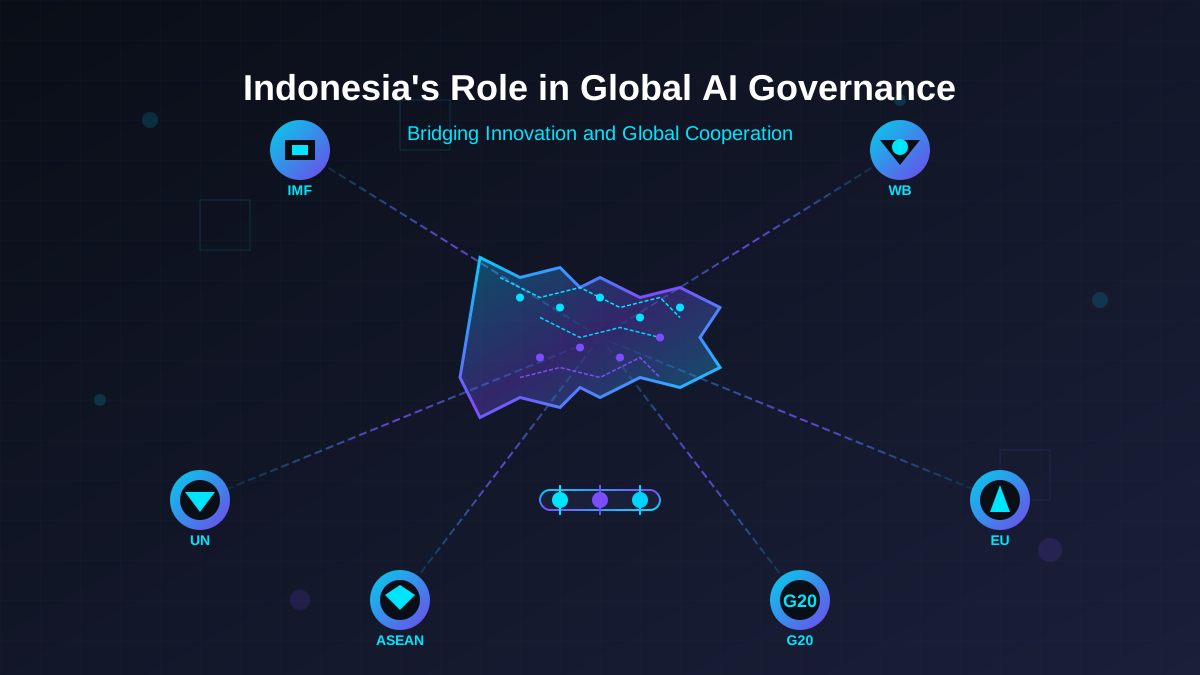
Why Does an AI Declaration from a Southeast Asian Nation Make Global Tech Giants Uneasy?
Direct answer: Because Indonesia represents not just one country, but the collective demand of the entire “Global South” for a voice in tech governance. Its massive digital population, rapidly growing ICT infrastructure, and strategic position as a key manufacturing and data hub give its stance tangible negotiating leverage, enough to influence the rules for future AI products entering emerging markets.
Over the past decade, global AI governance discourse has been largely dominated by three camps: the US’s innovation-driven model, the EU’s risk-regulation model, and China’s state-led model. While these frameworks differ, they are essentially based on the conditions and values of developed economies. As AI applications deeply penetrate populous nations like Indonesia, India, and Nigeria, governance blind spots become glaringly apparent—issues these regions care most about, such as “bridging the digital divide,” “local employment impacts,” and “safeguarding data sovereignty,” often become marginal footnotes in existing frameworks.
Indonesia’s current declaration aims to push these issues to the core. The five systemic risks specifically highlighted by the Finance Minister—AI investment asset bubbles, labor market shocks from automation, concentration in the global platform market, financial stability risks from AI decision-making, and fiscal erosion from cross-border digital activities—each directly point to the unique vulnerabilities developing countries face amid the current global AI frenzy.
Let’s use a simple table to contrast traditional governance focuses with those represented by Indonesia and other developing nations:
| Governance Dimension | Traditional Focus (Primarily US/EU) | Developing World Focus (Using Indonesia as an Example) |
|---|---|---|
| Core Concerns | Privacy protection, algorithmic bias, existential risks, militarization | Technology accessibility, job displacement and transition, protection of local industries, digital sovereignty |
| Regulatory Logic | Harm prevention, compliance review, accountability mechanisms | Development-oriented, benefit distribution, capacity building |
| Primary Tools | Legislation (e.g., EU AI Act), industry standards, ethics committees | Industrial policy, infrastructure investment, international alliance negotiations |
| Expected Outcomes | Controllable, safe, value-aligned AI | Inclusive, empowering, locally-driven economic growth AI |
This paradigm shift means tech giants can no longer rely solely on a one-size-fits-all global compliance manual. Deploying AI solutions in the Indonesian market may require demonstrating how they create local jobs, keep data processing within borders, and share value with local SMEs. This will fundamentally change the rules of the game.
Indonesia’s “Hard Power” Leverage: More Than Just Demographic Dividend, It’s an Infrastructure and Data Hub
Direct answer: Indonesia’s negotiating confidence is built on tangible digital infrastructure and economic forecasts. Over 12,000 km of fiber-optic backbone, 150Gbps of national satellite capacity, and an explosively growing digital economy elevate it from a “market” to an “ecosystem co-builder.”
Minister Purbaya’s mention of an 8.35% ICT industry growth rate is not baseless. According to the World Bank’s report, Indonesia’s digital economy value is expected to exceed $130 billion by 2025, making it the absolute core of Southeast Asia. More crucially, the country is transitioning from a pure consumption market to a regional data and computing hub. The government’s “National Data Center” initiative aims to localize government and critical industry data, directly touching the core business model of cloud giants (AWS, Google Cloud, Microsoft Azure)—data mobility.
Furthermore, Indonesia possesses rich “contextual data,” indispensable for training AI models that can truly serve Southeast Asia’s diverse cultures. From thousands of island dialects, unique business practices, to specific agricultural environmental data, these are not easily accessible in Silicon Valley labs. This allows Indonesia to use “data contribution” as leverage in negotiations for technology transfer and local capacity building.
The flowchart below illustrates how Indonesia transforms its national advantages into a concrete influence pathway in global AI governance negotiations:
flowchart TD
    A[Indonesia's National Strategic Resources] --> B1[270 Million Digital Population<br>and Consumer Market]
    A --> B2[Rapidly Growing ICT Infrastructure<br>Fiber and Satellite Networks]
    A --> B3[Unique Regional<br>Contextual Data]
    A --> B4[As Natural Representative of<br>ASEAN and the Global South]

    B1 & B2 & B3 & B4 --> C{Transformed into Governance Negotiation Leverage}

    C --> D1[Market Access Conditions<br>Requiring Local Value Creation]
    C --> D2[Infrastructure Cooperation Leverage<br>for Technology Transfer]
    C --> D3[Data Sharing Frameworks<br>Ensuring Sovereignty and Reciprocity]
    C --> D4[Alliance Building<br>Forming a Developing Nations Bloc]

    D1 & D2 & D3 & D4 --> E[Reshaping Global AI Governance Rules<br>Towards Inclusivity and Development Orientation]
Once this transformation process succeeds, it will create a demonstration effect. Regional powers like India, Brazil, and Nigeria are likely to follow, forming a collective force capable of dialoguing with traditional tech powers.
AI Early Warning Mechanism: A Firewall for Financial Stability or a New Tool for Trade Protection?
Direct answer: Indonesia’s proposed “AI-specific early warning mechanism,” while ostensibly for preventing global systemic risks, also provides countries (especially developing ones) with a policy tool to monitor and regulate cross-border tech capital flows, potentially becoming a new form of “digital border management.”
Minister Purbaya’s proposal of this mechanism at an IMF venue is highly symbolic. It formally anchors AI as a core issue of global macroeconomics and financial stability, beyond just technology and industry. Indicators the mechanism might monitor include:
- Concentration and valuation levels of AI-related venture capital and private equity investments (to prevent asset bubbles).
- Correlation between employment indices in specific sectors and the speed of automation adoption (to warn of labor market shocks).
- Market share changes of major AI platforms in key markets (e.g., cloud services, advertising) (to prevent market monopolization).
- Financial institutions’ reliance on AI for credit scoring and trading algorithms (to manage financial stability risks).
However, the potential impact of this mechanism extends far beyond risk warning. It could evolve into a global AI activity monitoring system. For example, if mechanism data shows a US AI giant holds excessively high market share in Indonesia’s cloud business with substantial profit repatriation, the Indonesian government could use this to demand increased local investment, establishment of R&D centers, or payment of digital service taxes. This provides “data-based legitimacy” for state intervention.
We can foresee that future financial reports of multinational tech companies may need to disclose not only financial data but also “AI impact indicators” in various countries, as shown in the table below:
| Warning Indicator Category | Possible Measurement Standards | Potential Policy Responses |
|---|---|---|
| Capital Flow Risk | AI sector FDI proportion, unicorn valuation/revenue ratio | Adjust foreign investment review thresholds, guide investment to physical industries |
| Labor Market Risk | Speed of automation replacing roles like customer service, junior analysis | Launch skills retraining programs, tax fully automated services |
| Market Competition Risk | Combined market share of top three AI platforms in search, advertising, cloud | Implement interoperability requirements, foster local alternatives |
| Fiscal Erosion Risk | Ratio of cross-border digital service revenue to local tax payments | Enforce Significant Economic Presence (SEP) taxation rules |
This thinking of applying macroprudential regulatory frameworks to the digital realm marks a new phase in global governance. It is no longer just about regulating products after the fact, but proactively guiding the flow of capital and technology.
Implications for Taiwan’s Tech Industry: Strategic Upgrade from Supply Chain to “Governance Chain”
Direct answer: Taiwanese players must move beyond hardware supply chain thinking and actively participate in building Southeast Asia’s “AI governance ecosystem.” The opportunity lies in providing solutions aligned with the new governance paradigm; the risk is that ignoring this trend will lead to being perceived as part of the old order and face exclusion.
Taiwan’s advantages in semiconductors, server hardware, and networking equipment are undeniable. But its voice in AI software, algorithms, and governance compliance is relatively weak. The process by which countries like Indonesia assert governance rights is a golden window for Taiwan to reposition itself. We should not just sell shovels (hardware) to gold miners (AI companies), but also think about how to help emerging market nations design their gold mining rules.
Specific strategies could include:
- Develop “Compliance by Design” AI toolkits: Assist Southeast Asian governments and enterprises in building compliance with local regulations (like data localization, employment impact assessments) directly into AI application development.
- Participate in regional AI governance standard-setting: Through academia, think tanks, and industry alliances, actively contribute to the formulation of AI ethics and governance guidelines at the ASEAN level, transforming Taiwan’s tech governance experience into soft power.
- Co-create contextualized AI models with local Indonesian partners: Leverage Taiwan’s technical prowess and Indonesia’s data and market insights to jointly develop vertical models for Southeast Asian finance, healthcare, and agriculture, sharing intellectual property rights.
The mind map below outlines the strategic upgrade path for Taiwan’s tech industry in this changing landscape:
mindmap
  root(Taiwan Tech Industry Strategic Upgrade)
    (Consolidate Hardware Advantages)
      Maintain leadership in wafer foundry and packaging
      Develop complete AI server solutions
      Invest in next-generation computing architectures
    (Software and Governance Entry Points)
      Develop localized AI compliance tools
        GDPR/ASEAN AI Act comparison engine
        Automated impact assessment modules
      Participate in regional governance standard-setting
        Through APEC and ASEAN forums
        Collaborate with international think tanks to publish white papers
      Establish co-creation partnerships
        Partner with Indonesian state-owned telco Telkomsel
        Invest in local AI startups and data companies
    (New Market Positioning)
      Become a "Trusted AI Ecosystem Technology Partner"
      Upgrade from supplier to co-rule maker
According to predictions from MIC, III, ASEAN’s digital economy output will exceed $300 billion by 2025. If Taiwan seizes the opportunity of this governance transformation, it has the chance to move up the value chain, securing higher profit margins and strategic initiative.
Conclusion: The Multipolar Era of Global AI Governance Has Officially Arrived
Indonesia’s declaration is a watershed moment. It heralds the shift of global AI governance from an era of “technocratic and great-power dominance” to a more chaotic, yet more democratic, era of “multi-stakeholder博弈.” Future rules will not only be written in meeting rooms in San Francisco or Brussels, but also formed at negotiation tables in Jakarta, New Delhi, and Nairobi.
For businesses, compliance costs will rise, but new business models and partnership opportunities will also emerge. For nations, tech sovereignty will become a strategic issue as important as trade and defense. The winners of this race will be countries and companies that can flexibly adapt to diverse governance environments and transform compliance challenges into innovation drivers.
Taiwan stands in a unique position: we possess top-tier tech manufacturing capabilities, deep involvement in global supply chains, and rich experience in democratic governance and civil society participation. We are fully capable of becoming a bridge between advanced and developing economies in AI governance. The key lies in whether we possess sufficient strategic vision and drive to proactively shape this emerging future, rather than merely reacting to it.
Further Reading
- World Bank - Indonesia Economic Prospects Report (focus on digital transformation chapter): https://www.worldbank.org/en/country/indonesia/publication/indonesia-economic-prospects
- Institute for Information Industry, Market Intelligence & Consulting Institute (MIC) - ASEAN Digital Economy Trend Analysis: https://mic.iii.org.tw/
- Organisation for Economic Co-operation and Development (OECD) - AI Policy Observatory (for querying national policies): https://oecd.ai/