Introduction: When Capital Chooses a “Digital Passport,” the War for Tech Hubs Has Just Begun
We are witnessing a silent migration: not of people, but of capital and innovative entities seeking the most advantageous “digital passport” for themselves. In the past, companies chose operational bases primarily based on market access or cost; today, for AI startups, crypto funds, and even Indian tech giants seeking globalization, selecting an International Financial Centre (IFC) is a core technical infrastructure decision. This hub determines whether your data can flow freely, whether your algorithm training can enjoy tax incentives, and whether your investors can participate in the next funding round with minimal friction.
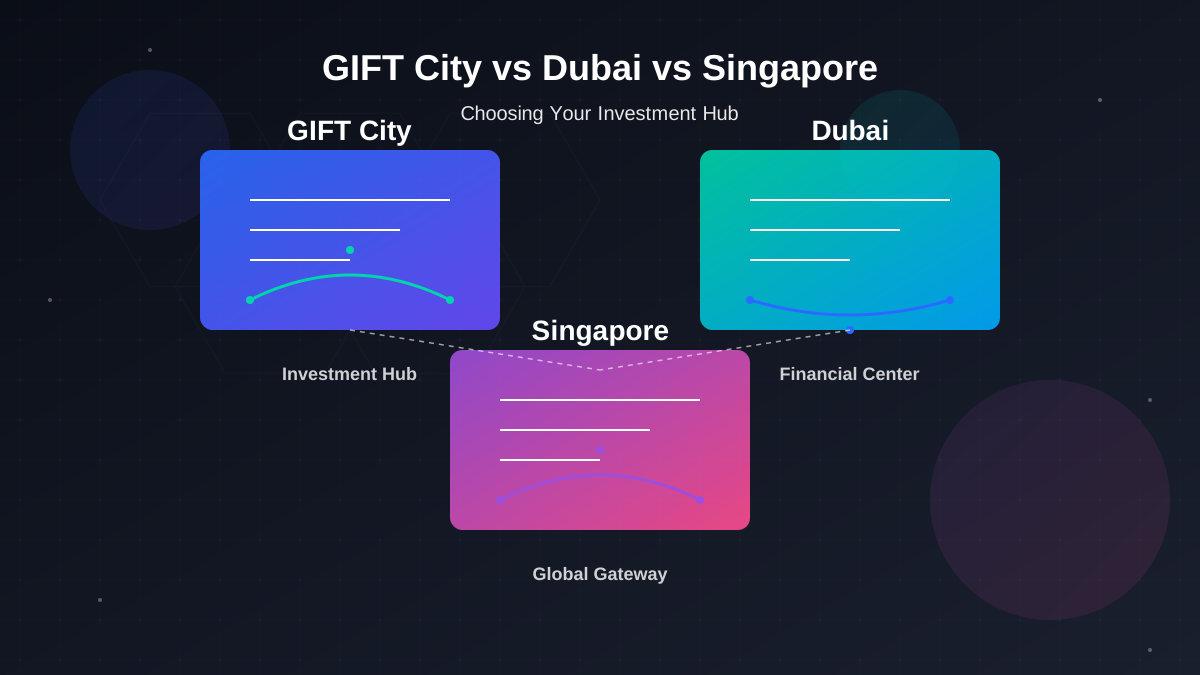
The rise of India’s GIFT City, the continuous evolution of Dubai DIFC, and the steady defense of Singapore form a dynamic triangle of competition. This is not merely a comparison of tax rates or regulations, but a collision of three distinct tech governance philosophies. This article will cut through the surface-level policy rhetoric, analyzing from the practical operational logic of the tech industry how these three hubs are redefining the innovation capital map of Asia and the world.
Why Has the “Company Registration Location” for Tech Giants and Startups Become a Strategic Asset?
Simple answer: because the regulatory environment itself is a productivity tool. In the AI era, the iteration speed of algorithms, the compliant convergence of cross-border data, and the efficiency of capital fundraising are all directly linked to the legal framework of the location. A well-designed jurisdiction can become a competitive advantage for enterprises, much like high-speed internet.
Paradigm Shift from “Tax Havens” to “Innovation Incubators”
Traditional offshore centers primarily offered tax optimization and privacy protection. But for today’s tech companies, especially those handling large volumes of data or involving new types of assets (such as digital currencies, AI model rights), they need proactive regulatory collaboration. This is why we see GIFT City establishing the International Financial Services Centre Authority (IFSCA), which is not just a regulator but also positions itself as a “co-creator,” working with companies to design new frameworks for blockchain settlement and AI model risk management.
This shift means that the metrics for evaluating a hub have changed. Beyond tax rates, we should focus on:
- Scope and speed of regulatory sandboxes: Can new business models be tested quickly?
- Clarity of data governance rules: Are cross-border transfers of training data restricted?
- Ownership and liquidity of intellectual property: Is the licensing and trading of AI models as assets convenient?
The table below compares the core regulatory philosophies of the three hubs regarding tech innovation:
| Hub | Core Regulatory Philosophy | Representative Tech-Friendly Policies | Potential Challenges |
|---|---|---|---|
| GIFT City (IFSCA) | Proactive Collaborative | Allows a single fund entity to conduct both domestic and foreign investments simultaneously; establishes dedicated accelerators for fintech and green tech. | Global market perception of its regulatory maturity still requires time to build; ecosystem support services (e.g., legal, audit) are still developing. |
| Dubai DIFC | Flexible and Open | Dedicated regulatory framework for crypto assets; DIFC courts use common law, making judgments easier to enforce internationally. | Increasing economic substance requirements; geopolitical volatility may affect long-term stability expectations. |
| Singapore (MAS) | Robust and Balanced | Pre-defined regulatory sandboxes (e.g., Sandbox Express); issues clear licenses for payment services and crypto exchanges. | Relatively high compliance costs; may be more cautious in approving extremely cutting-edge, ambiguously defined innovations. |
Capital “Latency” and “Throughput”: The Hidden Costs of Infrastructure
For a venture capital fund investing globally, the “latency” and “friction costs” between capital deployment from limited partners (LPs) and investment in startups across different continents are crucial. A hub’s financial infrastructure—including clearing systems, foreign exchange controls, and mutual recognition agreements with other jurisdictions—directly determines the “throughput” of capital.
flowchart TD
    A[Tech Startup Fundraising Needs] --> B{Choose Fund Establishment Hub}

    B --> C[GIFT City IFSC]
    B --> D[Dubai DIFC]
    B --> E[Singapore]

    C --> F[Advantage: Seamless investment in Indian market<br>Tax exemption passes through to investors]
    C --> G[Consideration: Lower familiarity among international LPs]

    D --> H[Advantage: Access to Middle Eastern sovereign wealth funds<br>High freedom of capital movement]
    D --> I[Consideration: Economic substance requirements]

    E --> J[Advantage: Highest global credibility<br>Extensive bilateral agreement network]
    E --> K[Consideration: Highest operational and compliance costs]

    F & H & J --> L[Decision Key: Target portfolio geography<br>and investor preferences]
As seen in the decision flowchart above, the choice of hub essentially pre-matches target portfolios with investor composition. A fund focused on AI applications in South and Southeast Asia finds GIFT City’s “single entity for domestic and foreign investment” structure highly attractive; while a fund targeting Middle Eastern digital transformation and connecting European capital naturally gravitates towards Dubai DIFC.
GIFT City: Can It Replicate the “Bangalore Miracle” to Create a New Sanctuary for Fintech?
Simple answer: Its ambitions are greater. GIFT City does not want to be merely a conduit for capital; it aims to become the source of value creation. Its strategy is to directly connect India’s software talent, vast data pools, and global capital within a tax-free zone, catalyzing the next generation of financial and AI applications.
Using “Tax Pass-Through” to Solve Startup Financing Challenges
One of GIFT City’s sharpest weapons is the tax incentives for Alternative Investment Funds (AIF). Funds established in GIFT City enjoy 100% tax exemption on income, and this exemption “passes through” to the investor level. For funds investing in early-stage tech startups, this means that capital gains from high-risk investments are completely tax-free, significantly enhancing potential investment returns.
According to the IFSCA 2025 annual report, by the end of 2025, assets under management by funds registered in GIFT City exceeded $45 billion, with over 30% explicitly listing technology, AI, and fintech as key investment areas. This figure was nearly zero two years ago, indicating an extremely steep growth curve.
Connecting “India Stack” with Global Capital
India’s digital public infrastructure—collectively known as “India Stack,” including Aadhaar identity authentication, UPI payment systems, and data empowerment architecture—is globally recognized as a model. A key vision for GIFT City is to enable global fintech companies to conduct innovative experiments within its jurisdiction, accessing or building upon “India Stack” in a compliant manner.
For example, a company could develop a solution in GIFT City that uses Aadhaar for cross-border KYC (Know Your Customer), serving the global remittance market, while enjoying local regulatory guidance and tax benefits. This deeply bundles regulatory advantages, technological infrastructure, and market opportunities.
Dubai DIFC: How Does the “Venture Capital Crucible” for Web3 and Fintech Operate?
Simple answer: By creating an experimental ground with high tolerance for failure and rapid connection to Middle Eastern “sovereign wealth capital.” Dubai’s success lies in its precise capture of the regulatory vacuum demand from the last tech wave—fintech and Web3—and providing certainty at an astonishing speed.
Regulatory Certainty as a Magnet for Early-Stage Capital
Between 2019 and 2025, numerous crypto asset and blockchain startups faced global regulatory uncertainty. Dubai DIFC and its broader Dubai Virtual Assets Regulatory Authority (VARA) framework were among the first to introduce detailed licensing regimes. Although compliance requirements are strict, the mere fact of “having a law to follow” provided the underlying confidence needed for global venture capital investments.
According to a McKinsey 2025 analysis, over 70% of fintech financing activity in the Middle East and North Africa region flows through holding entities or major funding channels based in DIFC. A strong network effect has formed here: capital aggregation attracts talent, talent creates success stories, and success stories attract more capital.
The Double-Edged Sword of Geographic Location: Connectivity and Volatility
Dubai’s geographic location is a significant advantage, situated at the crossroads of Europe, Asia, and Africa, with time zones covering Asian afternoons and European mornings. For tech funds managing global portfolios, operational convenience is notable.
However, geopolitics remains a variable overhead. Savvy tech investors adopt a “hub diversification” strategy, for example, setting up legal entities in DIFC but deploying some key asset custody or technical teams in other jurisdictions to mitigate risk. This has spurred new demand for cross-hub compliance and operational coordination services.
Singapore: Facing Challengers, How Does the Mature “Tech Headquarters Ecosystem” Defend?
Simple answer: Not engaging in a tax rate brawl with challengers, but continuously reinforcing its moats of “trust” and “connectivity.” Singapore understands that its greatest assets are the international credibility, political stability, and unparalleled global agreement network built over decades.
Bilateral Agreement Network: The Invisible Infrastructure for Multinational Tech Companies
For large-scale, globally operating listed tech companies or major unicorns, tax planning complexity is extremely high. Singapore’s Double Taxation Avoidance (DTA) agreements with over 46 countries, along with its extensive investment guarantee agreements, provide a clear and reliable global tax map.
When a Chinese AI company plans to deploy smart city solutions across Southeast Asian countries, setting up its regional settlement center in Singapore maximizes profit repatriation efficiency and minimizes tax risks. This advantage is difficult for emerging hubs to replicate in the short term.
Focusing on “Deep Tech”: From Financial Center to AI R&D Hub
Singapore’s defensive counter-strategy is to move upstream, heavily investing in foundational “deep tech” R&D. National-level initiatives like the “National AI Strategy 2.0” and ongoing investments in semiconductors and quantum computing aim to attract AI labs and hard-tech companies that require top research talent, long-term capital, and close industry-academia collaboration.
The table below shows the attractiveness matrix of the three hubs for different types and stages of tech enterprises:
| Enterprise Type / Development Stage | GIFT City Attractiveness | Dubai DIFC Attractiveness | Singapore Attractiveness |
|---|---|---|---|
| Early-Stage AI/FinTech Startup | ★★★★☆ (Tax pass-through, proximity to Indian market) | ★★★★☆ (Regulatory sandbox, VC density) | ★★★☆☆ (Higher cost, but high quality) |
| Growth-Stage Tech Unicorn | ★★★☆☆ (Fundraising convenience, regional HQ incentives) | ★★★★☆ (IPO preparation, Middle East investor relations) | ★★★★★ (International credibility, M&A springboard) |
| Multinational Tech Company Regional HQ | ★★☆☆☆ (Ecosystem still developing) | ★★★☆☆ (Serving Middle East and Africa markets) | ★★★★★ (Stability, agreement network) |
| Crypto/Web3 Fund | ★★☆☆☆ (Regulatory trend towards caution) | ★★★★★ (Dedicated licensing framework) | ★★★☆☆ (Clear licensing but high thresholds) |
Decisive Points in the Next Five Years: Who Can Win the Favor of “AI-Native Capital”?
Future competition will revolve around one core: Who can become the preferred hub for “AI-native capital”? AI-native capital refers not only to money investing in AI but also to funds and family offices whose operations—using AI for investment decisions, risk management, asset allocation—have entirely new requirements for computing power access, data mobility, and regulatory adaptability.
Prediction: Hybrid Hub Strategies and the End of “Regulatory Arbitrage”
We will see more tech enterprises adopting “hybrid hub” architectures:
- Legal and financing entities located in optimal tax/regulatory locations (e.g., funds in GIFT City).
- Core R&D and data centers located in talent and infrastructure hubs (e.g., Singapore or mainland India).
- Market operation entities distributed across target markets.
This architecture relies on smooth legal cooperation and data transfer agreements between hubs. This also means that the era of relying solely on low tax rates for “regulatory arbitrage” is ending. Future winners must provide tangible innovation value—whether through access to vast datasets, unique research collaboration environments, or irreplaceable professional service ecosystems.
timeline
    title Competition Timeline of Three Major Tech Investment Hubs
    section 2024-2025
        Singapore : Strengthens AI governance framework<br>Releases generative AI assessment tools
        Dubai DIFC : Launches updated virtual assets law<br>Attracts major crypto exchanges to relocate
        GIFT City : AIF assets exceed $30 billion<br>Launches Fintech Accelerator 2.0
    section 2026-2027
        Singapore : Expands deep-tech investment tax incentives<br>Quantum computing center completed
        Dubai DIFC : Focuses on climate tech and AI ethics sandboxes<br>Faces economic substance review pressures
        GIFT City : Initiates "AI Data Zone" pilot<br>Signs MOUs with more global regulators
    section 2028+
        Competition Focus : Regulatory mutual recognition and data flow agreements<br>Becoming compliant hubs for AI model training and trading
Implications for Taiwan’s Tech Industry
As a core hub for global semiconductor and hardware manufacturing, Taiwan’s tech capital flows profoundly impact its industry fate. Taiwan’s tech enterprises and investors should view this triangular competition as an opportunity matrix:
- Financing option diversification: Consider using GIFT City as a financing and investment platform to enter the Indian and South Asian markets, leveraging its preferential structures to invest in local software ecosystems.
- New paths for technological cooperation: Connect with Middle Eastern sovereign wealth funds’ investment demands in hard tech and energy transition through Dubai DIFC.
- Risk diversification strategy: Learn from Singapore’s robust framework to manage global assets while utilizing emerging hubs to capture high-growth opportunities in specific sectors.
Ultimately, the winners of this hub competition will be the jurisdictions that best understand that “tech capital” is not just currency but the financialized expression of combinations of technology, data, and talent. For every tech entrepreneur and investor, choosing a hub means selecting the most powerful operating system for their future competitiveness.