Why Is “Compression” Becoming the Next Arms Race in the Autonomous Vehicle Competition?
Simple answer: because data costs are stifling the pace of innovation. When a single autonomous test vehicle generates several terabytes of data per day, and fleets often consist of hundreds of vehicles, companies face not just a technical challenge, but an economic one. The infrastructure costs for storing, transmitting, and processing this data grow exponentially, yet the speed of development iteration is bottlenecked by the throughput of the data pipeline. The maturation of ML-Safe compression technology means we can physically “shrink” the scale of the problem, freeing precious computational resources and engineering time from the drudgery of data management and refocusing them on algorithmic innovation.
Autonomous vehicle development has entered deep waters. The early phase of “stacking sensors and collecting massive data” is ending. The industry is increasingly realizing that the “quality” and “management efficiency” of data are becoming as important as, if not surpassing, sheer “volume.” According to an industry analysis cited by Forbes, the global autonomous vehicle data management market is projected to exceed $80 billion by 2030, with data optimization and compression solutions being one of the fastest-growing sub-sectors.
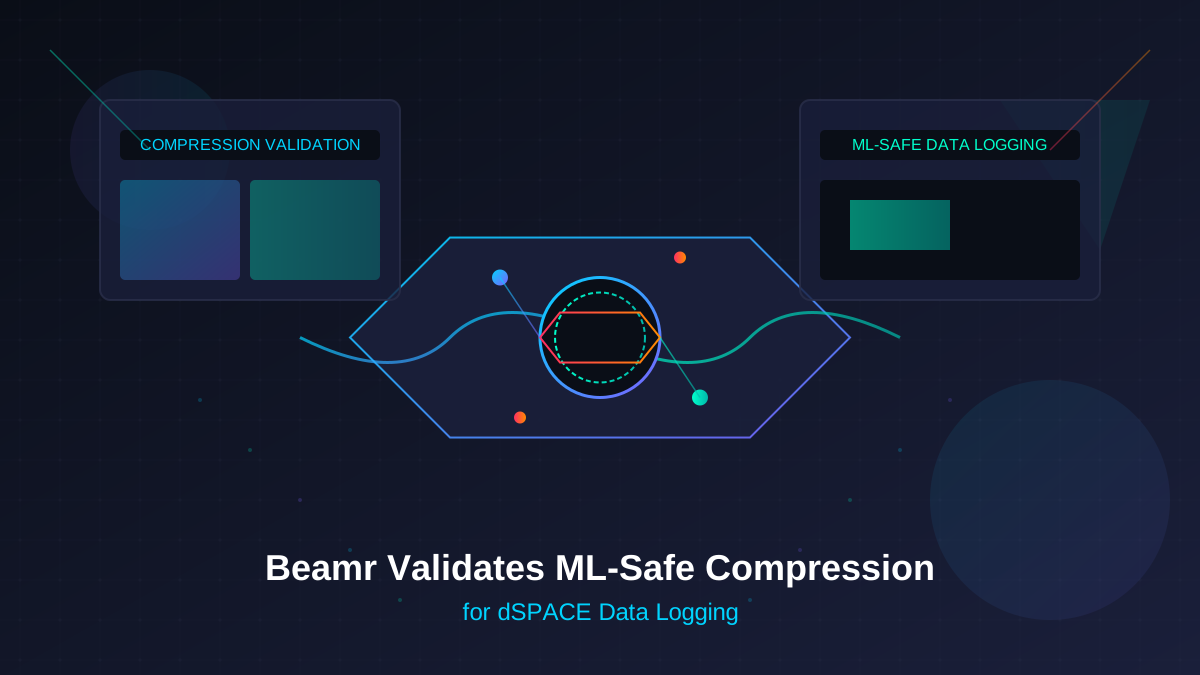
The collaboration between Beamr and dSPACE is a precise positioning at this inflection point. dSPACE’s RTMaps is one of the de facto standard software frameworks in the automotive industry, especially for Advanced Driver-Assistance Systems (ADAS) and autonomous vehicle development, used for recording, replaying, and real-time processing of multi-sensor data. Validating the effectiveness of compression technology within this ecosystem is equivalent to obtaining a key to enter the mainstream automotive supply chain. This is not merely a feature integration; it is a strong industry signal: future development toolchains must have data efficiency built into their DNA.
Let’s use a simple table to compare the cost differences with and without compression:
| Cost Item | Uncompressed Data Pipeline (Baseline) | With ML-Safe Compression (Estimate) | Savings Margin |
|---|---|---|---|
| Raw Storage Cost (per PB/year) | $300,000 - $500,000 | $210,000 - $350,000 | ~30% |
| Data Transmission to Cloud Cost | High (depends on bandwidth & volume) | 31% less data volume, cost reduced proportionally | Significant |
| Cloud Processing & Compute Cost | High (requires processing full data) | Potentially lower (reduced data volume) | Indirect savings |
| Development Iteration Cycle | Limited by data transfer/preparation time | Shortened, as data is easier to move and access | Hard to quantify but crucial |
This table reveals a harsh reality: at scale, the marginal costs of hardware and bandwidth become a heavy burden. The over 30% reduction provided by compression technology directly translates into real operational expenditure (OpEx) savings. More importantly is the last item—development speed. In the highly competitive autonomous driving race, the ability to complete a training loop faster means being able to improve models and address corner cases more quickly, constituting the most core competitive advantage.
mindmap
  root(ML-Safe Compression's Industry Ripple Effects)
    Technical Impact
      Redefining data fidelity standards<br>(for ML, not human vision)
      Making edge data preprocessing<br>a standard feature
      Promoting dedicated AI codec<br>development (e.g., MPEG-5 LCEVC)
    Supply Chain Impact
      Automakers & Tier 1 Suppliers
        : Lower total data management cost
        : Accelerate ADAS/AV feature development
      Cloud & Storage Service Providers
        : Demand shifts from "capacity" to "intelligent data services"
        : Offer integrated compression data lake solutions
      Chip & Hardware Vendors
        : Need to support high-performance real-time codecs
        : NPU-integrated compression engines become a new trend
    Business Model Impact
      From "selling storage space" to<br>"selling data efficiency solutions"
      Rise of Compression-as-a-Service (CaaS) models
      Data pipeline optimization becomes<br>a new software licensing market
How Does This Validation Shake the Design Philosophy of Existing Data Pipelines?
The core lies in a shift of “trust.” Past data pipeline designs generally held a “reverent” attitude towards raw data, fearing that any preprocessing (like compression) could contaminate the data, leading to untraceable biases in subsequent model training. Therefore, they preferred to pay high costs to preserve everything rather than make trade-offs at the source. The validation by Beamr and dSPACE aims to shatter this myth: through scientific methods, it proves that data compressed by specific algorithms (like CABR) results in less than a 2% difference in key ML task performance (e.g., object detection metrics like mAP), a difference that may even fall within the normal fluctuation range of the models themselves.
This is not just a technical breakthrough; it is a paradigm shift in engineering philosophy. It pushes data pipeline design principles from “passive storage and transmission” towards “active optimization and filtering.” The ideal future data flow should be intelligent: at the data generation point (the onboard recorder), it should instantly determine which data requires high-fidelity preservation (e.g., segments before and after an incident) and which can undergo higher compression ratios (e.g., steady highway driving segments), ensuring all processing meets the needs of downstream AI models.
This transformation impacts different stakeholders in varied ways:
| Industry Role | Traditional Data Pipeline Mindset | New Mindset Influenced by ML-Safe Compression | Potential Challenges |
|---|---|---|---|
| Data Engineer | Ensure data integrity, traceability, and pipeline stability. | Need to understand compression’s impact on ML tasks, design tiered compression strategies, manage versions and metadata of compressed data. | Requires new skill sets, spanning codec and ML domains. |
| ML Researcher/Engineer | Demand access to the most raw data, skeptical of any preprocessing. | Can accept certified ML-Safe compressed data, focus more on data diversity and annotation quality rather than pure data volume. | Need to build trust in compressed data and adjust model evaluation processes. |
| IT/Infrastructure Manager | Continuously expand storage and bandwidth to meet data growth demands. | Evaluate the cost and benefits of adopting compression technology, optimize hybrid cloud data flows, reduce Total Cost of Ownership (TCO). | Need to integrate new tools into existing architectures, manage licensing and compatibility. |
| Enterprise Decision-Maker (CTO/CFO) | View data as a necessary cost, focus on model performance metrics. | Treat “data efficiency” as a key performance indicator, invest in technologies that optimize total data lifecycle costs (from edge to cloud). | Need to make long-term investment decisions amid technical uncertainty. |
The deeper significance of this revolution is that it makes resource allocation for AI development more efficient. It is estimated that in a large autonomous vehicle project today, up to 70% of collected data is never used for model training, merely occupying storage space as “data dark matter.” ML-Safe compression technology, combined with smarter data selection strategies, holds the potential to free precious computational resources from processing this “dark matter.”
Who Are the Winners, and Who Faces Pressure? How Will the Competitive Landscape Reshape?
The winners are not just Beamr, but the entire ecosystem adopting an efficiency-first strategy. In the short term, Beamr is undoubtedly the direct technological beneficiary; its CABR technology gaining dSPACE’s endorsement establishes a strong beachhead in the vertical automotive industry. dSPACE also strengthens its toolchain’s value, upgrading from a “data recording and replay tool” to part of an “end-to-end data efficiency solution.”
However, the true winners may be small and medium-sized autonomous vehicle startups struggling with data costs, and traditional automakers seeking to catch up quickly. For them, this technology lowers the barriers to entry and scaling. They don’t need to build massive data centers like cash-rich tech giants but can achieve similar development efficiency with leaner resources through smarter data management. This levels the competitive playing field to some extent.
Pressure will naturally transfer to players in other domains:
- Pure Storage Solution Providers: If customer demand shifts from “more storage space” to “more effective storage methods,” business models focused solely on selling hard drives or cloud storage buckets will face challenges. They must integrate upwards, offering services that include data optimization.
- Traditional Video Codec Vendors: Codecs focused on visual losslessness may no longer be the optimal choice for AI data pipelines. The market needs new standards born for AI training. In fact, standards bodies like MPEG have already begun positioning; for example, MPEG-5 LCEVC (Low Complexity Enhancement Video Coding) is considered a codec direction suitable for AI applications.
- Development Tool Vendors Failing to Keep Pace: If data compression and management become necessities, then all tools related to the data pipeline (annotation platforms, model training platforms, data version control tools) need to consider seamless integration with such compression technologies, or risk becoming obsolete.
Future competition will be ecosystem versus ecosystem. We can foresee several possible development axes:
timeline
    title ML-Safe Compression Technology Development and Market Application Forecast
    section 2026-2027
      Technology Validation & Early Adoption : Beamr and dSPACE validation<br>Other toolchains follow with integration<br>Automakers initiate Proof of Concept (POC)
    section 2028-2029
      Standardization & Scaling : Industry alliances promote<br>ML data compression standards<br>Becomes standard for new vehicle data recording<br>Cloud service providers launch integrated solutions
    section 2030+
      Cross-Domain Proliferation & Deepening : Technology spreads to robotics,<br>medical imaging, and other fields<br>Integrates with neural codecs<br>Achieves perception-level compression
Insights for Taiwan’s Tech Industry: Opportunities Lie in Vertical Integration and Hardware Acceleration
Taiwan holds a crucial position in the global tech supply chain, from semiconductors and servers to edge computing devices. The transformation in autonomous vehicle data efficiency brings not just opportunities in software algorithms, but also chances for hardware-defined innovation.
First, edge computing devices (like onboard data recorders, advanced ECUs) will require more powerful real-time codec capabilities. This isn’t just about CPU/GPU computing power, but dedicated acceleration cores (ASICs or IP) optimized for specific compression algorithms (like CABR). Taiwan’s IC design companies can fully collaborate with algorithm companies like Beamr to develop hardware compression accelerators with lower power consumption and higher speed, licensing them as IP or integrating them into next-generation automotive SoCs. The accumulated expertise of companies like MediaTek and Realtek in multimedia processing is an advantage for entering this market.
Second, cloud and data center infrastructure also face upgrades. When compression is done at the edge, the amount of data transmitted to the cloud decreases, but the cloud may need to decode or transcode this compressed data for different training tasks. This means demand for video transcoding servers within data centers may change, requiring support for more diverse, AI-friendly codec formats. Server ODM manufacturers like Quanta and Wiwynn can collaborate with Cloud Service Providers (CSPs) to design server solutions optimized for such mixed workloads.
Finally, and most importantly, is knowledge integration in vertical domains. Taiwan has a solid foundation in automotive electronics, but it’s mostly concentrated in infotainment and body control. To seize the opportunity of the autonomous vehicle data revolution, it’s necessary to combine automotive electronics experience, hardware manufacturing advantages, and a deep understanding of AI data workflows. For example, developing a “smart data recording black box” that integrates ML-Safe compression hardware acceleration and comes pre-loaded with dSPACE RTMaps-compatible software stacks, offered as a turnkey solution to autonomous fleet operators. Such highly integrated products can create higher added value and profit margins.
The table below outlines potential entry points and value-upgrading paths for Taiwan’s industry chain:
| Taiwan Industry Segment | Current Primary Role | Upgrade Path Leveraging ML-Safe Compression Trend | Potential Value Increase |
|---|---|---|---|
| Semiconductor Design (IC Design) | Provide general-purpose automotive chips, multimedia processor IP. | Collaborate with algorithm companies to develop dedicated acceleration IP or co-processors for ML compression. | Upgrade from generic component supplier to key technology provider for AI data efficiency. |
| Server/Hardware Manufacturing (ODM/OEM) | Manufacture standard cloud servers, edge computing devices. | Collaborate with CSPs and software vendors to design hardware platforms optimized for compressed/decompressed data flows. | Move from contract manufacturing towards co-design and solution provision. |
| Automotive Electronics System Suppliers | Supply sensor modules, onboard computers, data loggers. | Integrate ML-Safe compression software/hardware into next-gen products, offering “data-ready” solutions. | Upgrade from single-part supply to system-level supplier providing data management value. |
| Software & System Integrators | Undertake software development and testing projects for automakers or Tier 1s. | Master the evaluation and implementation capabilities of ML-Safe compression technology, becoming consultants for clients’ data pipeline modernization. | Raise technical service barriers and project value, entering core development processes. |
Conclusion: This Is Not Just About Compression, But About the Maturation of AI Industrialization
The joint demonstration by Beamr and dSPACE is like a key, unlocking the door to a new world of “high-performance AI data management.” It signifies that the autonomous vehicle industry, and indeed the entire machine learning application field, is beginning to seriously address and systematically solve efficiency bottlenecks in the data lifecycle.
The ultimate vision of this transformation is to make data pipelines resemble modern logistics systems: not just pursuing transport volume, but also load factor, route optimization, and real-time tracking. ML-Safe compression is the key technology for optimizing “load factor.” When this technology becomes foundational, it will pave the way for more agile, cost-effective, and rapid AI innovation across industries.