Why Can a Single Switch Stir Such Waves?
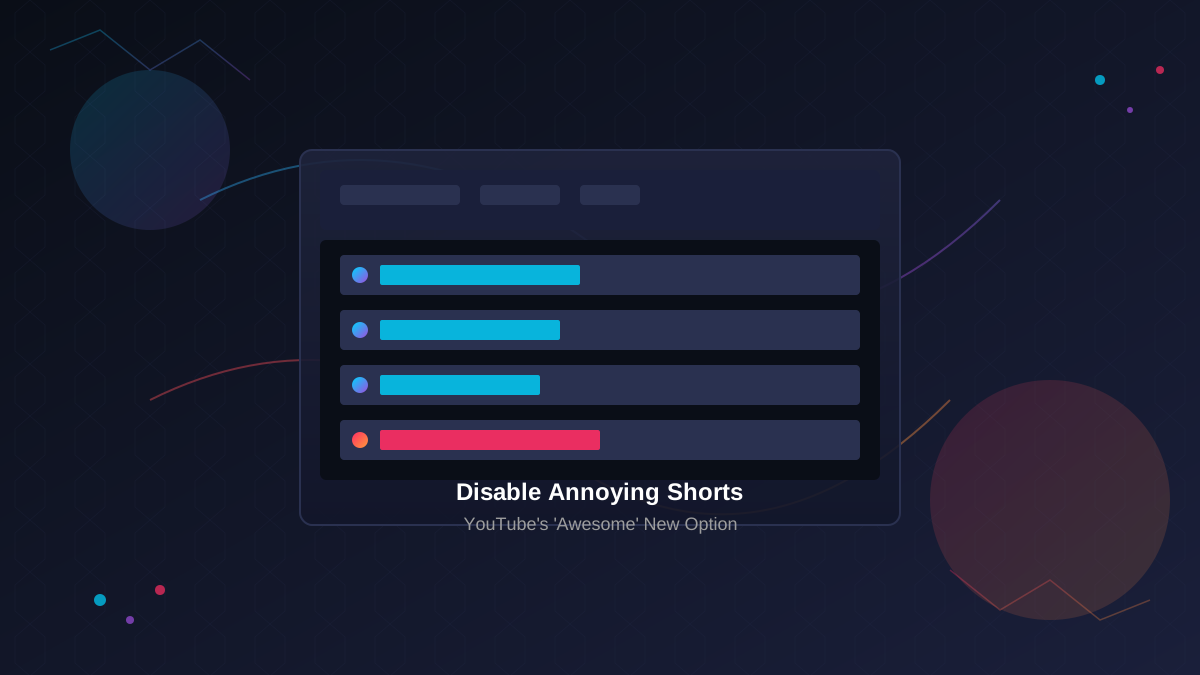
The answer is simple: it shakes the core belief of social media operation over the past decade—that the algorithm knows what is best for you. YouTube allowing users to manually disable Shorts recommendations, this seemingly minor feature, is actually a public correction of the platform’s own strategy. It acknowledges that the “one-size-fits-all” short-form video bombardment strategy does not meet all user needs and may even harm the core long-form video viewing experience. This is not just a feature update; it is a signal of a strategic pivot.
Delving into the industry context, we find this decision stems from the convergence of multiple pressures: data feedback on user fatigue, creators’ complaints about traffic quality, advertisers’ doubts about short-form video monetization efficiency, and increasing regulatory focus on algorithm transparency. According to leaked internal Google data, about 38% of active users surveyed stated that Shorts’ autoplay and intrusive recommendations “significantly reduced” their overall satisfaction with YouTube. This is not a negligible minority.
More critically, this feature emerges at the 2026 juncture. The first phase of the short-form video war—“full TikTok-ization”—is nearing its end. All major platforms now have their own short-form video products. Competition has entered the second phase: differentiation and experience optimization. Whoever can better balance the addictive nature of short content with the depth and value of long content will win the next round of user loyalty battles. YouTube’s move is precisely an attempt to reinforce its foundation as a “deep video library” while not completely abandoning the short-form video battlefield.
The End of the Short-Form Video Frenzy? A Paradigm Shift in Platform Strategy
Has short-form video reached its growth ceiling? Data suggests not yet, but the红利 period of “indiscriminate推送” is indeed ending. While YouTube Shorts’ daily watch time continues to grow, the growth rate has slowed from a peak annual increase of 120% in 2024 to an estimated 25% in 2026. This indicates market saturation and diminishing marginal returns. The platform’s challenge shifts from “how to get more people to watch Shorts” to “how to get the right people to watch the right Shorts” and “how to prevent those who dislike Shorts from leaving.”
This triggers a paradigm shift in platform strategy. The formula of the past decade was: more content + stronger algorithm = higher engagement = more ad revenue. But this formula ignores users’ “intent diversity.” Sometimes users want deep learning; sometimes they just want mindless relaxation. Forcing all usage scenarios toward short, fast-paced stimulation ultimately erodes user trust.
The table below compares key metrics and strategic thinking before and after YouTube introduced and adjusted its Shorts strategy:
| Dimension | Early Strategy Phase (2020-2023) | Adjustment Phase (2024-2026) | Industry Significance |
|---|---|---|---|
| Core Objective | Maximize overall user dwell time | Optimize “intent satisfaction” and user satisfaction | Shift from quantitative to qualitative metrics |
| Algorithm Role | Singular, dominant content distribution engine | Layered, adjustable recommendation filter | Algorithm shifts from “god’s perspective” to “tool option” |
| Content Ecosystem | Encourage all creators to转向 Shorts | Distinguish between “short-form creators” and “long-form creators” and provide相应 tools | Ecosystem specialization and division of labor |
| Monetization Model | Use Shorts traffic to drive overall ad exposure | Explore balance between Shorts-specific ad products and long-form video memberships | Diversify revenue structure, reduce single-mode risk |
| Competitive Focus | Feature presence (having Shorts or not) | Experience quality (how to integrate Shorts) | Competitive门槛 rises from feature replication to system integration |
This feature update is a concrete manifestation of the “adjustment phase” mindset. It no longer pursues absolute Shorts view counts but returns choice to users, aiming to improve “intent satisfaction,” a more sustainable long-term metric.
Who Wins, Who Loses? Reshuffling of the Industry Chain
Every turn in platform strategy reshapes the distribution of benefits within its ecosystem. The option to disable Shorts, seemingly affecting only end-users, actually牵一发而动全身, triggering chain reactions among creators, advertisers, competitors, and even hardware manufacturers.
First, for content creators, this is a clear watershed. Over the past three years, many creators were forced into a “short-form video arms race,” regardless of content suitability. The new feature means the platform acknowledges that “long and short并行” is not the only success formula. Creators focused on depth, tutorials, and reviews may see a return of traffic. Their audience can disable Shorts distractions and focus more on new content from subscribed channels. Conversely, Shorts creators relying solely on algorithmic recommendations with high content homogeneity will face tougher traffic challenges. They must enhance content creativity and quality to remain in the recommendation feed.
For advertisers, the impact is more subtle. Short-term, disabling Shorts may lead to a slight decrease in some ad impressions. But long-term, this helps improve ad environment quality and audience intent purity. When users actively choose “long-form mode,” they are more focused, potentially showing higher acceptance and conversion willingness for relevant product tutorials or in-depth review ads. This pushes advertisers from pursuing “maximum exposure” to seeking “precise context.”
mindmap
  root(Industry Impact of YouTube's
  Disable Shorts Feature)
    Content Creators
      Long-form Creators
        : May see traffic return
        : Improved viewer focus
      Short-form Creators
        : Face traffic filtering pressure
        : Must enhance content quality & creativity
    Advertisers & Brands
      Short-term
        : Slight possible dip in some ad impressions
      Long-term
        : Improved ad environment & audience intent purity
        : Drive shift from "max exposure" to "precise context"
    Competitors (e.g., TikTok, Instagram)
      Pressure
        : Users may expect similar control features
      Opportunity
        : Strengthen own short-form core experience advantage
        : Attract users dissatisfied with YouTube's mixed model
    Users
      Gains
        : Regain control over content consumption
        : Reduce information overload & distraction
      Potential Impact
        : May miss cross-format potential interest content
The competitive landscape will also change. TikTok, as a short-form purist, may initially view this as YouTube’s “concession” and intensify promotion of its focused, immersive short-form experience. But medium to long-term, pressure反而 falls on TikTok. When YouTube offers a “pure long-form” option, should TikTok also consider solutions for users wanting longer, more serialized content? This forces all platforms to reflect on their irreplaceable core value.
The Struggle Behind the Technology: AI Algorithm’s Transformation from Pusher to Servant
Implementing “disable Shorts” is far more complex than adding a switch. It represents a fundamental shift in the design philosophy of AI recommendation systems. Traditional recommendation algorithms operate in a “black box” mode: input user behavior, output a single content stream, aiming to maximize click-through rates for the next video. Now, the system needs to understand higher-level user “intent states”: does the user currently want to explore short content or immerse in long content? This intent may switch at any time.
This requires algorithms with more nuanced “context awareness.” They must not only consider what users watch but also combine time of day, device, historical patterns, and even potential active signals (like search keywords) to determine whether to temporarily suppress Shorts recommendations. This is a transformation from a “push engine” to a “personalized filter.” According to Stanford HAI research, building such intent recognition models is about 40% more complex than traditional recommendation models, as they need to handle more diverse signals and longer-term user state modeling.
Furthermore, this may lead to a more modular, pluggable recommendation system architecture. In the future, users might not only toggle Shorts but also adjust other dimensions, such as “reduce gaming videos,” “increase tutorial content,” or “this week, only watch subscribed channels.” This turns AI from a behind-the-scenes decision-maker into a user-configurable tool. This “explainable, controllable AI” is precisely the frontier in academia and industry, aligning with growing global demands for algorithm regulation and transparency.
The platform must technically resolve a矛盾: does giving users control权 exacerbate “filter bubbles,” trapping users entirely in their existing interests and reducing serendipitous discovery of new ones? This requires algorithms to respect explicit user instructions while still conducting gentle exploratory recommendations within permitted bounds. The art of this balance will become the core competitiveness of the next generation of social platforms.
What Trends Will We See in the Next Three Years?
This feature adjustment is not an endpoint but a starting point. It预示 several key development trends for social media and video platforms from 2026-2029:
- Return of Control as a Premium Feature: Providing granular content control options will gradually shift from a “differentiating feature” to a “standard.” Platforms will package this as part of a “premium experience” or “membership benefits,” becoming new value-added service points. We may see YouTube Premium members gaining more recommendation control, such as customizing homepage layouts or setting specific content时段.
- Further Fusion and Redefinition of Content Formats: The binary对立 of “long” and “short” will be broken. We will see more “hybrid” content formats, e.g., embedding independently shareable Shorts highlights within long videos, generated automatically by AI; or using Shorts as trailers or supplementary explanations for long videos. Content value will no longer be defined by length but by “completeness” and “information density.”
- Dual Upgrade of Creator Tools and Monetization Models: Platforms will provide more powerful analytical tools to help creators understand audience profiles under different content preference settings. Monetization models will adjust accordingly. For example, for深度 users who choose “disable Shorts,” platforms may introduce less intrusive, higher-value ad formats or direct sponsorship opportunities. The creator economy will shift more from “traffic monetization” to “trust monetization” and “expertise monetization.”
The table below predicts potential user control features platforms might introduce in the next three years:
| Potential Feature | Description | Target User Group | Expected Launch Window |
|---|---|---|---|
| “Deep Focus” Mode | Temporarily hide all non-traditional video content like Shorts and community posts. | Learners, research-oriented users | 2026-2027 |
| “Content Diet” Planner | Let users set weekly desired proportions for various content types (e.g., tutorials 30%, entertainment 50%, news 20%). | Users seeking balanced information intake | 2027-2028 |
| “Algorithm Transparency” Panel | Visually展示 why a video is recommended and allow user correction (e.g., “reduce similar content”). | Advanced users skeptical of algorithms | 2026-2027 |
| Cross-Platform Interest Sync | Allow safe synchronization of interests from Platform A (e.g., Podcast app) to Platform B (e.g., YouTube) to improve recommendations. | Heavy multi-platform users | 2028 onwards |
The underlying logic of these trends is consistent: transforming users from passive “content consumers” to active “media curators.” The platform’s role gradually transitions from “feeder” to “tool provider.” This is a slow transfer of power.
Implications for Taiwanese Creators and Businesses
For Taiwanese creators and brands within the global video ecosystem, this transformation presents both challenges and opportunities. The Taiwanese content market, with its blend of localization and internationalization, requires even more灵活应对 to platform rule changes.
First, creators must reassess their content positioning. Are you a “short-form expert,” a “long-form authority,” or a “cross-format storyteller”? There is no standard answer, but a clear strategy is essential. If your strength lies in深度 analysis or tutorials, then YouTube’s adjustment is favorable. You should double down on long-form video quality and use community posts, member-exclusive content, etc., to build stronger connections with core fans who choose “depth mode.” According to preliminary surveys in the Taiwanese creator community, about 60% of long-form-focused creators believe this feature helps improve their core audience’s viewing experience and interaction quality.
For brands and businesses, marketing strategies also need adjustment. The past approach of simply allocating budgets to “long-form video ads” and “Shorts ads” may no longer suffice. Deeper analysis is needed: in what “intent state” is your target audience most likely to accept your message? Is it a short promotional video seen while relaxing, or a深度 product review sought when actively looking for solutions? “Contextual targeting” in ad placement will become more important than “demographic targeting.”
timeline
title Short-Form Feature Evolution & Industry Impact Timeline
    section 2020-2023 Expansion Phase
        2020 : YouTube launches Shorts<br>in response to TikTok competition
        2021-2023 : Full-platform push<br>for algorithm-driven Shorts recommendations
    section 2024-2026 Reflection & Adjustment Phase
        2024 : User fatigue data emerges<br>creator feedback surges
        2025 : Platform internal assessment<br>of long-term short-form strategy
        2026 Q2 : "Disable Shorts" feature launches<br>strategic paradigm begins to shift
    section 2027-2029 Experience Differentiation Phase
        2027 : Expect more<br>personalized control features to appear
        2028 : Long-short video fusion formats<br>become mainstream content forms
        2029 : "User control" becomes<br>a core competitive metric for mainstream platforms
More importantly, opportunities for Taiwan’s tech industry beyond hardware and semiconductors in soft power. This transformation driven by user control requires more advanced AI models, smoother UX/UI design, and more complex content management systems. Taiwan possesses excellent software engineering and design talent. Can it seize the opportunity to participate in the global supply chain building next-generation content platform tools? This is a strategic question worth pondering. We already see some Taiwanese startups gaining recognition in “AI content analysis tools” and “creator CRM systems”; platform strategy shifts will bring them clearer demand and markets.
Conclusion: A Single Switch Marks the Dawn of a New Era in User Experience
YouTube offering the option to disable