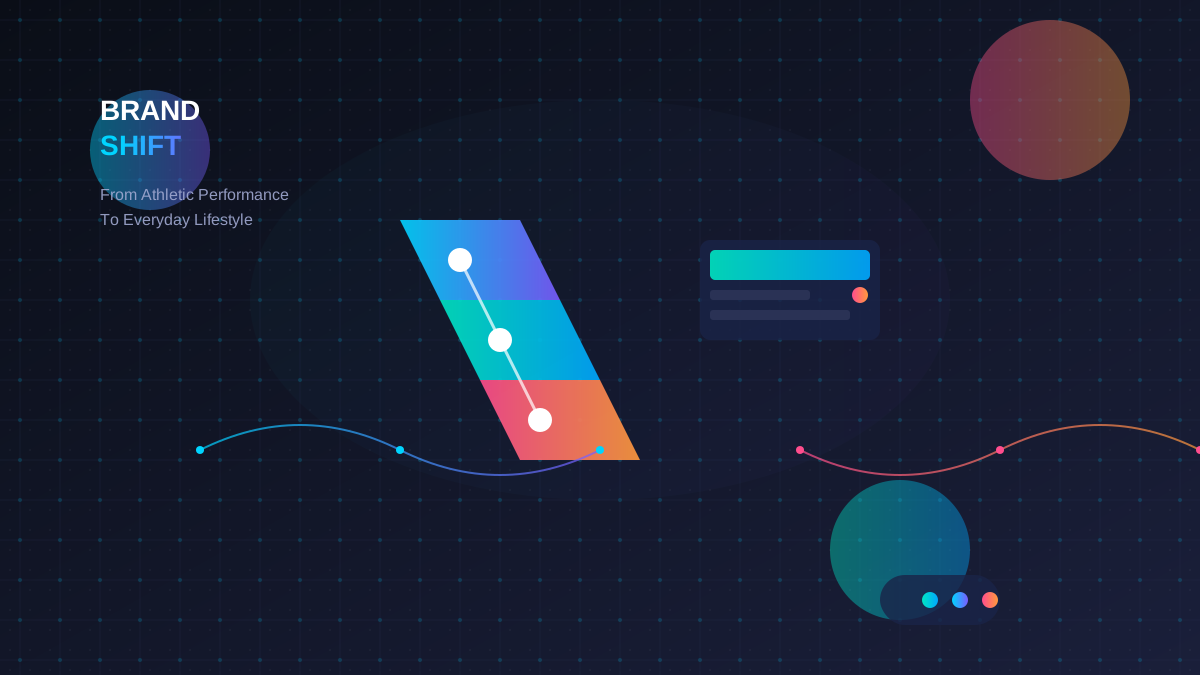
Why is a 60-Year-Old Sports Icon “Descending” to Attack the Everyday Market?
Simple answer: because its core customer base is no longer athletes. When up to 60% of buyers purchase it just for commuting to work, long flights, or even alleviating hangovers, continuing to confine itself to the gym is tantamount to commercial self-deception. This is not brand extension; it is the brand’s acknowledgment of reality.
Gatorade’s transformation, superficially an adjustment in marketing rhetoric, is fundamentally a high-stakes gamble on “whether functionality can become daily.” Over the past sixty years, it successfully equated “sweating” with “electrolyte loss,” building an impregnable professional barrier. But this barrier has now become a ceiling. According to Mintel data, what drives market growth is no longer elite athletes pursuing 0.01-second improvements, but the general public outside the gym, equally anxious about hydration, energy, and health status. This is a market several orders of magnitude larger.
The more critical industry background is that the definition of “health” is being deconstructed and reassembled by technology. Apple Watch’s “Activity Rings,” Oura Ring’s “Readiness Score,” and various health apps tracking “water intake” are transforming the vague “feeling thirsty” into quantifiable data metrics. When hydration becomes a “health KPI” that can be monitored, reminded, and even scored, the provider of solutions is no longer just a “beverage” but a key node in a data feedback loop. Gatorade’s current pivot is precisely an attempt to leap from a mere “supplement supplier” into this data ecosystem war dominated by wearable devices and health platforms. What it aims to sell is not just a bottle of sugar water containing sodium, potassium, and magnesium, but a scientific solution for “non-exercise fluid loss.” The logic behind this mirrors that of tech companies shifting from selling hardware to selling services (like Apple’s services revenue)—moving from one-time product transactions toward continuous value delivery based on scenarios and needs.
From the Field to Life: How Do the Rules Differ in the New Battlefield?
The professional sports market and the mass health market are fundamentally two different games. The former values extreme performance, sponsorship prestige, and coach endorsements; the latter is dominated by convenience, flavor variety, ingredient transparency, and integration into life scenarios.
In the athlete market, Gatorade’s competitors are Powerade and specific sports nutrition products. But in this new battlefield of “daily hydration,” its competitors instantly multiply into the following categories:
- Traditional bottled water and sparkling water: Such as Evian, Perrier, and even its own group’s Aquafina.
- New functional beverage startups: Such as various DTC (direct-to-consumer) brands focusing on adaptogens and sugar-free options.
- Electrolyte supplements and powders: Such as Liquid I.V. and DripDrop, which are more portable and offer more flexible sugar control.
- Smart water bottles and hydration reminder technology: Such as HidrateSpark, which directly address drinking habits at the “container” level.
Facing such a complex competitive landscape, Gatorade cannot just change packaging and slogans. It must reconstruct its value chain. The table below compares its core strategy differences in the two markets:
| Dimension | Traditional Athlete Market Strategy | New Mass Daily Market Strategy |
|---|---|---|
| Value Proposition | Enhance extreme sports performance, accelerate recovery | Maintain daily well-being, prevent dehydration, manage mild discomfort (e.g., travel fatigue) |
| Communication Channels | Team sponsorships, athlete endorsements, event exposure | Social media health influencers, workplace wellness programs, travel retail channels |
| Product Development Focus | Osmolality, carbohydrate types, sport-specific formulas | Low-sugar/no-sugar options, diverse flavors, convenient packaging (e.g., small sizes, easy-open caps) |
| Purchase Decision-Makers | Sports teams, professional coaches, core sports enthusiasts | Individual consumers, household shoppers, corporate procurement |
| Technology Integration Points | Sports science lab data, sweat analysis | Data sync with health apps (Apple Health, Google Fit), integration with wearable device hydration reminders |
The difficulty of this transformation lies in Gatorade’s need to make its products “approachable” without diluting its professional prestige. This requires extremely precise market segmentation and messaging. For example, it may need to develop clearer sub-product lines: one is the极致专业化的 “Gatorade Pro,” continuing to solidify its sports殿堂 status; the other is the简约设计的 “Gatorade Everyday,” targeting supermarket shelves and delivery platforms.
Who Are the Winners and Losers in This Quiet Revolution?
Every major brand’s strategic pivot creates ripple effects across the industry chain, creating new beneficiaries and those under pressure.
Potential Winners:
- Retail channels and e-commerce platforms: A broader customer base means more frequent purchases and greater shelf space demand. Hypermarkets like Carrefour and PX Mart, as well as instant delivery platforms like foodpanda and Uber Eats, will gain a strongly promoted daily consumer category.
- Health data platforms and wearable device companies: As mentioned, Gatorade needs to digitize and contextualize “hydration” behavior. This creates excellent opportunities for data integration and business collaboration with platforms like Apple Health, Fitbit, and Garmin. Future scenarios may include “Apple Watch detects you are at risk of dehydration, suggesting you purchase a bottle of Gatorade Fit at a nearby 7-Eleven” contextual push notifications.
- Ingredient suppliers and packaging innovation companies: Demand will rise for more diverse flavors (natural flavors), healthier formulations (rare minerals, vitamins), and eco-friendly, convenient packaging.
Potential Losers:
- Other traditional sports drink brands: Such as Coca-Cola’s Powerade, forced to follow this赛道扩张 it may not be prepared for, otherwise risking market share erosion.
- Vaguely positioned “light functional” beverages: Many brands touting “micro-supplementation” or “light energy” slogans but lacking strong scientific backing will face direct competition from the giant.
- Pure bottled water brands: If Gatorade successfully educates the market on the necessity of “daily electrolyte supplementation,” some premium bottled water markets may be replaced by more cost-effective functional beverages.
To more clearly depict the industry ecosystem changes triggered by this transformation, we can use the following mind map to illustrate its辐射影响:
mindmap
  root(Gatorade Strategy Pivot)
    (Technology Integration Driven)
      ::icon(fa fa-microchip)
      Health Data Platform Collaboration<br>(Apple Health, Google Fit)
      Wearable Device Contextual Integration<br>(Dehydration Alert → Purchase Suggestion)
      IoT Smart Inventory Management<br>(Real-Time Restocking & Promotions)
    (Market Landscape Reshuffle)
      ::icon(fa fa-chart-line)
      Winners
        Retail & Delivery Channels
        Health Tech Platforms
        Ingredient & Packaging Innovators
      Losers
        Slow-to-Follow Competitors<br>(e.g., Powerade)
        Vaguely Positioned Light Functional Drinks
        Some Premium Bottled Water Brands
    (Product & Marketing Transformation)
      ::icon(fa fa-product-hunt)
      Dual Product Lines<br>(Pro Series vs. Everyday Series)
      Marketing Scenarios Lifestyle-Oriented<br>(Office, Travel, Parenting)
      Communication Science Popularization<br>(Daily Importance of Electrolytes)
How Will Technology and Data Determine the Success or Failure of the Transformation?
Without technology and data, this transformation is merely a traditional packaging redesign. The real deciding factor lies in whether Gatorade can successfully build a “data-based personalized hydration service.”
Imagine a scenario: A consumer’s Garmin watch detects higher-than-usual sweat loss today (possibly due to hot weather or light activity). After data syncs to Gatorade’s app, the app not only reminds hydration but also recommends a low-sugar Gatorade Zero based on their activity patterns and historical preferences, providing nearby convenience store inventory locations and a专属的 electronic coupon. After drinking, the consumer can scan a QR code on the bottle to log the ingested electrolyte and water data back into the health app, completing the data loop.
Realizing this scenario relies on integration across several key technological layers:
- API ecosystem打通: Establishing bidirectional data transmission agreements with mainstream health platforms.
- Edge computing and context awareness: Using sensors from phones or wearables to more accurately determine hydration need scenarios (e.g., working in an air-conditioned office vs. commuting outdoors).
- Dynamic supply chain and recommendation engine: Combining location, personal health data, and real-time inventory for precise product recommendations and promotions.
According to a survey on health tech applications, personalized nutrition advice integrating external data (like wearable device data) has over 3 times higher user retention than普通应用. This is precisely the metric Gatorade must pursue: transforming one-time beverage buyers into long-term engaged “health solution subscribers.”
The table below展望了 future possible levels of technology-integrated services:
| Service Level | Function Description | Potential Tech Partners |
|---|---|---|
| Basic Level: Data Visualization | Automatically log Gatorade product成分 (electrolytes, carbs) into health apps | Apple Health Kit, Google Fit, Samsung Health |
| Advanced Level: Contextual Reminders | Push personalized hydration reminders and product suggestions based on activity, weather, sleep data | Garmin, Fitbit, Oura Ring, Weather Data APIs |
| High Level: Closed-Loop Service | Detect need → Recommend product → Navigate to purchase point → Complete payment → Log intake → Evaluate效果 | Map services (Google Maps), mobile支付 (Apple Pay), retail IoT sensors |
What Are the Implications for the Taiwan Market and Tech Industry?
Gatorade’s global strategy will undoubtedly influence its operations in Taiwan. As a mature market for functional beverages (from保力达B to various electrolyte supplements), Taiwanese consumers may be more receptive to such transformations, but competition is equally fierce.
Unique aspects of the Taiwan market include:
- High-density convenience stores: 7-Eleven, FamilyMart, etc., are the main battlegrounds for beverage consumption. Precise communication on shelves for specific scenarios like commuting, night shifts, and fieldwork is crucial.
- High penetration of delivery platforms: Partnerships with foodpanda and Uber Eats are not just sales channels but entry points for即时性 health needs (e.g., sudden fatigue, hangovers).
- Strong local brands: Companies like HeySong and Vitalon have related products, with deeper understanding of local consumer habits and potentially more agile responses.
For Taiwan’s tech industry, this is an excellent entry point. Local优秀的 app developers, IoT startups, and data analytics companies can assist international or本土 brands in creating more接地气的 “smart hydration” solutions. For example, integrating部分匿名 data from Taiwan’s National Health Insurance app (under regulatory compliance) to analyze potential dehydration risks across different regions and age groups, combined with regional beverage delivery services.
From a broader industry perspective, Gatorade’s case reveals a universal trend: all traditional consumer goods are being reshaped by the two forces of “data empowerment” and “scenario重构.” The next颠覆的 could be vitamins, sleep aids, or even coffee. This provides vast跨界整合 opportunities for Taiwan’s hardware manufacturing (sensors), software services, and data application companies. We are no longer just OEM-ing bottle caps or beverage machines but have the opportunity to participate in defining the service standards and data protocols for the next generation of “smart health consumer goods.”
timeline
title Gatorade Brand Positioning & Tech Integration Evolution
    section Professionalization Era
        1965-2000 : Sports Science Endorsement<br>Lab Data Backing<br>Sponsorship of Top Events
    section Mass Market Germination
        2000-2020 : Launch of Low-Cal Series (G2)<br>Entry into Chain Supermarkets<br>Flavor Diversification
    section Digital Transformation
        2020-2026 : Acquisition of Health Data Startups<br>Pilot Integration with Fitness Apps<br>Release of Hydration Studies Integrating Wearables
    section Ecosystem War (Future)
        2026- : Full Embrace of Health Platform APIs<br>Launch of Context-Aware Subscription Services<br>Integration with Smart Home Appliance/Car Scenarios
Conclusion: This Is Not Just a Beverage Transformation, but an Industry Rehearsal
Gatorade’s shift from “For Athletes” to “For Anyone with a Need to Hydrate” holds significance far beyond the beverage industry. It is a clear战报 from the consumer market frontline: the democratization of专业功能, the daily integration of health management, and the servitization of product value are irreversible trends.
The key to success lies in whether technology can translate deep sports science积累 into simple solutions that the general public can perceive, trust, and seamlessly integrate into daily life. This path is fraught with risks—potential brand dilution, data privacy challenges, or stumbling in the泥沼 of tech integration. But without taking this step, the brand risks being trapped on an island with光环 but stagnant growth.
For all of us observing the intersection of technology and consumption, this is an excellent case study. It reminds us that the next wave of product innovation will increasingly come not from纯粹 physical or chemical breakthroughs in labs, but from profound insights into human behavior data and the systemic ability to weave hardware, software, services, and content into全新体验. This quiet revolution始于 sports drink shelves will ultimately resonate in every corner of the consumer tech industry.
FAQ
Why is Gatorade shifting from athletes to general consumers?
Market data shows that up to 60% of sports drink buyers are not athletes but ordinary consumers seeking daily hydration and health functions, indicating a structural shift in the brand’s core market and forcing Gatorade to reposition to capture the larger health and lifestyle market.
How will this transformation affect other sports nutrition brands?
It will trigger a chain reaction, forcing competitors like Powerade and BodyArmor to follow suit, potentially squeezing market space for peripheral categories like bottled water, electrolyte powders, and smart water bottles, accelerating the integration and technological advancement of the entire hydration solutions market.
How will technology and AI influence this beverage brand transformation?
The success of the transformation will heavily rely on data and personalization technology. The brand needs to create personalized hydration recommendations and seamless purchase experiences through app integration, wearable device connectivity, and AI-driven nutrition insights.