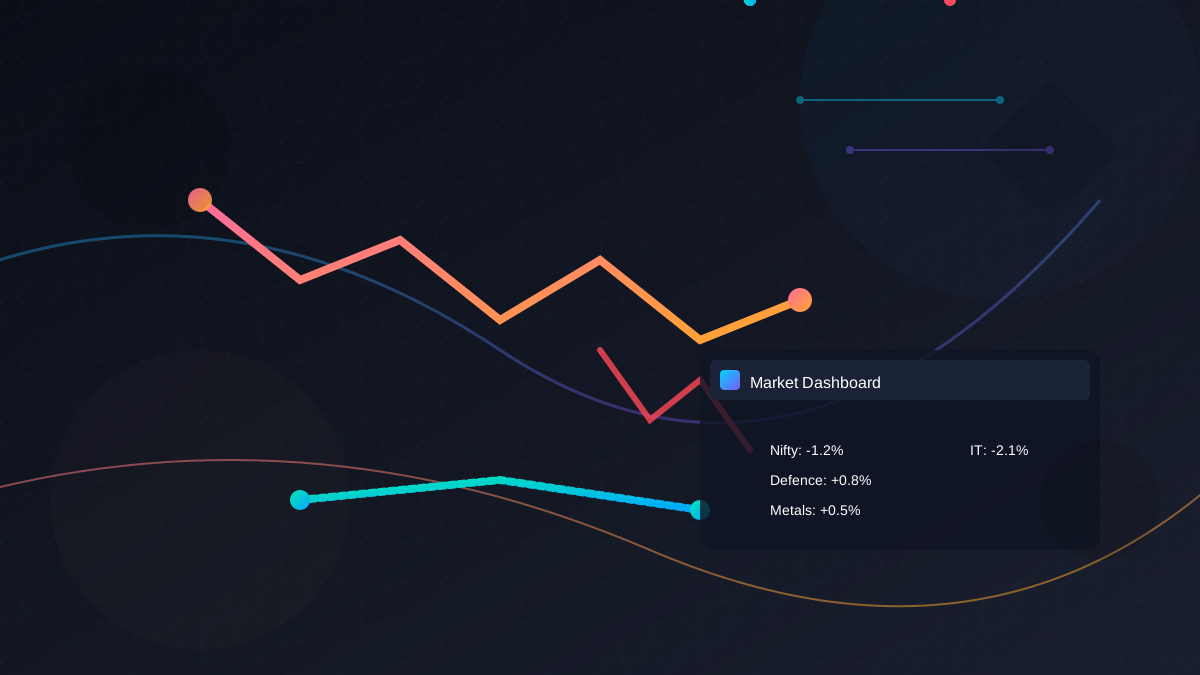
The Fading Software Myth: Why Is the Market Starting to Take Profits in Pure IT Services?
Direct answer: Because the market realizes that the AI transformation narratives of many traditional IT services companies cannot translate into matching profit growth and valuation support in the short term. As AI moves from concept to large-scale deployment, the massive capital expenditure, specialized hardware, and underlying infrastructure required instead highlight the limitations of pure software service business models. Investors are voting with their feet, withdrawing funds from overvalued stocks with ambiguous growth momentum.
The weakness in Wipro’s stock price post-earnings is a highly representative case. The company announced a share buyback plan of up to 150 billion rupees, theoretically a strong confidence signal, but the market did not buy it. The message behind this is brutal and clear: in the current tech investment environment, financial maneuvers can no longer mask the structural challenges facing core businesses. Investors are asking: How deep is the moat of your AI solutions? How much pricing power do you retain under pressure from cloud giants and open-source models? How much of your revenue growth comes from genuine technology premiums versus headcount expansion?
We are witnessing a comprehensive revaluation of tech stock valuations. The table below compares the valuation drivers and pressures faced by different types of tech companies in the current market environment:
| Company Type | Traditional Valuation Core | Current AI Transformation Pressures | Market Sentiment Shift |
|---|---|---|---|
| Traditional IT Services (e.g., Wipro, Infosys) | Long-term contracts, stable cash flow, human resource scale | AI automation erodes margins of traditional businesses; lack of proprietary AI platforms, becoming dependent on cloud vendors | Revalued from “stable growth stocks” to “structurally challenged stocks” |
| Pure Software SaaS | Subscription revenue, high gross margins, market share expansion | Generative AI features become standard, increasing product differentiation difficulty; facing competition from giants integrating AI | Adjusted from “hyper-growth” expectations to “steady growth,” with higher profitability demands |
| AI Hardware & Semiconductors | Technology leadership cycles, production capacity advantages, ecosystem lock-in | Geopolitics cause supply chain fragmentation, capital expenditure surges, but demand certainty is extremely high | Revalued from “cyclical stocks” to “strategic asset stocks,” tolerating higher P/E ratios |
| Critical Materials & Defense Tech | Resource scarcity,特许经营权, government orders | Demand benefits from叠加 of multiple tech and strategic trends, but expansion cycles are long, ESG scrutiny is strict | Revalued from “cyclical value stocks” to “strategic resource stocks,” focusing on long-term contract visibility |
This revaluation is not an isolated event. According to a Gartner report at the end of 2025, over 65% of global corporate investment in generative AI ultimately flows to cloud infrastructure, AI accelerator chips, and data center construction, rather than top-layer application development or consulting services. This massive capital expenditure is reshaping the profit distribution map of the tech industry.
flowchart TD
    A[AI Investment Wave Enters New Phase] --> B{Capital Flow Decision}
    B --> C[Software & IT Services Layer]
    B --> D[Hardware & Physical Assets Layer]

    C --> C1[Valuation Pressure Sources<br>1. Intensifying Homogeneous Competition<br>2. Unclear AI Monetization Paths<br>3. High Cloud Platform Commissions]
    C1 --> C2[Market Reaction: Profit Booking<br>Capital Outflow]

    D --> D1[Value Revaluation Drivers<br>1. Supply Chain Autonomy Demand<br>2. Geopolitical Premium<br>3. Physical Capacity Scarcity]
    D1 --> D2[Market Reaction: Bargain Hunting<br>Capital Inflow]

    C2 --> E[Result: Severe Sector Divergence<br>Tech Investment Paradigm Shift]
    D2 --> E
From Chips to Mines: Why Are Defense and Metals Becoming the New “Tech Safe Havens”?
Direct answer: Because they represent the “physical foundation” indispensable for the AI and digital revolution. The defense industry is the ultimate integrator and buyer of cutting-edge technologies (AI, unmanned systems, space tech, cyber warfare); metal minerals are the raw material starting point for manufacturing chips, batteries, power grids, and all hardware. Against a backdrop of geopolitical tensions and global supply chain restructuring, these sectors have transformed from “old economy” representatives into “strategic assets” securing the future of technology, gaining valuation premiums.
The strength of defense stocks is not merely geopolitical risk hedging. Modern defense is thoroughly technological. From AI-driven intelligence analysis, autonomous drone swarms, electronic warfare systems to hypersonic weapons, each is built on massive software-hardware integration and advanced manufacturing capabilities. Defense budgets thus become key drivers for cutting-edge tech R&D and application. Taking the U.S. FY2026 defense budget as an example, funding for research, development, test, and evaluation hit a record high, focusing precisely on microelectronics, hypersonics, artificial intelligence, and cyber capabilities. Which companies will this funding ultimately flow to? Not only traditional defense contractors but also top chip designers, software developers, and new material suppliers.
The logic for metals is equally profound. Electric vehicles and energy transition require lithium, cobalt, nickel; grid construction requires copper; and the manufacturing of all advanced semiconductors离不开 rare earth elements (for magnets, polishing), gallium, germanium, and other critical materials. The explosive growth in AI computing demand directly pushes up demand for these physical resources. The International Energy Agency (IEA) clearly stated in its “Critical Minerals Market Review 2025” that the mineral demand intensity of an advanced data center is several times that of a traditional data center. However, the mining, refining, and processing of these resources are highly concentrated, and capacity expansion is slow, creating structural supply-demand tension and pricing power.
| Critical Material | Primary Tech Application Scenarios | Supply Concentration Risk (Top 3 Producer Share) | Relevance to AI/Digitalization |
|---|---|---|---|
| Rare Earths (Neodymium, Praseodymium, etc.) | Permanent magnet motors (EVs, wind turbines), hard drives, military equipment | ~85% (China dominates refining) | High - Core of electrification and high-performance motors |
| Copper | Electrical wiring, EV motors, data center power distribution | ~40% (Chile, Peru, Congo) | Very High - Foundation of electrification, AI compute centers consume large amounts of copper |
| Lithium | Lithium-ion batteries (EVs, energy storage) | ~75% (Australia, Chile, China) | High - Energy foundation supporting mobile and distributed AI computing |
| High-Purity Silicon | Semiconductor wafers | ~70% (China, Norway, Brazil) | Very High - Base material for all digital chips |
| Gallium | Compound semiconductors (for 5G RF, optoelectronics) | Over 95% (China dominates refining) | High - Key for high-frequency communication and optical sensing |
This shift in thinking from “software-first” to “hardware and materials as foundation” is redefining tech company competitiveness. A company that cannot clearly articulate control over or partnerships in critical supply chains in its technology roadmap will struggle to gain favor in future capital markets.
How Has Geopolitics Become the Most Important Fundamental for Tech Stocks?
Direct answer: Geopolitics has transformed from an external risk variable into a core fundamental affecting tech companies’ revenue growth, cost structures, R&D roadmaps, and valuations. It determines market access, technology acquisition, supply chain security, and capital flows. Tech firms perceived as having “geopolitical resilience” or serving “national strategies” are receiving unprecedented valuation premiums.
In the Nifty market, stocks related to India’s domestic infrastructure, energy autonomy (e.g., NTPC, ONGC), and defense showed relative stability, which is no coincidence. This reflects that in a multipolar, increasingly competitive world, state capital and policies are strongly guiding economic development direction. “Technological sovereignty” is no longer just a slogan but actual budget expenditures and procurement lists for various countries. For tech companies, this means two parallel tracks: one is fierce competition in the global consumer market, the other is a strategic market with regional protectionist characteristics serving various governments’ “autonomous and controllable” needs.
The latter may have higher profit margins and less demand volatility, as it is driven by long-term strategic needs rather than short-term consumer business cycles. This explains why even amid expectations of a potential slowdown in global tech spending, hardware and infrastructure companies in specific fields remain favored. Their clients are nations and large strategic enterprises, with long order visibility and few alternative suppliers.
Taking semiconductors as an example, the U.S. CHIPS and Science Act, the EU’s European Chips Act, and similar subsidy plans in India, Japan, and other countries are催生 dozens of new wafer fabs globally. This is not just产能 expansion but a battle over technology standards, patent ecosystems, and future AI hardware architecture话语权. The diagram below simplifies how geopolitics is reshaping the decision logic of global tech supply chains:
mindmap
  root((Geopolitics<br>Reshapes Tech Chains))

    (Policy-Driven)
      (National Subsidies & Tax Incentives)
        (Guide Capital to Domestic R&D & Manufacturing)
      (Export Controls & Tech Bans)
        (Force Supply Chain "Friend-Shoring"<br>or "Localization")
      (Government Procurement Priorities)
        (Create Protected Domestic Markets)

    (Corporate Strategy Responses)
      (Supply Chain Diversification)
        (Increase Costs but Enhance Resilience)
      (Dual-Track Technology Roadmaps)
        (Develop Different Versions for Different Markets)
      (Geopolitical Risk Pricing)
        (Incorporate Risk Premiums in Product Pricing & Contracts)

    (Capital Market Pricing)
      ("Resilience Premium")
        (Assign Higher Valuations to Companies with Secure Supply Chains)
      ("Strategic Value Revaluation")
        (PE Ratios Revised Upward for Defense, Energy, Critical Materials Companies)
      ("Regional Market Discount")
        (Companies Overly Concentrated in Single<br>High-Risk Regions Face Pressure)
Within this framework, the situation of Taiwan’s tech industry becomes particularly complex and critical. Taiwan possesses the world’s most advanced semiconductor manufacturing cluster, the undeniable core of the AI hardware revolution. This brings immense strategic value and economic benefits but also accompanies extremely high geopolitical risk concentration. Global capital, when allocating tech assets, will inevitably assess and hedge “Taiwan risk” as a key variable. This may prompt more international clients and investors to demand Taiwanese manufacturers accelerate global capacity布局, and also give Taiwan’s domestic defense and critical infrastructure tech companies a new perspective for scrutiny.
Implications for Investors and Tech Workers: Where to Look Next?
Direct answer: For investors, portfolios should shift from a “broad tech” concept to focus on sub-sectors with “hardware moats, access to critical materials, or clear alignment with national strategies.” For tech workers, skill development must emphasize software-hardware integration, supply chain management, and fields meeting strategic industry needs (e.g., semiconductor processes, battery technology, systems engineering).
The tech winners of the next five years may not be the teams creating the coolest apps, but those solving the toughest physical problems: How to manufacture advanced chips with lower energy consumption and cost? How to efficiently recover rare earths from electronic waste? How to design infrastructure systems that resist cyber attacks while integrating AI? These challenges require deep interdisciplinary integration capabilities.
Investors can focus on several specific trends:
- AI and Simulation-Driven R&D: Using AI to accelerate new material discovery, chip design, and process optimization. The value of such software companies will be tied to their penetration depth into physical industries.
- Energy and Computing Synergy Innovation: The design of next-generation data centers and AI factories must place energy efficiency (cooling, power distribution) at the core. Related power management and cooling technology companies will benefit.
- Modular and Open Hardware Architectures: To address supply chain uncertainty and rapid technology iteration, open architectures like RISC-V, and reconfigurable, easily maintainable hardware designs will become more popular.
The table below lists tech investment themes worth watching and those requiring caution under the current paradigm shift:
| Investment Theme | Core Logic | Risk Factors | Representative Focus Areas |
|---|---|---|---|
| AI Hardware Infrastructure | AI computing power demand grows rigidly, the “power plant” of the digital economy | Massive capital expenditure, fast technology iteration, geopolitical supply chain disruptions | Advanced packaging, HBM memory, optical interconnects, liquid cooling solutions |
| Critical Materials & Resource Recycling | Supply growth slower than demand, rising strategic reserve needs | High price volatility, increasing ESG standards, long new mine development cycles | Rare earth refining, lithium extraction tech, urban mining (e-waste recycling) |
| Defense & Space Tech | Stable budget growth, the ultimate testing ground for cutting-edge tech integration | Strict regulation,单一客户 (governments), long project cycles | Satellite communications, unmanned systems, cybersecurity, space situational awareness |
| Themes Requiring Caution | |||
| Pure Software AI Applications | Relatively lower entry barriers, facing competition from giants’ built-in features | Low user stickiness,单一 monetization models, increasing regulatory risks | Homogeneous copy/image generation tools, marketing automation SaaS |
| Traditional IT Outsourcing Services | AI automation erodes mid-to-low-end business, profit margins under pressure | Slow transformation speed, painful talent structure adjustment period | Traditional system integration relying mainly on headcount expansion for growth |
In summary, this seemingly ordinary fluctuation of the Nifty index in the spring of 2026 actually sounds an alarm and points in a direction. It tells us that the light-asset, high-valuation software story has reached a point where it needs to deliver substance.