A Loss-Making Luxury Car and a Distant Robotaxi Dream: Lucid’s Survival Paradox
Lucid Motors has once again proven that in today’s capital markets, a dazzling future narrative is no longer sufficient to offset the chill brought by poor current financial performance. In the first quarter of 2026, this luxury electric vehicle manufacturer, once seen as a potential challenger to Tesla, delivered a staggering report: revenue guidance of only $280 to $284 million, far below market expectations of $433.8 million—a gap of 35%; vehicle deliveries of just 3,093 units, over 40% short of the expected 5,237 units. Even more alarming is its quarterly operating loss approaching $1 billion. This means that for every vehicle Lucid delivers, it is burning through massive amounts of cash.
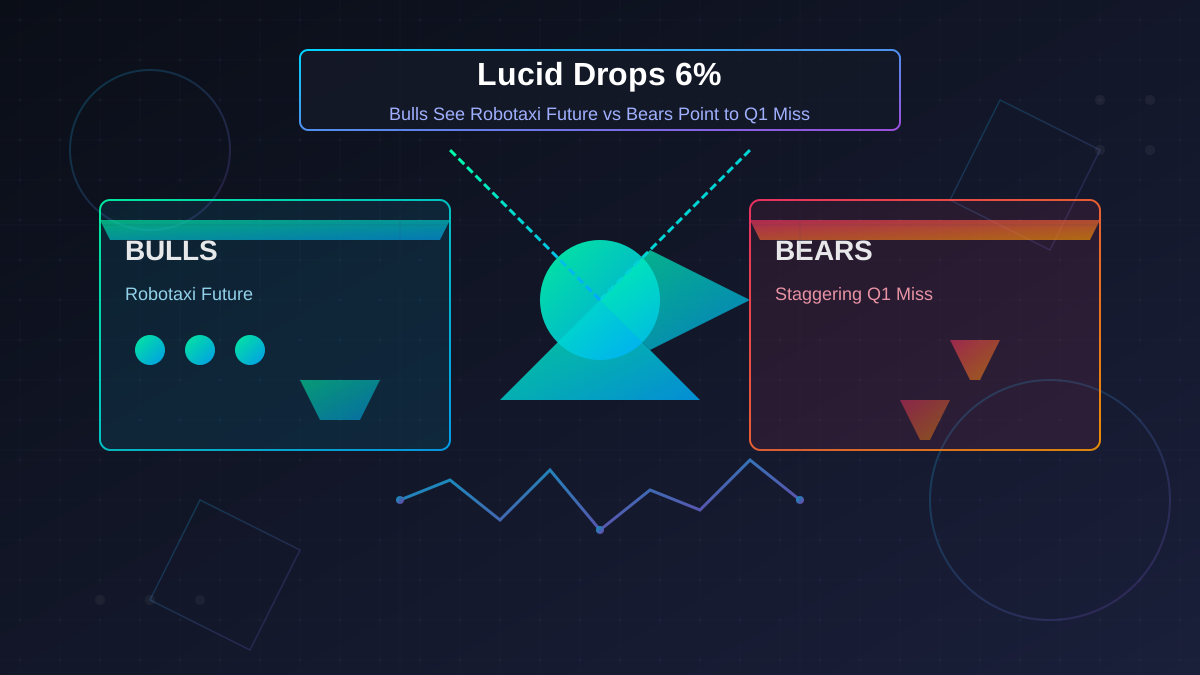
Yet, at the same time, the company announced two seemingly振奋人心的 news items: ride-hailing giant Uber committed an additional $200 million investment and signed an agreement to purchase up to 35,000 Lucid vehicles for future robotaxi services; additionally, Saudi Arabia’s Public Investment Fund (PIF) added $550 million in convertible note investment, along with $300 million raised from a public offering, bringing a total of $1.05 billion in new funding to Lucid. This creates an极其讽刺的对比: on one side, there is severe bleeding in the core business and a崩溃 in execution, while on the other, capital markets are still willing to pay for an unrealized “autonomous driving future.” This分裂 is the most typical investment paradox at the intersection of today’s technology and automotive industries.
Why Is the Market “Unmoved” by Massive Funding and Large Orders?
The answer is simple: credibility has been exhausted. For Wall Street and institutional investors, Lucid’s history of repeatedly failing to meet production and delivery targets casts a巨大问号 over any future promises. Uber’s order is “意向性,” contingent on Lucid producing vehicles that meet autonomous specifications and the autonomous driving technology itself reaching commercialization levels—both premises appear充满变数 in 2026. The continuous输血 from Saudi PIF is more interpreted as part of geopolitical and national strategic布局 (Saudi Arabia is Lucid’s largest shareholder, and its “Vision 2030” requires a domestic EV industry), rather than a纯市场化背书 of Lucid’s business model success.
Investors are more focused on the structural problems revealed by冰冷的财务数字. We can see the致命伤 in Lucid’s operational efficiency through the following table:
| Financial & Operational Metrics | Lucid Q1 2026 Actual Performance | Market Expectations / Benchmark | Issues Revealed |
|---|---|---|---|
| Revenue | $282 million (median) | $433.8 million | Demand or产能严重不如预期,growth narrative破灭 |
| Vehicle Deliveries | 3,093 units | 5,237 units | Supply chain极度脆弱 (second-row seat supplier断供 for 29 days) |
| Quarterly Operating Loss | Approximately $980 million | — | Cash burn rate未见改善,diseconomies of scale |
| 2025 Free Cash Flow | -$3.8 billion | — | Astonishing cash consumption,highly dependent on external financing |
| Stock Price Drop from Peak | -96% | — | Market confidence濒临崩溃 |
This table赤裸地显示 that Lucid remains trapped in a恶性循环 of “the more it produces, the more it may lose.” While its AMP-1 factory in Arizona has increased capacity, yield rates, supply chain management, and cost control are clearly更大的瓶颈.
How Can a Single Bolt in the Supply Chain Shake the Future of a Billion-Dollar Company?
Lucid attributed the delivery shortfall to a 29-day断供 from a “second-row seat supplier.” This sounds like an isolated incident, but for资深产业观察者, it is a典型症状 of a startup automaker’s “Achilles’ heel.” Unlike Tesla, which built vertical integration and强势话语权 in the supply chain after经历磨难, and unlike traditional automakers with their采购规模 and backup systems, latecomer luxury brands like Lucid have weak bargaining power in the supply chain, high dependence on single suppliers, and any环节出错 directly leads to production line停摆.
Making matters worse, Lucid simultaneously announced a recall of 3,627 units of the 2024-2026 Air Pure RWD models due to potential loosening of half-shaft bolts connecting the drive unit. This is not just a financial cost (recall repairs) issue but a direct打击 to the brand’s “luxury” and “high-quality” positioning. When consumers pay a high premium for a Lucid Air, they expect craftsmanship and reliability超越特斯拉, not basic mechanical defects. This recall,叠加 with supply chain issues, severely侵蚀了市场对其制造能力的信任.
mindmap
  root(Lucid Q1 Crisis Core:<br>Supply Chain Fragility)
    (Production Disruption)
      直接原因: Single Seat Supplier断供29天
      根本原因: Small采购规模,Low议价权<br>Lack of Backup Supplier System
      影响: Delivery Volume暴跌41%,Revenue不如预期
    (Quality Crisis)
      事件: Half-Shaft Bolt Defect Recall 3,627 Vehicles
      根源: Manufacturing Process or Part Quality Control疏失
      冲击: Luxury Brand Image受损<br>Potential Safety Concerns Affect Sales
    (Financial & Trust Chain Reaction)
      结果1: Revenue巨额短缺,Losses加剧
      结果2: Market Loses Confidence in Execution & Management Capability
      结果3: Even with New Funding, Investors Focus More on<br>Its Ability to Solve These Fundamental Operational Issues
This mind map clearly reveals how a seemingly局部 supply chain or quality control issue can, through连锁反应, ultimately动摇 the company’s financial foundation and market confidence. For Lucid, increasing production numbers is no longer the primary task; building a resilient supply chain and an impeccable quality management system is the生存之本.
Uber’s 35,000-Vehicle Order: A Lifeline or a Mirage?
Uber’s agreement无疑为 Lucid’s stock story provides new想象空间: transitioning from a “luxury electric vehicle manufacturer” to a “vehicle and technology supplier for autonomous mobility services (Robotaxi).” If this narrative materializes, the valuation model would shift from the cyclical automotive manufacturing industry to the software and services industry with network effects and recurring revenue. This is the典范转移 investors dream of.
However, let’s冷静拆解 the现实面 of this agreement:
- Order Nature: This is not an irrevocable purchase contract but an意向协议 with前提条件. Conditions include Lucid developing specific vehicle specifications that meet Uber’s autonomous service requirements and successful technology integration between both parties.
- Time Frame: Large-scale robotaxi commercialization deployment, even under the most optimistic forecasts, is at least post-2028. This means that for the next 2-3 years, this agreement cannot contribute any实质营收 to alleviate Lucid’s current losses.
- Competitive Landscape: Uber is not putting all its eggs in Lucid’s basket. It also collaborates with autonomous driving companies like Waymo and Motional, with a strategy to build an open platform with multiple suppliers. Lucid is just one of its future vehicle supplier options, and its autonomous driving technology (primarily developed in-house) has not undergone large-scale real-world testing, with maturity far落后于头部玩家.
- Own Burden: To meet Robotaxi需求, Lucid needs to invest additional R&D resources to modify vehicles, which will further increase its already high capital expenditures.
The table below compares Lucid’s main potential competitors in the Robotaxi赛道, highlighting the challenges it faces:
| Company | Autonomous Tech Approach | Vehicle Platform | Commercialization Progress | Advantages | Lucid’s Relative Disadvantages |
|---|---|---|---|---|---|
| Waymo | Vision+Lidar, Full Self-Driving | Jaguar I-PACE, Chrysler Pacifica, Future Own Brand | Already offers paid fully driverless services in SF, Phoenix | Tech领先,Most路测数据,Earliest商业化 | Tech成熟度落后数年,No actual运营数据 |
| Tesla | Vision-Only,渐进式演进 | Own Fleet (Model 3/Y, etc.) | FSD辅助驾驶付费订阅,Full Self-Driving Not Yet Realized | Massive existing fleet for data collection, Strong cost control | Different tech路线,Tesla prioritizes its own ecosystem |
| Cruise (GM) | Lidar & Sensor Fusion | Dedicated Origin Vehicle (No Steering Wheel) | Previously operated in SF, paused due to incidents, restarting | Backed by GM manufacturing & funding | Independent automaker,劣势 in manufacturing scale & cost |
| Lucid | Details not fully公开 | Plans to modify Lucid Air / Gravity | Only has协议,No timeline | Vehicle platform性能优异,Has Uber合作意向 | All aspects are in early or落后阶段 |
From the竞争分析, it’s clear that Lucid’s Robotaxi story is充满不确定性. Uber’s order, rather than being确定的未来营收, is more like an expensive “入场券,” allowing Lucid to stay in a game that may not see outcomes for another decade. But the question is, can Lucid’s cash reserves support it until then?
Is Saudi Capital a White Knight or a Stay of Execution?
The continuous加码 by Saudi Arabia’s Public Investment Fund (PIF) is an无法忽视的地缘政治因素 in Lucid’s story. PIF is not only the largest shareholder but also the关键金主 for Lucid’s ongoing operations. This $550 million convertible note,加上之前的注资, totals investments exceeding tens of billions of dollars.
This brings two层面的影响: Positive Side: Provides宝贵的流动性, giving Lucid more time to adjust operations, develop new vehicles (like the Gravity SUV), and invest in autonomous driving technology. PIF’s long-term strategic意图 (building an EV industry chain in Saudi Arabia) means less退出压力, offering management a relatively宽松的 “安全网.”
Risk Side:
- Moral Hazard: Management may lack紧迫感 for艰难改革 (e.g.,大幅裁员, renegotiating supply chain contracts) due to expectations of “无限输血.”
- Corporate Governance Concerns: Major company decisions might prioritize Saudi national strategy over单纯股东价值最大化.
- Double-Edged Sword for Market Confidence: When a company’s financing relies primarily on a single sovereign fund rather than public markets, it is seen as “非市场化生存,” which could反而吓退 other institutional investors, viewing its stock as a “policy tool” that has lost独立成长的 investment value.
From the following diagram of资金流向与战略意图, we can更清楚看到 the complex network Lucid is situated in:
flowchart TD
    A[Saudi PIF<br>National Strategic Investor] -- Invests Billions --> B[Lucid Motors<br>Operating Entity]
    B -- Provides Vehicles & Tech Blueprint --> C[Saudi Localized Production<br>(Future Plan)]
    C -- Achieves "Vision 2030"<br>Economic Diversification --> A

    D[Uber<br>Mobility Platform] -- $200M Investment + <br>35k意向 Order --> B
    B -- Dedicated Robotaxi Vehicles<br>(Future) --> E[Uber Autonomous Network<br>(Future Ecosystem)]
    E -- Enhances Platform Value & Efficiency --> D

    B -- Severe Losses<br>Cash Burn --> F[Public Market Investors]
    F -- Lack of Confidence<br>Stock Price Decline --> B

    subgraph “Lucid's Strategic Paradox”
        B
    end

    style A fill:#e1f5fe
    style D fill:#f3e5f5
    style F fill:#ffebee
This flowchart reveals that Lucid is caught between three forces: Saudi national strategy, Uber’s future ecosystem ambitions, and public market demands for profitability. Currently, the first two are输血 Lucid, attempting to counter the stock price pressure from the third force. The outcome of this tug-of-war will determine whether Lucid becomes a关键节点 connecting future mobility ecosystems or沦为 a costly industry教训.
Industry启示: The EV赛道 Enters a “残酷淘汰赛” Phase
Lucid’s困境 is not an孤例. It marks the end of a phase in the EV industry: the era when raising billions was easy with just a good story and a dazzling prototype is over. The market environment in 2026, with potentially different interest rates than the zero-rate era of 2021, has made investors more挑剔与务实.
The industry is entering the second phase of a “残酷淘汰赛,” where key success factors have shifted:
| Phase | Core Driver | Key Success Factors | Representative Companies (Then) | Current Challenges |
|---|---|---|---|---|
| Phase 1: Vision & Prototype (Around 2020) | Loose Capital, Story Narrative | Tech Innovation, Brand Building, Fundraising Ability | Rivian, Lucid, Multiple SPAC Mergers | Scaling prototype production and achieving positive gross margins |
| Phase 2: Scale & Efficiency (2026 Present) | Cash Flow, Profit Path | Supply Chain Control, Manufacturing Costs, Operational Efficiency, Clear Monetization Model | Tesla (Already Passed), BYD | Stop burning cash, prove business model sustainability |
| Phase 3: Ecosystem & Services (Future) | Software & Service Revenue | Autonomous Driving Tech, Energy Networks, Software Platforms, Data Monetization |