This Is Not Just Layoffs, but the Official Starting Gun for the Tech Industry’s “AI Pivot”
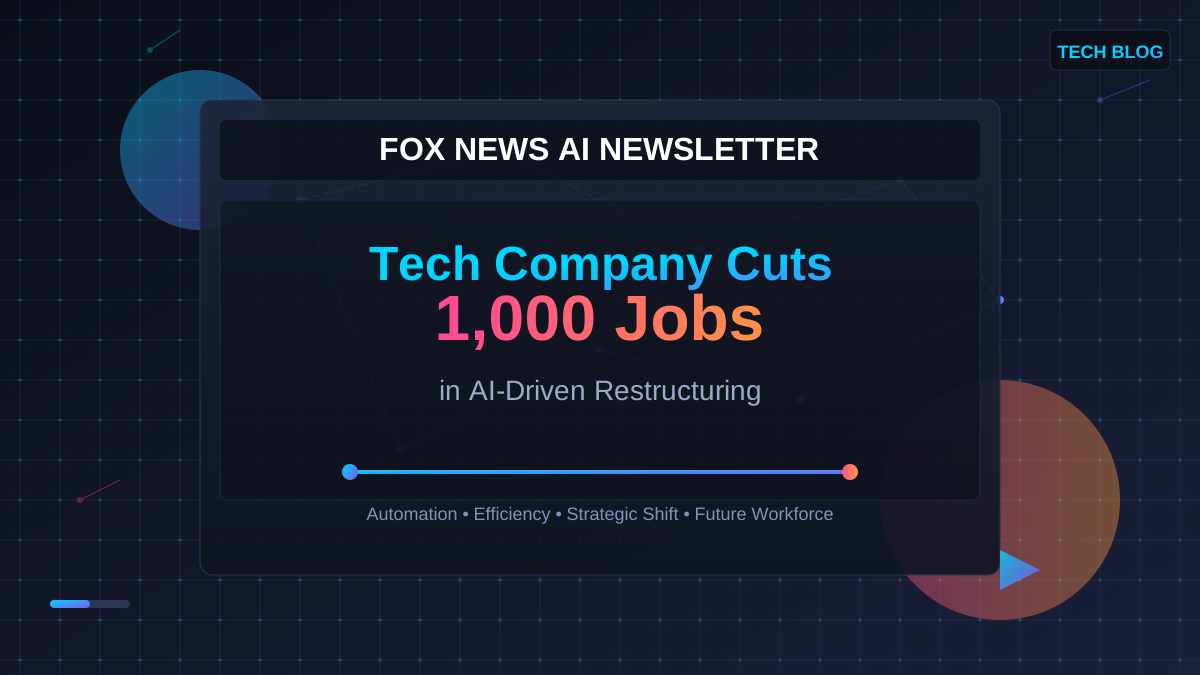
Snapchat’s parent company slashed thousands of positions at once, superficially a cost-control measure under financial pressure, but at its core, it’s a long-planned “AI pivot.” Over the past three years, tech giants’ investments in generative AI were mostly experimental or supplementary, but by 2026, the situation has changed. AI is no longer a toy for the “innovation department” but a “core engine” vital for survival. The deeper significance of these layoffs is that they mark a consensus among corporate leadership: future growth must, and can only, come from AI-driven efficiency improvements and business model innovation. Teams and functions that cannot directly contribute to this will be the first to go.
This is a painful but necessary process. We are moving from the “investment phase” of AI to the “profit phase,” with an inevitable “restructuring phase” in between. For investors, this might signal efficiency gains; for practitioners, it’s a severe test of skills and careers; and for the entire ecosystem, it means resources will concentrate at an unprecedented speed toward a few key AI domains.
What Are the Three Core Drivers of the AI Restructuring Wave?
Market pressure, technological maturity, and investor expectations converge, forcing tech companies to make tough choices.
First, slowing global economic growth and volatility in the advertising market have put pressure on social media platforms reliant on online ads. The era of relying solely on user growth dividends is over; profits must be squeezed from “smarter monetization” and “more efficient operations.” AI, especially generative AI’s applications in personalized advertising, content creation, and automated customer service, offers the most direct path.
Second, the technology stack for large language models (LLMs) and multimodal AI stabilized and became productizable in 2025-2026. The rapid catch-up of open-source models (like Meta’s Llama series) also lowered the barriers and costs of AI applications, making large-scale deployment “feasible and necessary” rather than just “possible.”
Finally, Wall Street has grown weary of the “AI story”; they want to see tangible financial impact. Cutting traditional teams while increasing AI budgets is the clearest signal to the market that “we are serious.” This is a brutal zero-sum game: resources are limited, so more for AI inevitably means less for other departments.
The table below compares key differences between traditional cost-cutting layoffs and AI-driven strategic restructuring:
| Comparison Dimension | Traditional Cost-Cutting Layoffs | AI-Driven Strategic Restructuring |
|---|---|---|
| Core Objective | Short-term financial improvement, meeting quarterly profits | Long-term competitiveness reshaping, betting on future tracks |
| Layoff Logic | Uniform/proportional cuts by department or cost center | Precise cuts based on skills and relevance to future business |
| Subsequent Investment | Generally frozen or reduced | Resources saved from layoffs reinvested in strategic areas like AI, cloud |
| Market Message | Company in trouble | Company undergoing difficult but proactive transformation |
| Impact on Employees | Company-wide morale generally dampened | Skill-mismatched employees eliminated, AI talent fiercely competed for |
| Typical Timing | During economic recessions or significant performance declines | During critical windows of technological paradigm shifts |
mindmap
  root(AI Restructuring Three Core Drivers)
    (Market and Profit Pressure)
      Slowing growth
      Advertising market volatility
      Investor demand for ROI
    (Technology Mature Enough for Deployment)
      LLM/Multimodal AI stabilizing
      Open-source models lowering barriers
      Cloud AI services proliferating
    (Organizational and Resource Reallocation)
      Diverting resources from maintenance businesses
      Tilting toward strategic AI teams
      Reshaping company skill trees
Who’s Next? Snap’s AI Restructuring Roadmap as a Blueprint for Tech Giants
Snap’s move is no isolated case; it’s more like a public blueprint, hinting at paths other social and consumer tech companies might take. The core logic is: shifting resources from “user growth and maintenance” to “deepening user value extraction and monetization efficiency.” This means teams not directly linked to core AI ad systems, personalized recommendation algorithms, or AI creation tool development will face scrutiny.
It’s foreseeable that Meta, Pinterest, and even TikTok may make similar adjustments. Meta has already undergone multiple restructurings under the slogan “year of efficiency,” but its massive investments in AI infrastructure (like custom chips) and the metaverse still require more resources, making further “focus” inevitable. For Google, the AI transformation of its search and ad businesses has been ongoing for years, with restructuring pressure likely manifesting more in dynamic resource balancing between the cloud division (Google Cloud) and hardware departments.
More noteworthy are second- and third-tier tech companies. Without the cash reserves of giants, they struggle more in the AI arms race. Snap’s layoffs may force them into more radical choices: either go all-in on a niche AI application scenario or seek acquisition. Over the next 18 months, we might see a wave of mergers and acquisitions centered on AI capabilities.
Who Typically Gets Laid Off? The Cruel Reality of the “Skill Gap” in the AI Era
This restructuring clearly draws a “skill gap line.” Those most affected are often in roles with high repetitiveness, partially or fully replaceable by AI tools or automated processes. This includes some content moderation, junior data labeling, traditional QA testing, and may extend to mid-level product operations, localized marketing, and even some general project management positions.
Conversely, demand for three types of talent will grow exponentially:
- AI/ML Core R&D Talent: Researchers and engineers capable of training, fine-tuning, and deploying large models.
- AI Productization and Application Talent: Product managers and developers who can translate AI capabilities into specific user features or business solutions.
- Data and Ethics Experts: Specialists who can manage high-quality datasets and design ethical, privacy-compliant AI systems.
According to LinkedIn’s late-2025 report, global demand for “generative AI skills” grew over 150% in the past year, while demand for “traditional digital marketing skills” grew only 15%. This supply-demand imbalance will further drive up salaries for top AI talent and intensify talent wars between large enterprises and startups.
The table below shows predicted changes in demand for key functions within tech companies before and after AI restructuring:
| Functional Area | Pre-Restructuring Demand Heat | Post-Restructuring Demand Heat | Key Shift |
|---|---|---|---|
| AI/ML Engineering and Research | High | Very High | Elevation from support role to core strategic department |
| Data Engineering and Science | Medium-High | High | Shift from analysis-oriented to AI model training and governance-oriented |
| Traditional Product Management | High | Medium | Requires added AI product thinking and technical understanding |
| Content Operations and Moderation | Medium | Low | Bulk of work replaced by AI pre-moderation and classification tools |
| User Growth and Marketing | High | Medium-High | Must master AI-driven personalized advertising and marketing automation |
| Legal and Compliance | Medium | Medium-High | New demands in AI ethics, algorithm transparency, and copyright compliance |
The Future of Products and Ecosystems: Smarter, but Also More Concentrated?
From the consumer perspective, the impact of this restructuring will be gradual but profound. Snapchat users may gradually notice AR filter creation becoming more intelligent and simpler (powered by AI generation), ad targeting becoming more precise (even eerily so), and customer service bots improving in problem-solving ability. These are potential fruits borne on the product side as resources tilt toward AI.
However, the flip side is risk concentration. When a company’s core competitiveness over-relies on a few AI models and algorithms, systemic risks increase. A major algorithm bias scandal, a critical model failure, or a disruptive new AI technology could impact the business more severely than before. Additionally, AI’s “black box” nature may make product decisions less transparent, exacerbating user concerns about privacy and manipulation.
For the developer ecosystem, platform companies’ AI restructuring also means opportunities and challenges coexist. Platforms may release more powerful AI APIs, enabling developers to build more innovative apps; but simultaneously, platforms might leverage their AI advantages to enter and dominate niche markets originally explored by ecosystem partners, intensifying “platform-partner coopetition” tensions.
timeline
    title AI Restructuring Impact Timeline on Product Ecosystem
    section 2026-2027
        User Experience Layer : AI-driven personalization reaches new heights<br>AR/content creation tools become intelligent
        Platform Risk Layer : Algorithm bias and privacy controversy incidents increase<br>Dependence on core AI models deepens
        Developer Ecosystem : Gain more powerful AI APIs<br>Face intensified direct competition from platforms
    section 2028+
        Industry Landscape Layer : Formation of 2-3 dominant AI platform ecosystems<br>Apps failing to AI-ify gradually marginalized
        Regulation and Society Layer : Global AI regulatory frameworks take initial shape<br>Skill retraining becomes a societal issue
Lessons for Taiwan’s Tech Industry: Crisis or Opportunity?
Snap’s layoff wave may seem distant, but it holds profound lessons for Taiwan’s tech industry, whether brand manufacturers, OEMs, or software service providers. Taiwan’s strengths lie in hardware manufacturing and supply chain management, but its voice is relatively weak in the AI software and service value chain. As global brand clients begin AI-centric restructuring, their expectations from the supply chain will no longer be just “cost, quality, delivery,” but also “intelligence, data, collaboration.”
For example, laptop OEMs may need to provide design solutions with built-in AI-optimized chips; server suppliers may need to collaborate with clients to optimize cooling and energy consumption for AI workloads; and software companies must prove their solutions seamlessly integrate into clients’ AI-driven workflows. This means Taiwan’s tech companies must also initiate their own “AI skill reshaping,” not just by forming AI teams but by permeating AI thinking into every link from R&D and manufacturing to sales.
Specifically, Taiwanese enterprises can start with the following:
- Invest in “AI + domain knowledge” composite talent, such as engineers who understand both semiconductor processes and machine learning.
- AI-fy internal processes as a training ground while boosting operational efficiency, which itself is a form of competitiveness.
- Actively participate in open-source AI communities and international standard-setting to avoid isolation in technological paths.
According to estimates from Taiwan’s Institute for Information Industry (MIC), Taiwan’s corporate investment in generative AI-related software and hardware will exceed NT$50 billion in 2026, with an annual growth rate over 40%. Whether this investment yields maximum returns hinges on whether it’s accompanied by deep organizational and strategic transformation resolve, akin to Snap’s.
Conclusion: Embrace the Pains, but Must See the Direction Clearly
Snapchat’s parent company laying off thousands is a loud alarm bell and a clear roadmap. It declares the end of the old paradigm centered on “user growth” in the tech industry, ushering in a new paradigm centered on “AI-driven unit economic efficiency.” This process will inevitably be accompanied by pains, uncertainties, and chaos in talent mobility.
For business operators, the question is no longer “whether to do AI” but “how and with what level of determination to restructure the organization to embrace AI.” For tech workers, lifelong learning is no longer a slogan but a survival necessity; they must proactively align their skill trees with AI. For society as a whole, we need to start seriously considering how to build more robust social safety nets and skill retraining systems to cushion the employment shocks from this technological revolution.
Over the next two years, we will witness more companies embarking on this restructuring path. Those that treat AI as mere decoration, unwilling to touch core organizational and resource allocation, may quietly fall behind in the next round of competition. This AI-driven restructuring has only just begun.
Further Reading
- LinkedIn 2025 Workplace Learning Report: AI Skill Demand Surges (Focuses on global skill supply-demand changes)
- McKinsey: The Economic Potential of Generative AI (Analyzes AI impact from a macroeconomic perspective)
- Stanford HAI AI Index Report 2026 (Authoritative annual report on AI industry development and investment trends)
{
  "image_prompt": "A conceptual, futuristic illustration depicting the tension between human workforce and AI-driven restructuring in a tech company. On the left, stylized human figures with puzzle pieces missing from their silhouettes, walking away from a traditional office building that is partially deconstructing into digital cubes. On the right, a luminous, complex neural network or circuit board pattern is growing and absorbing resources, with keywords like 'Machine Learning', 'LLM', and 'Automation' integrated into the design. The overall tone is dynamic, slightly tense, with a blue and grey color scheme accented by neon orange or yellow highlights. The style is clean, vector-based with"
}