Is This Truly the “iPhone Moment” for Smartphones?
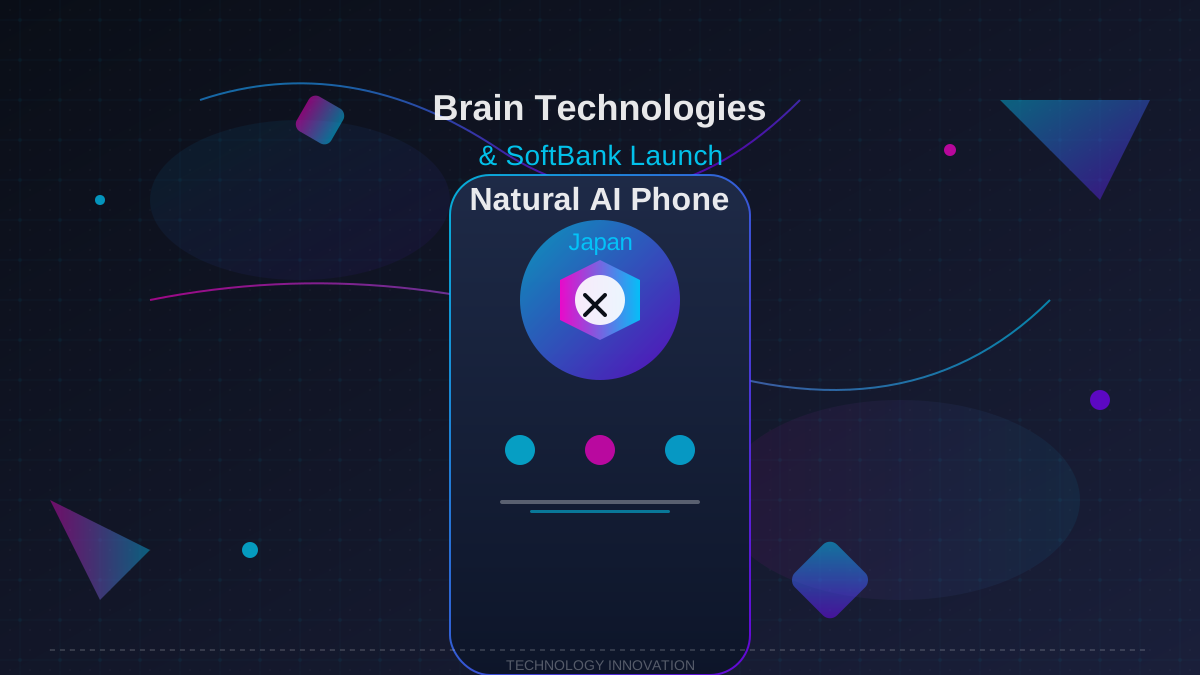
Yes, but with even more profound significance. If the 2007 iPhone redefined “what a phone is,” then the 2026 launch of the Natural AI Phone challenges the fundamental logic of “how we use phones.” The iPhone established the paradigm of the “app grid” with multi-touch and the App Store, dominating mobile computing for eighteen years. Brain’s Natural OS attempts to declare this paradigm obsolete. Its underlying argument is: when software can directly understand intent, requiring users to find and launch specific apps from a grid of icons to complete tasks is itself an inefficient “wrong abstraction.” This large-scale rollout in Japan through SoftBank’s over 5,000 retail points is not a niche experiment but a frontal assault aimed at rewriting the rules.
The confidence for this assault stems from Brain’s decade-long technological groundwork. While the entire industry only realized the potential of AI Agents with ChatGPT in 2023, Brain had already filed provisional patents for related architectures in 2016 and completed non-provisional applications in 2017 covering core patents for automated multi-step execution (now called tool use), operation graph generation (planning foundation), and OS-level operation imitation (now called computer use). The United States Patent and Trademark Office granted these patents between 2020 and 2024, with US 10,838,779 and US 11,210,593 forming the execution engine and planning graph foundation of what the industry now calls “agentic AI.” This means Brain is not a follower but a pioneer with the blueprint. The launch in the Japanese market is the first large-scale consumer test of this decade-old architecture.
How Does Intent-Based Interaction Fundamentally Restructure User Experience?
It shifts the experience from “manual execution” to “declarative goals.” Traditional phone experience is procedural: to book a restaurant, you must 1) open a map app to search, 2) switch to a review app to check ratings, 3) copy the address, 4) open a reservation app or browser to make a booking. The entire process requires the user to act as a “system integrator,” constantly switching between apps and copying-pasting information. The goal of Natural OS’s “intent-based interaction” is to allow users to simply express, “I want to find a four-star Italian restaurant in Shibuya and book a table for two at 7 PM tonight.” The AI agent behind the system will then automatically coordinate services like maps, reviews, and reservations, plan and execute all steps, and finally confirm the result with the user.
The technical core of this transformation is an AI-native operating system layer that can understand natural language intent, decompose it into executable operations, and dynamically generate an “operation graph.” This is not just an upgrade of voice assistants but deep integration of AI as the scheduling hub of the operating system. We can compare the differences between the traditional and intent-based interaction paradigms through the following table:
| Dimension | Traditional App-Centric Paradigm | Natural OS Intent-Based Paradigm |
|---|---|---|
| Interaction Starting Point | Finding and clicking a specific app icon | Expressing goals via natural language or contextual triggers |
| Task Flow | User manually, linearly executes multiple steps | AI agent automatically plans and coordinates multiple steps |
| System Role | Passively provides tools (apps) | Actively understands and completes tasks |
| Information Flow | Fragmented, stored in isolated app silos | Task-centric, dynamically flows and integrates |
| Learning Cost | High (need to learn each app’s UI) | Theoretically low (uses natural language), but requires adapting to new logic |
The challenges of this restructuring are evident: AI intent understanding accuracy must be extremely high, as any misunderstanding could lead to disastrous erroneous operations; it requires deep integration with third-party services, involving complex API ecosystem development; simultaneously, it must find a precise balance between empowering AI and protecting user privacy. However, once successful, it will unleash immense productivity and make smart devices truly “intelligent.”
Can SoftBank’s Channel Advantages Pave the Way for This Revolution?
Absolutely a key enabler. Choosing Japan and partnering with SoftBank is a highly strategic move. SoftBank is not just a telecom operator; it owns one of Japan’s densest and most unified consumer electronics retail networks. Over 5,000 physical stores mean product visibility, experience touchpoints, and localized support capabilities reach top-tier levels. For a disruptive product that needs to educate the market and change user habits, a powerful offline channel is an irreplaceable asset. Consumers can personally experience the difference between “intent-based interaction” and traditional operation, with sales staff providing explanations to lower the initial usage barrier.
From a business strategy perspective, the Japanese market is an excellent testing ground for validating the commercialization capability of high-end innovative products. Japanese consumers have high acceptance of technological innovation while demanding stringent product quality and completeness. Success here would provide strong endorsement and operational experience for subsequent expansion into global markets like North America and Europe. Furthermore, SoftBank Group’s vast global tech investment portfolio (from ARM to numerous AI startups) may open strategic collaboration opportunities for Brain in areas like chip co-optimization and ecosystem investment. This partnership is not just a distribution agreement but an ecosystem alliance.
timeline
    title Natural AI Phone Commercialization and Technology Development Path
    section Technology Accumulation Period (2016-2023)
        2016 : Submitted provisional patent for autonomous AI agent architecture<br>Approximately 7 years ahead of the industry
        2017 : Completed non-provisional applications for four core patents<br>Covering tool use, planning graphs, etc.
        2020-2024 : Core patents successively granted by the US Patent Office
    section Productization and Launch (2024-2026)
        2024 : Completed Natural OS development and hardware integration
        2026 Q2 : Partnered with SoftBank for Japan launch<br>Rolled out through 5000+ stores
    section Expected Expansion and Challenges (2026-)
        2026 H2 : Initiated global market expansion
        2027 : Faced peak challenges from Apple/Google ecosystem countermeasures<br>and app compatibility issues
        2028+ : Paradigm competition decisive period<br>Determining if intent-based interaction can become mainstream
How Will Apple and Google Respond to This “Operating System Layer” Surprise Attack?
They cannot remain indifferent, but their response paths will differ drastically. For Apple, its closed and highly integrated hardware-software ecosystem is both its moat and its burden. The iOS experience is deeply tied to the business model built by millions of developers around the App Store. Apple may adopt an “evolution and containment” strategy: on one hand, accelerating the deep integration of more advanced AI agent capabilities (like results from Project Greymatter) into Siri and iOS, offering similar intent-understanding features, but likely presenting them as an “enhanced Siri” or “smart shortcuts” rather than completely abandoning the app grid. On the other hand, it will emphasize its advantages in privacy security, ecosystem stability, and user habit continuity, portraying Natural OS as a radical and risky choice.
Google’s situation is more nuanced but also more flexible. Android itself is an open-source ecosystem, with Google’s control manifested in GMS (Google Mobile Services) and the Play Store. Google can experiment more rapidly with AI-native interfaces, even launching an “Android AI Edition” or enhancing Google Assistant’s agent capabilities. Its greatest advantage lies in cloud AI capabilities and data scale. However, Google also faces the dilemma of embracing change without disrupting the business models of existing Android partners (like Samsung, Xiaomi). A possible strategy is to engage in coopetition with Brain, attempting acquisition or seeking deep collaboration to integrate its technology into the Android ecosystem.
Regardless, the giants’ countermeasures will focus on the following points: 1) Ecosystem Lock-in: Emphasizing the richness and irreplaceability of the existing app ecosystem; 2) Privacy and Security Card: Questioning the data risks posed by AI agents accessing multiple services throughout the process; 3) Experience Integrity: Pointing out potential failures of intent-based interaction in complex, non-standardized tasks with current technology. The essence of this competition is a clash of two operating system philosophies.
What Three “Market Chasms” Must AI-Native Phones Cross to Succeed?
The first is the “Technology Credibility Chasm.” What level of intent understanding accuracy is required for users to entrust critical tasks? The industry generally believes that for tasks like booking restaurants or arranging schedules, success rates need to stably exceed 95% to gain mainstream acceptance. Any frequent errors will quickly erode user trust. This requires AI models to achieve unprecedented robustness in planning, tool use, and real-world API integration.
The second is the “Ecosystem Compatibility Chasm.” Today’s mobile internet is built on tens of millions of apps. How will Natural OS coexist with them? Completely abandoning apps may be unrealistic. A more feasible path is “dual-mode coexistence”: providing seamless intent-based experiences for deeply integrated services; for other services, it may still need to fall back to traditional app interfaces or web versions. Building an ecosystem that attracts developers to optimize services for its AI-native platform will be a long-term challenge. The table below analyzes three possible compatibility modes:
| Mode | Operation Method | Advantages | Challenges |
|---|---|---|---|
| Deep Integration Mode | Brain collaborates with service providers, offering dedicated APIs for direct AI agent invocation. | Smooth experience, high automation. | High negotiation costs, limited service coverage. |
| Automation Script Mode | AI agents simulate user operations by analyzing app UI or webpage structures. | No need for provider cooperation, broad coverage. | Unstable, prone to failure from UI updates, security risks. |
| Hybrid Bridging Mode | Uses deep integration for simple tasks; launches apps and guides users for complex or unintegrated tasks. | Pragmatic, ensures basic functionality availability. | Inconsistent experience, weakens the “app-less” value proposition. |
The third is the “User Habit Chasm.” Changing the deeply ingrained “click the icon” behavior of eighteen years requires strong value drivers. Users need to be clearly told what significant rewards learning this new interaction method can bring: saving an hour daily? Or accomplishing complex tasks previously impossible on phones? Early adopters may be tech enthusiasts and business professionals, but to enter the mass market, the product must provide a “Wow Moment” that outweighs the discomfort of changing habits.
mindmap
  root(AI-Native Phone Success Keys)
    Technology Credibility
      Intent Understanding Accuracy Rate(>95%)
      Multi-Step Planning Robustness
      Real-World API Integration Stability
    Ecosystem Compatibility
      Coexistence Strategy with Existing App Ecosystem
      Developer Ecosystem Establishment
      Depth of Service Provider Collaboration
    User Habit Transformation
      Providing Significant Value Return (e.g., Time Savings)
      Designing a Smooth Learning Curve
      Creating Early "Wow Moments"
    Business and Channels
      Strong Partner Support (e.g., SoftBank)
      Effective Market Education
      Reasonable Pricing Strategy
What Does the Outcome of This Battle Mean for the Tech Industry Over the Next Decade?
This is not just about the success or failure of one phone but a battle for the definition rights of the “next-generation human-computer interaction paradigm.” If the Natural AI Phone and the intent-based interaction it represents succeed, we will see the following profound impacts:
- Hardware Value Redistribution: The focus of phone competition will shift from specifications like camera lenses and screen refresh rates to on-device AI computing power (NPU performance), energy efficiency, and sensor suites optimized for AI agents. This will reshape the competitive landscape of the semiconductor industry, benefiting companies leading in AI accelerator design.
- Software Business Model Shake-up: The current model centered on app downloads and in-app purchases may be disrupted. Service value will increasingly depend on AI accessibility and task completion quality, potentially giving rise to subscription or billing models based on “task completion.” According to an Accenture prediction, by 2030, over 40% of digital service revenue may come from AI-driven interaction methods that go beyond traditional app interfaces.
- Battleground for Startups and Giants: It demonstrates that a startup deeply focused on core technology can challenge giants at the operating system level. This will incentivize more capital and talent to invest in foundational, paradigm-shifting innovations, not just incremental application-layer innovations. Similar to how Rethink Robotics once challenged the robotics programming paradigm (though not ultimately successful, its influence was profound), Brain’s attempt, regardless of outcome, will force the entire industry to contemplate the next step.
- “AI Agents” Move from Concept to Daily Life: This will be the largest-scale consumer education of AI agent technology. Success or failure will pave the way or provide lessons for subsequent products like AI personal assistants and automated workflows. As noted in the Stanford HAI Institute report, the societal adoption speed of AI technology is accelerating, with hardware carriers being key accelerators.
In summary, the launch of this phone in Japan in April 2026 is a significant signal of an industry inflection point. It marks the beginning of AI transitioning from “features” and “characteristics” to “architecture” and “paradigm.” For tech observers, investors, and even ordinary users, closely monitoring its market response, user feedback, and the giants’ moves will be the best window to understand the main axis of competition in the next tech generation.