Why Did Aurionpro Choose to Enter AI-Driven Trade Finance Now?
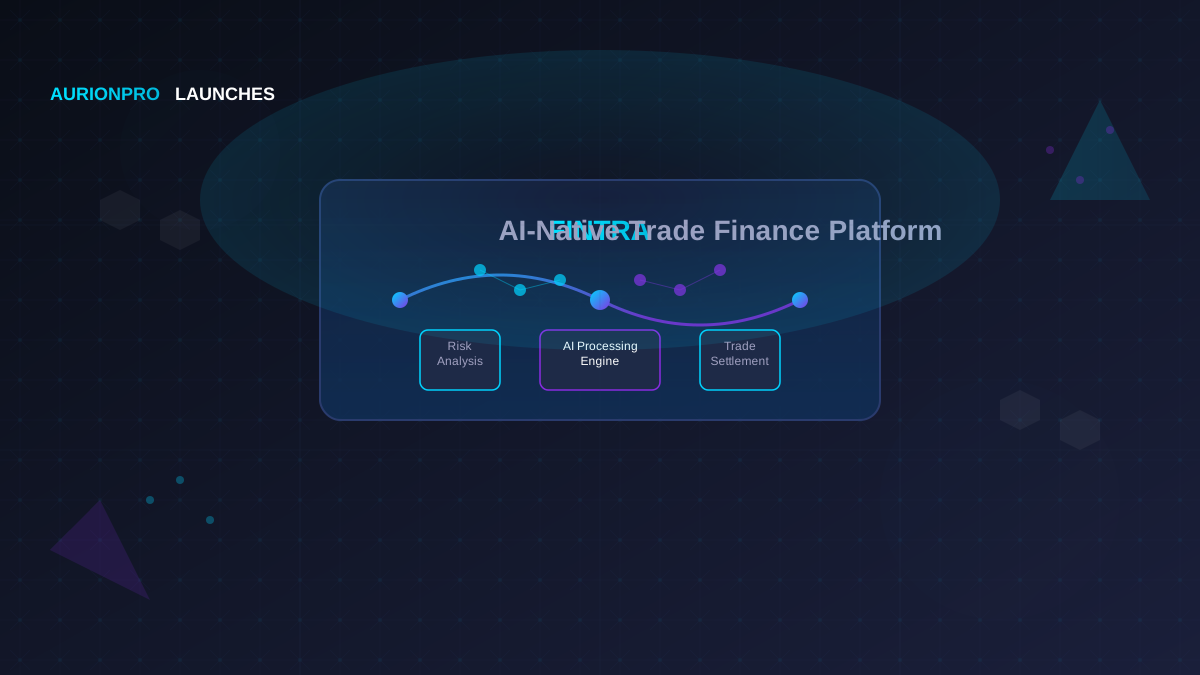
Because trade finance is the last bastion of banking digitization and the path of least resistance for AI monetization. Over the past three decades, core trade finance processes have remained frozen in the era of paper and fax. ICC statistics show an initial document submission rejection rate as high as 70%, causing tens of billions of dollars in efficiency losses and dispute costs annually. Aurionpro has identified this “high-pain, low-innovation” market gap and launched the Fintra platform, using an AI-native architecture to directly attack the industry’s most antiquated环节.
The uniqueness of trade finance lies in its high standardization yet extreme reliance on human judgment. Instruments like letters of credit, bank guarantees, and documentary collections, while governed by uniform rules set by the International Chamber of Commerce, involve multiple national laws, currencies, and regulatory requirements per transaction—traditional systems struggle with this “non-standard within standards.” Fintra’s breakthrough is designing AI as domain-specific agents, not general-purpose tools. Each agent focuses on a specific task: document OCR, compliance list screening, intelligent clause recommendation, dynamic risk scoring. This modular design allows banks to adopt gradually, reducing transformation risk.
More crucially, Aurionpro is not starting from scratch. Its parent company has deep roots in banking technology for over two decades, accumulating process data and business logic from more than 200 financial institutions. The Aurion AI stack behind Fintra essentially transforms this domain knowledge into trainable AI models. This creates a data moat difficult for competitors to cross—startups lack bank trust and historical data, while traditional software vendors are constrained by legacy code architectures. Aurionpro sits precisely at the sweet spot between technological novelty and industry credibility.
From a market timing perspective, 2026 is when global banking faces peak capital pressure. Basel IV implementation squeezes traditional credit margins, forcing banks to extract profits from operational efficiency. Trade finance, as a low-capital-consumption intermediary business, directly contributes to ROE improvement through automation. According to McKinsey, fully digitized trade finance platforms can reduce operational costs by 40-60% while shortening transaction processing from days to hours. This financial incentive, combined with AI technology maturity, creates the perfect storm for Fintra’s launch.
| Traditional Trade Finance Pain Points | Fintra’s AI Solutions | Expected Efficiency Gains |
|---|---|---|
| 70% initial document submission rejection rate | Multimodal AI agent pre-check and correction | Rejection rate reduced to below 20% |
| Manual processing time of 3-7 days | Automated workflows and intelligent routing | Processing time shortened to within 4 hours |
| Compliance review reliant on static lists | Dynamic risk scoring and situational monitoring | Compliance omission rate reduced by 85% |
| Clause negotiation lacking data support | Historical clause library and intelligent recommendation | Clause disputes reduced by 70% |
| Cross-system data silos | Unified AI stack integrating core banking systems | Data retrieval time reduced by 90% |
Confidence Gateway Handover Protocol: Where Is the Golden Ratio Between AI and Human Decision-Making?
CGHP is not a technical feature but a management framework for organizational change. The Confidence Gateway Handover Protocol designed by Aurionpro in Fintra appears as a technical mechanism but fundamentally redefines the authority boundaries of “human-machine collaboration” in banking. Traditional automation systems are either fully automated (black-box risk) or fully manual (inefficient). CGHP首次在贸易金融领域实现了dynamic authority allocation.
The protocol operates based on a four-dimensional assessment matrix: AI processing confidence level, transaction importance, regulatory sensitivity, and transaction novelty. For example, a large letter of credit application from a high-risk country, even if the AI agent has 95% confidence in document format recognition, will be automatically handed over to a senior transaction reviewer due to regulatory sensitivity hitting red lines, while providing a complete risk assessment report and suggested clauses. Conversely, repetitive small to medium-sized transactions can be directly approved and documented by AI after compliance screening and clause matching.
This design addresses the biggest psychological barrier to AI adoption in banking—accountability. All transactions processed through Fintra, regardless of final decision-maker (human or AI), generate immutable audit trails and decision chains. This means regulators can trace the judgment basis for each transaction, and banks can perform post-hoc model calibration. From a compliance perspective, CGHP transforms AI from a “decision-maker” to a “decision support system,” with support levels dynamically adjustable based on risk tolerance.
The deeper industry impact lies in reshaping bank back-office human capital. Fintra does not replace bank staff but liberates them from repetitive paperwork, transforming them into three high-value roles: AI supervisors (monitoring model performance and anomalies), complex transaction architects (handling novel structured finance), and client advisory consultants (providing trade strategy advice). According to IIF predictions, by 2028, 30% of back-office positions in global trade finance will transform into these new roles, with an additional 15%新增 in AI operations and data analysis positions.
flowchart TD
    A[Trade Finance Transaction Submission] --> B{Aurion AI Agent Processing<br>Document Recognition Compliance Screening Risk Scoring}
    B --> C[Confidence Gateway Handover Protocol CGHP]

    C --> D[Four-Dimensional Assessment Matrix]
    D --> E[Confidence Level >90%]
    D --> F[Transaction Importance Low]
    D --> G[Regulatory Sensitivity Low]
    D --> H[Transaction Novelty Low]

    E & F & G & H --> I[All Conditions Met]
    I --> J[AI Auto-Approval and Execution]
    J --> K[Generate Audit Trail and Decision Chain]

    C --> L[Any Condition Not Met]
    L --> M[Handover to Human Banker]
    M --> N[AI Provides Risk Report and Recommendations]
    N --> O[Human Decision and System Feedback]
    O --> P[Reinforcement Learning Model Update]
Aurion AI Technology Stack: Is the Blueprint for Banking’s “AI Operating System” Emerging?
Fintra is just the opening act; Aurion AI targets the entire banking industry’s cognitive layer infrastructure. Most financial institutions’ AI applications remain at “point experiments,” with each department purchasing or developing isolated models, leading to data silos, inconsistent compliance standards, and soaring maintenance costs. Aurionpro’s strategy is to provide a vertically integrated AI stack, from底层 models and development frameworks to runtime environments and system integration, all designed for banking’s specific needs.
The Aurion AI stack architecture has four layers: the底层 is domain-specific pre-trained models, trained on millions of脱敏 bank transaction data points, understanding专业 knowledge like credit risk, money laundering patterns, and trade terminology; the second layer is an AI engineering framework, providing可视化 tools for bank data scientists to fine-tune models quickly without training from scratch; the third layer is a governance agent runtime, ensuring all AI decisions comply with regulatory and internal policies; the top layer is pre-built integration interfaces with core banking systems, avoiding years-long对接 projects.
The商业智慧 of this stack design lies in lock-in effects. Once a bank deploys Fintra in trade finance and adapts to Aurion AI’s operational模式, expanding to corporate lending, retail credit, transaction banking, etc., migration costs are minimal. Aurionpro has预告 it will launch four additional platforms based on the same stack within 18 months, forming an AI product matrix covering banks’ main revenue sources. According to Gartner predictions, by 2027, banks adopting unified AI stacks will launch new applications 2.3 times faster than peers, with 40% lower total cost of ownership.
More importantly, the Aurion AI stack could become banking’s new standard interface. Like Android for phone manufacturers, Aurion AI provides foundational capabilities, allowing banks to develop customized applications on top while maintaining core compliance and security frameworks. This breaks the traditional banking software market垄断 by a few欧美 giants, especially in emerging markets where banks prefer flexible, cost-controllable solutions. From this perspective, Aurionpro is not just selling software but defining the rules of the game for next-generation bank IT architecture.
| Aurion AI Stack Layer | Core Components | Banking Pain Points Solved |
|---|---|---|
| Domain Model Layer | Pre-trained models for trade finance, credit risk, AML, etc. | Lack of domain-labeled data, high model training costs |
| AI Engineering Framework Layer | Visual fine-tuning tools, model version management, performance monitoring | Communication gap between data scientists and business units, slow model iteration |
| Governance Runtime Layer | Compliance check engine, audit logs, decision explanation generation | Complex regulatory requirements, AI black-box risk, accountability tracing difficulties |
| System Integration Layer | Core banking APIs, legacy system adapters, cloud deployment options | Long system integration cycles (typically 18-24 months), data silos |
Global Trade Finance Market Reallocation: Who Will Be the Winners and Losers of AI Transformation?
Fintra’s launch will accelerate banking’s “AI capability gap,” which will directly translate into market share reshuffling. Trade finance has long been seen as relationship-driven, with banks relying on relationship managers’ networks and experience. But when AI platforms can reduce processing costs by 60% and speed by tenfold, competition shifts from “who has better relationships” to “who has higher efficiency.” This efficiency revolution will trigger chain reactions across different market tiers.
First impacted are regional banks and specialized trade finance institutions. These entities traditionally compete with multinational banks through local knowledge and flexible services but lack scale to invest in AI systems. Platform-as-a-service models like Fintra allow中小型 banks to access top-tier AI capabilities via subscription, theoretically leveling the technological playing field. However, in practice, AI systems require continuous data feeding and tuning; banks with higher transaction volumes generate more training data, creating a “data flywheel” effect. This could lead to polarization: a few领先 banks expand market share via AI, while most中小 banks become users of white-label services, with profit margins squeezed by platform providers.
Multinational large banks face a more微妙 situation. They possess vast historical data and technology budgets but also carry the heaviest legacy system burdens. Trade finance giants like Citi, HSBC, and Standard Chartered have core systems mostly built in the late 20th century, requiring lengthy migration to integrate new AI platforms. These banks may adopt a dual-track strategy: internally developing AI capabilities while partnering with suppliers like Aurionpro for pilots in specific regions or product lines. But internal development faces talent competition and time costs; according to BCG analysis, banks building equivalent AI platforms in-house cost 3-5 times more than purchasing third-party solutions, with time-to-market delayed by 2-3 years.
The most interesting competition may come from tech platforms and non-bank institutions. E-commerce giants like Amazon and Alibaba are already involved in supply chain finance, holding real-time transaction and logistics data that is more immediate and granular than banks’ reliance on financial statements. If these tech companies integrate trade finance AI modules into their commerce platforms, SMEs could obtain financing directly within transaction scenarios, completely bypassing traditional banks. Fintra’s AI agent architecture can theoretically interface with such external data sources, opening a new battlefield in the “coopetition” between banks and tech companies—banks provide funding and regulatory compliance, tech companies provide data and customer touchpoints.
timeline
title Trade Finance AI Transformation Competitive Landscape Evolution
    section 2026-2027 : Pilot and Capability Building Phase
        Leading banks launch large-scale pilots<br>中小 banks观望
        Suppliers like Aurionpro<br>refine product matrix
        Regulators issue<br>AI decision audit guidelines
    section 2028-2029 : Market Differentiation and Consolidation Phase
        Top 30% banks complete core process AI化<br>market share increases
        中小 banks forced to choose<br>white-label services or exit market
        Tech companies enter trade finance<br>via API scenarios
    section 2030+ : New Ecosystem Stabilization Phase
        AI-native bank processes become standard<br>human transformation complete
        Profits concentrate among platform providers<br>and data owners
        Global trade finance market<br>redraws spheres of influence
From Fintra to the Next Wave of AI Productization: Vertical Integration vs. Horizontal Generality
Fintra’s success or failure will validate a key proposition: the future of enterprise AI belongs to vertically integrated domain experts, not horizontally general foundation model providers. Over the past three years, AI industry attention has focused on large language models like GPT and Claude, as if one general model could solve all problems. But实践 in highly regulated fields like finance, healthcare, and law shows that domain knowledge barriers and regulatory constraints are far harder to overcome than technical complexity.
Aurionpro has chosen a与众不同的 path: not pursuing maximum parameter scale but追求 deepest domain understanding. The AI agents in Fintra are not directly calling GPT-5 APIs but are专用 models fine-tuned on bank transaction data. These models may have only tens of billions of parameters but are far more sensitive to letter of credit clauses, ICC rules, and sanction list changes than general models. This vertical integration strategy’s advantage lies in controllability—banks can确切 know model training data sources and decision logic, crucial for compliance audits.
This预示 AI productization will enter a “deep vertical” phase. Each major industry may see专属 stacks类似 Aurion AI: medical diagnosis AI stacks, legal document review AI stacks, industrial manufacturing quality inspection AI stacks. These stacks treat foundation models as raw materials, not end products, requiring大量 domain data, business logic encoding, and regulatory adaptation to form commercializable solutions. According to the Stanford AI Index Report, post-2025, enterprise investment growth in vertical AI solutions will首次 exceed that in general AI platforms, with a projected CAGR of 34%.
The启示 for Taiwan’s tech industry is: rather than chasing the foundation model arms race, deepen data assets and domain knowledge in specific fields. Taiwan has accumulated深厚 industry experience in精密 manufacturing, medical electronics, semiconductor supply chains, etc.—all稀缺 resources for training vertical AI models. In the next five years, the most valuable AI companies may not be teams训练出 the largest models but domain experts who best understand specific industry pain points and can seamlessly embed AI into workflows. Fintra’s case shows that when AI moves from “technology showcase” to operational core, vertical depth trumps horizontal breadth.