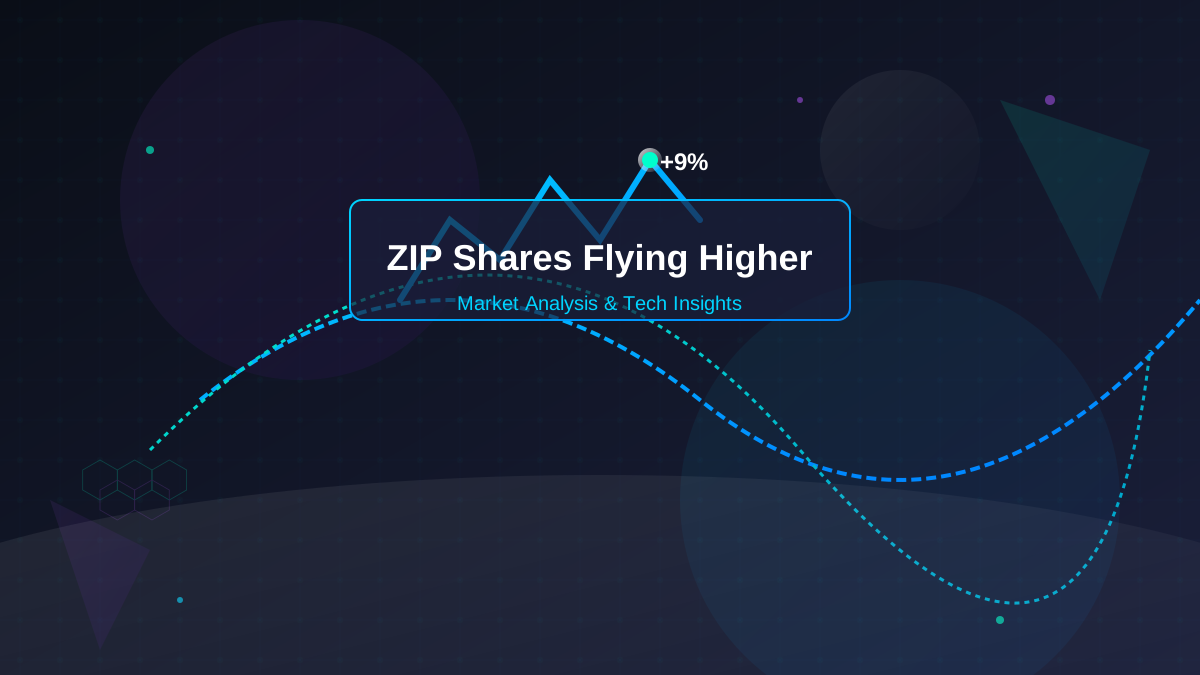
BLUF: Zip’s 9% single-day stock surge is no accident; it’s a clear market signal—the Buy Now, Pay Later industry is shifting from the old model of ‘burning cash for growth’ to a new paradigm of ‘precision profitability’ through AI-driven risk model upgrades. Investors are buying not a story, but visible improvements in unit economics.
Is This More Than a Stock Rebound? Is the Entire Industry’s Valuation Logic Being Rewritten?
Answer Capsule: Yes. The market is repricing for ‘AI-empowered profitability.’ In recent years, BNPL companies have been criticized for ‘rapid growth but staggering losses,’ with valuations heavily reliant on the single metric of Gross Merchandise Volume (GMV). The core of Zip’s stock jump lies in key messages from its latest financial report and tech briefing: Through its self-developed AI risk engine, its bad debt rate dropped by over 150 basis points last quarter, while customer approval efficiency improved by 40%. This isn’t marginal improvement; it’s a fundamental upgrade in the operational model. When a representative company’s core financial vulnerability (bad debt) starts being effectively plugged by technology, Wall Street and institutional investors immediately realize that the entire sector’s risk premium needs adjustment. The ripple effect of this surge will soon spread to other players like Klarna and Affirm, forcing the market to evaluate the industry with a new set of metrics—such as ‘AI-adjusted profit margins.’
We are witnessing a classic case of ’technology-triggered valuation re-rating.’ Recall the early days of cloud computing adoption: companies that could prove effective use of cloud architecture to reduce operational costs commanded much higher P/E ratios than peers. Now, the same script is playing out in fintech. AI is no longer a marketing gimmick but a weapon directly reflected on the bottom line of the income statement. Zip’s case clearly tells us: Growth without a technological moat is unsustainable in the current capital environment. Investors are tired of the ’losses for market share’ story; they want a clear, scalable path to profitability. Zip’s AI risk model provides exactly that roadmap.
The industry implication is that the competitive barrier in fintech has been significantly raised. In the past, it was about ground operations, merchant partnerships, and marketing budgets; in the future, the decisive factors will be data processing capability, algorithm iteration speed, and the reliability of real-time decision systems. This will accelerate industry consolidation, with resources and talent further concentrating toward leading companies with technological strength. For Zip, this 9% gain may be just the beginning; if it can continue to prove the resilience of its AI system during economic downturns, its valuation ceiling could be completely lifted.
| Valuation Driver Shift | Old Paradigm (2020-2024) | New Paradigm (2025-) |
|---|---|---|
| Core Metric | Gross Merchandise Volume (GMV), User Growth | Unit Economics, AI-Adjusted Profit Margins |
| Market Focus | Speed of Market Share Expansion | Profit Quality and Sustainability |
| Role of Technology | Supportive Function, Cost Center | Core Competitiveness, Profit Engine |
| Investor Expectation | Belief in Future Profit Story | Demand for Evidence of Current Operational Efficiency |
| Risk Pricing | Based on Macro Economy and Regulation | Based on Company’s Own Risk Model Effectiveness |
What Exactly Did the AI Risk Model Do to Win Over Wall Street So Convincingly?
Answer Capsule: It transformed credit assessment from ‘static historical review’ to ‘dynamic future prediction.’ Traditional BNPL risk management largely still relies on modified FICO credit scores and historical transaction records—a lagging and coarse-grained model. The revolutionary aspect of Zip’s newly deployed AI system, codenamed ‘Sentinel,’ lies in its integration of multi-dimensional real-time data streams—including users’ device behavior, app interaction patterns, and even browsing trails on partner merchant websites—and using machine learning models to predict the default probability of a single transaction within milliseconds. This not only reduces bad debt but, more importantly, allows Zip to serve ’thin-file’ customers previously rejected by traditional models at lower risk costs, thereby expanding the potential market.
Specifically, the system’s performance improvement is reflected in two hard metrics: First, the accuracy of first-transaction default prediction for new customers increased by 35%, directly translating to lower customer acquisition costs. Second, for existing customers, the system enables dynamic credit limit adjustments; for example, when it detects a user’s spending behavior stabilizing or income sources strengthening, it automatically and gently increases the limit, boosting user stickiness and lifetime value. According to Zip’s internal data, after implementing the AI model, the repurchase rate of high-quality customers increased by 22%.
The underlying tech stack is worth delving into. It’s not a single model but a cluster of models with hundreds of feature engineering elements, running on a hybrid cloud architecture. Real-time inference relies on AWS SageMaker and dedicated Inferentia chips to ensure low latency, while model training and iteration are completed on Google Cloud’s TPU clusters. This deep utilization of top-tier cloud AI services itself illustrates how tech giants’ ecosystems have become the infrastructure for fintech innovation. For competitors, replicating such a system requires not only massive data accumulation but also a top-tier team blending data science, financial engineering, and software development, with high time and capital barriers.
mindmap
  root(Zip AI Risk Model "Sentinel" Core Architecture)
    Data Input Layer
      Traditional Credit Data
      Real-time Transaction Behavior
      Device & Environmental Signals
      Partner Merchant Data Streams
    Core Processing Engine
      Feature Engineering Platform<br>(>500 Features)
      Machine Learning Model Cluster
        :::highlight
        Default Prediction Model
        Customer Value Prediction Model
        Dynamic Pricing Model
        :::
      Real-time Inference API
    Output & Decision Layer
      Millisecond Credit Decisions
      Dynamic Limit Management
      Personalized Product Recommendations
      Risk Dashboard & Alerts
    Technical Infrastructure
      AWS SageMaker (Inference)
      Google Cloud TPU (Training)
      Hybrid Cloud Data Lake
      Strict Compliance & Privacy Gateways
From Zip’s Transformation, How Can We Foresee the Competitive Landscape of Fintech in the Next Three Years?
Answer Capsule: The main theme for the next three years will be ‘differentiation’ and ‘integration.’ Differentiation manifests as: Companies like Zip that successfully internalize AI as a core capability will pull far ahead of competitors still reliant on traditional methods, who will face dual pressures of profitability strain and market share loss. Integration refers to: Pure BNPL services will disappear, replaced by AI-driven ‘intelligent consumer finance platforms’ deeply embedded in consumption scenarios. Zip’s next step will inevitably be productizing its risk assessment capabilities, offering them to partner merchants as value-added services—such as helping merchants identify high-value customers or prevent fraud—thereby opening up the higher-margin track of platform service revenue.
The essence of this competition is data and algorithms. Companies with more, more unique, and higher-frequency data, capable of extracting predictive insights from it, will win the game. This will trigger two major trends: First, the competitive-cooperative relationship between large tech companies (e.g., Apple, Google) and fintech firms will become more complex. Apple has already launched Apple Pay Later, with an advantage in vast hardware ecosystem data; Zip and peers possess more specialized credit behavior data. Future scenarios may include data partnerships or more intense direct confrontations. Second, deep vertical integration. We might see Zip establish exclusive or deep partnerships with specific retail ecosystems (e.g., fashion, electronics), creating hyper-personalized consumer credit products through data sharing.
For investors, the framework for identifying winners needs updating. The table below compares key evaluation dimensions under the old and new frameworks:
| Evaluation Dimension | Old Investment Framework | New Investment Framework (AI Era) |
|---|---|---|
| Technological Moat | Patent Count, IT Budget | AI Model Performance Metrics (e.g., prediction accuracy, iteration speed), Exclusive Data Sources |
| Profitability | When EBITDA Turns Positive | Trend in Unit Economics (CAC下降, LTV上升), AI’s Contribution to Operational Leverage |
| Growth | Annual GMV Growth Rate | High-Quality Customer Growth Rate, Proportion of Revenue from Platform & Services |
| Risk Management | Absolute Bad Debt Rate | Stability of Bad Debt Rate Through Economic Cycles, AI Model Resilience to Black Swan Events |
| Ecosystem Positioning | Number of Partner Merchants | Integration Depth with Key Ecosystems, Closure of Data Feedback Loops |
Additionally, regulatory technology (RegTech) will become indispensable. As AI model decision weights increase, their explainability and fairness will face stricter scrutiny from regulators. Companies that can seamlessly embed compliance requirements into the AI system development lifecycle will navigate the ever-changing global financial regulatory environment more smoothly, which itself constitutes a competitive advantage.
What Does This Mean for Apple, Tech Giants, and the Entire Consumer Tech Ecosystem?
Answer Capsule: This is both a wake-up call and a blueprint. For Apple, Zip’s success validates the immense value of the ‘hardware + services + finance’ closed loop, but also shows that specialized fintech companies may currently lead in risk pricing depth. Apple’s advantage lies in unparalleled user reach and device-level data; its disadvantage is that its culture isn’t built for high-risk credit businesses. Future paths may include: Apple accelerating acquisitions or investments in companies like Zip to bolster capabilities; or Zip and peers packaging their AI services for reverse supply to hardware or platform companies wanting to offer financial services, becoming ‘AI-as-a-service’ providers.
More broadly, Zip’s case is a microcosm of consumer tech value chain restructuring. Value is shifting from mere sales endpoints (e-commerce platforms, physical stores) upstream to ‘decision and fulfillment engines.’ Whoever can more accurately, safely, and smoothly facilitate transaction completion will capture a larger share of the profit pie. This will drive a series of chain reactions:
- Payment gateways and processors (e.g., Stripe, Adyen) must quickly integrate or develop similar AI credit assessment modules, or risk having their value squeezed.
- Data from consumer data platforms (CDPs) and marketing tech companies will collide and fuse more intensely with fintech risk data, spawning new business models.
- For end consumers, the benefit is more tailored, fairer financial services; the concern is deeper mining and utilization of personal data, making the privacy-convenience trade-off an ongoing public issue.
From an industry investment perspective, venture capital flows will also shift accordingly. The diagram below depicts potential capital and technology flow trends triggered by Zip’s AI transformation:
flowchart TD
    A[Zip AI Risk Model Success<br>Stock Surge] --> B{Market Signal Interpretation};
    B --> C[BNPL Industry Valuation Logic Reset];
    B --> D[AI in Fintech Application Feasibility Validated];

    C --> E[Capital Flows to AI-Capable<br>Fintech Companies];
    D --> F[Companies Increase Investment in<br>AI Infrastructure & Talent];

    E --> G[Industry Accelerates Consolidation<br>Weaker Players Acquired or Eliminated];
    F --> H[Cloud AI Platform &<br>Chip Demand Grows];

    G --> I[Formation of 2-3 AI-Driven<br>Global Fintech Giants];
    H --> J[Drives Next-Generation<br>Dedicated AI Hardware Development];

    I & J --> K[End State: Intelligent Financial Services<br>Become Default Consumer Tech Infrastructure];
What Should Investors Do Now? What Specific Signals Should They Watch?
Answer Capsule: Immediate action isn’t blindly chasing highs, but building a new analytical dashboard. For Zip and its peers, investors should shift focus from top-level financial numbers to operational ‘micro-metrics.’ First, closely watch the key performance indicators of the AI model disclosed by management in the next earnings call, such as dynamic default rates across customer segments, and the frequency and effectiveness of model iterations. Second, observe the company’s ratio of R&D capitalized expenditure to operational expenditure—sustained and efficient AI investment is a leading indicator of long-term competitiveness. Finally, monitor qualitative changes in the partnership ecosystem, such as whether technical integration agreements are reached with large software platforms (e.g., Shopify, Salesforce), which is more significant than merely adding hundreds of small merchants.
Specifically, key hypotheses to validate over the next few quarters include:
- Sustainability of Profitability: Is this 9% gain based on one quarter’s improvement or the start of a trend? We need to see bad debt rates remain stable at low levels for at least two consecutive quarters while revenue continues to grow.
- Scalability of Technology: The AI model succeeded in the Australian market; can it be quickly replicated in more complex, competitive markets like the US and Europe? This tests the generality and localization capability of the tech architecture.
- Regulatory Adaptability: As AI decision influence grows, will global regulators (e.g., EU, US CFPB) issue new guidelines? Can Zip’s model pass ‘algorithm audits’?
For investors not wanting to bet on a single company, this trend points to broader investment themes: AI-empowered enterprise software and cloud infrastructure. Regardless of which BNPL company ultimately wins, they all need powerful cloud computing, databases, and machine learning platforms. Thus, investing in tech giants providing these ‘picks and shovels’ might be a more diversified way to participate.
FAQ
Why did Zip’s stock suddenly surge 9%? The main driver is the market’s positive reaction to the effectiveness of its latest AI risk management system, which significantly reduced default rates and improved approval efficiency, giving investors a clear view of the profit path.
How is AI changing the rules of the game for the Buy Now, Pay Later industry? AI transforms risk management from passive defense to proactive prediction through real-time behavioral data analysis and dynamic credit scoring, drastically lowering bad debt costs and enabling more precise customer expansion, key to shifting from cash-burning growth to sustainable profitability.
Is this surge a flash in the pan or the start of a trend reversal? This is more likely a signal of an industry inflection point. When leading companies prove AI can tangibly improve unit economics, the market will re-evaluate the valuation logic of the entire sector, shifting focus from GMV to profit quality.
Which tech companies will be affected by Zip’s transformation? Peers like Klarna and Affirm will face more direct competitive pressure, while cloud platforms providing AI model services (e.g., AWS, Google Cloud) and data analytics firms may see a new wave of enterprise demand.
What metrics should investors focus on next? Investors should closely monitor Zip’s bad debt rate, customer acquisition cost, and profit per transaction—operational metrics that are the core validation of whether the AI transformation is successful, rather than just total transaction growth.
Further Reading
- AWS SageMaker Official Documentation – Understand how modern machine learning platforms support enterprise-grade AI model deployment.