From “Bad Bank” to “Lean Unit”: A National-Level Asset Management Tech Slim-Down
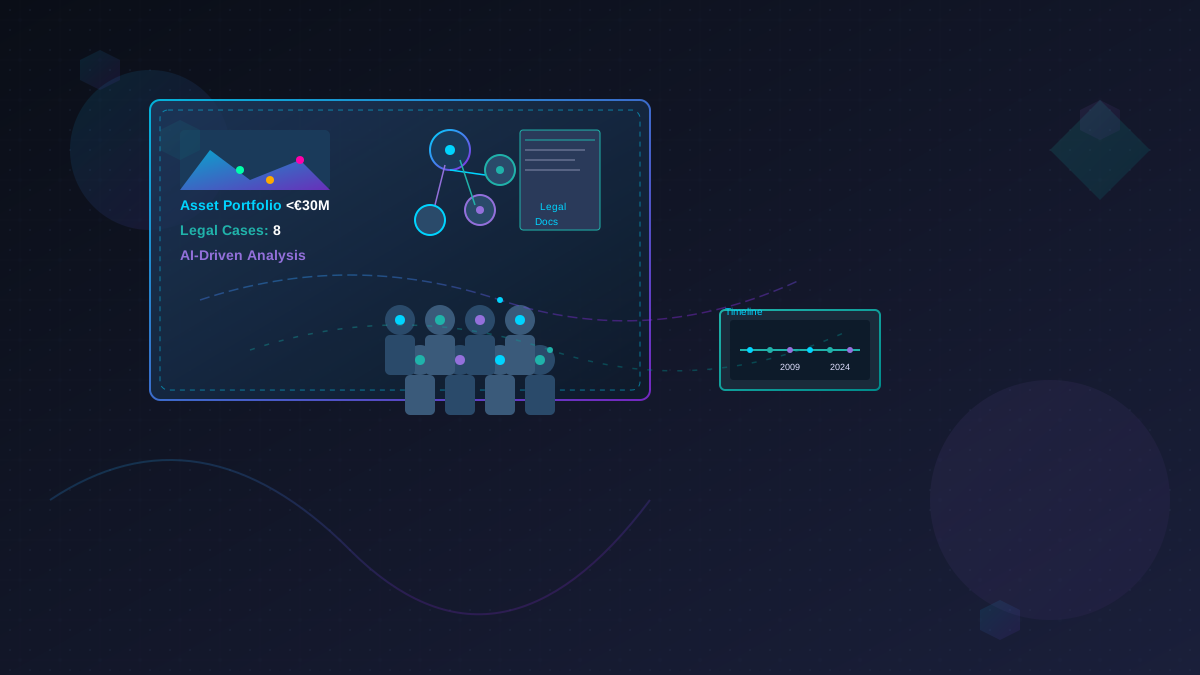
This is not an ordinary organizational downsizing, but a meticulously designed “tech slim-down surgery.” When a national-level “bad bank” that once managed over €30 billion in assets hands its final-stage mission to an eight-person unit, what we witness is not budget cuts, but a paradigm shift in public asset disposal efficiency. The case of Ireland’s National Asset Management Agency (NAMA) starkly demonstrates how modern financial technology and AI tools can completely restructure the cost and manpower requirements of asset management. The wind-down phase involves only assets valued below €30 million and eight legal cases, yet its symbolic significance far exceeds the book value—it proves that a behemoth institution of state market intervention can have an elegant, efficient, and cost-controlled exit mechanism.
Why Are Eight People Enough to Handle a National-Level Asset Endgame?
The answer lies in “outsourcing” complexity to algorithms and automated processes. The core of the wind-down work has shifted from large-scale asset disposal to legal process management, document archiving, and compliance monitoring. These are precisely the areas where AI and process automation can perform most effectively. The roles of unit members will transform from executors to supervisors and strategic decision-makers, relying on intelligent systems to handle daily operations.
Let’s break down the likely functional configuration of this eight-person unit and the technological pillars behind it:
| Functional Role | Core Tasks | Supporting Tech Tools | Traditional Model Manpower Required |
|---|---|---|---|
| Strategy & Legal Lead | Team leadership, final decision-making, complex legal negotiations | AI legal document analysis, risk prediction models | 3-5 people |
| Asset Analyst | Monitoring remaining asset values, disposal recommendations | Asset valuation AI models, market data platforms | 2-3 people |
| Legal & Compliance Officer | Managing 8 legal cases, ensuring procedural compliance | eDiscovery, compliance automation software | 3-4 people |
| Operations & Finance Officer | Budget control, report generation, administrative processes | RPA process robots, financial management SaaS | 2 people |
| Technology & Data Manager | System maintenance, data security and archiving | Cloud security platforms, data lake management tools | 1-2 people |
This configuration reveals a key trend: The “tech density” of the public sector is rising sharply. Tasks like documentation, analysis, and monitoring that previously required teams of over a dozen people can now be integrated into digital platforms operated by a few individuals. The National Treasury Management Agency (NTMA), as the parent body, itself manages over €200 billion in national debt and nearly €30 billion in investment assets. Its built-in technological infrastructure allows this eight-person unit to “plug and play,” eliminating the need to build from scratch. This drastically reduces marginal operating costs.
More noteworthy is the dramatic contraction in asset scale—from a peak of tens of billions of euros to the current less than €30 million. The diagram below illustrates the evolution of asset scale and human-tech investment across NAMA’s lifecycle stages:
timeline
    title NAMA Asset Management Lifecycle & Tech Application Evolution
    section 2009-2014 : Crisis Management Phase
        Asset Peak : Over €74 billion<br>non-performing loans
        Manpower Model : Large-scale teams<br>traditional due diligence
        Tech Role : Auxiliary tools<br>basic databases
    section 2015-2022 : Asset Disposal Phase
        Asset Scale : Rapid decline to below tens of billions
        Manpower Model : Specialized teams<br>focus on bulk transactions
        Tech Role : Data analytics platforms<br>transaction management systems
    section 2023-2026 : Wind-down Transition Phase
        Asset Scale : Reduced to below €3 billion
        Manpower Model : Streamlined core team
        Tech Role : AI-driven decision-making<br>automated processes
    section 2027- : Resolution Unit Phase
        Remaining Assets : < €30 million
        Manpower Model : 8-person elite unit
        Tech Role : Full automation<br>cloud collaboration & archiving
This evolution is not unique to Ireland. According to a Bank for International Settlements report, the median operating costs of asset management companies established after the global financial crisis fell by 60%-75% in the later disposal stages, while the proportion of tech investment increased from less than 10% in the early stages to over 30% later. This is a clear learning curve: early stages rely on manpower and capital momentum, later stages rely on technology and process efficiency.
What Deep Waters of Technology and Risk Management Are Hidden in the Remaining Eight Legal Cases?
The six NAMA-related and two IBRC-related legal cases that the wind-down unit must handle are the most challenging and least automatable part of the entire mission. These cases remain precisely because they involve highly complex legal disputes, cross-border jurisdictional issues, or political sensitivity. However, technology still plays a crucial role.
First, AI-driven legal tech can be used for “predictive analysis.” By analyzing thousands of past similar property disputes or commercial litigation precedents, judge tendencies, and settlement patterns, the system can provide the team with win probability assessments, time-cost predictions, and optimal strategy recommendations. This enables the eight-person unit to make “fight or settle” decisions on a more informed basis.
Second, blockchain technology may be used to clarify the ownership chain of remaining assets. Especially for non-performing assets involving multiple transfers over years and cross-border entities, their ownership history may be unclear. Hashing relevant transaction records and legal documents onto a blockchain can create an immutable audit trail, which would be powerful evidence in court.
Finally, cloud collaboration and case management platforms are the lifeline for maintaining efficiency. Team members, external lawyers, consultants, and regulators need real-time access to tens of thousands of pages of documents in a secure environment. Professional legal tech platforms like Clio or Relativity will become the unit’s “digital war room.”
The table below contrasts traditional and tech-enhanced approaches to handling such complex legal cases:
| Processing Stage | Traditional Model (High Manpower) | Tech-Enhanced Model (Streamlined Team) | Key Efficiency Gains |
|---|---|---|---|
| Discovery | Manual review of massive documents by paralegals | AI performs document classification, key information extraction, relevance tagging | Time reduced by over 70% |
| Legal Research | Manual search of case law and statutes | NLP tools automatically search, summarize, and link relevant cases | Broader research coverage, reduced risk of omission |
| Strategy Simulation | Judgment based on partner experience | Use historical data models for outcome prediction and strategy optimization | Decision-making shifts from “intuitive experience” to “data-driven” |
| Document Generation | Manual drafting and revision | Use smart templates and variables to auto-generate drafts | Significantly reduces basic paperwork burden |
| Cross-Border Collaboration | Email, phone calls, in-person meetings | Secure cloud platform for real-time progress and document synchronization | Breaks geographical and time zone barriers, transparent progress |
Behind these tech applications lies the digital reconstruction of risk. The risk of remaining cases is no longer just “win or lose,” but quantified into a multidimensional model of potential financial impact, time cost, reputational damage, and political consequences. The unit’s task is to use tools to manage this model, minimizing uncertainty.
Annual Budget of €1.3 Million: What Kind of Capability Can This Money Buy in the Tech Era?
An annual budget of €1.3 million is “micro” for a national-level project. These funds must cover salaries for eight top professionals, legal fees, tech licensing fees, office costs, and all other expenses. This forces the team to optimize resource allocation to the extreme, and cloud services and SaaS subscription models are key to achieving this.
- Maximizing Human Capital: The bulk of the budget will go towards hiring multidisciplinary talent with expertise in law, finance, and technology. Their salaries may be above market average, but one person can deliver the effectiveness of two to three people in the traditional model.
- Variable Costs Replace Fixed Costs: No more investment in expensive on-premise servers and software. All computing, storage, and applications are paid for on-demand via cloud services (e.g., AWS, Azure). Legal research databases and AI analysis tools also use subscription models, pay-as-you-go.
- Automation Replaces Outsourcing: Many routine tasks previously outsourced to accounting or law firms (e.g., compliance reports, document review) can now be handled internally via RPA and AI tools, with more controllable quality and lower long-term costs.
We can roughly estimate the allocation paradigm of this €1.3 million budget:
pie title Estimated Annual Budget €1.3 Million Allocation Model
    "Senior Personnel Salaries" : 65
    "Legal Tech SaaS Subscriptions<br>& Cloud Services" : 25
    "External Legal Counsel<br>& Expert Fees" : 20
    "Office, Travel<br>& Miscellaneous Expenses" : 10
    "Contingency & Buffer Funds" : 10
This budget structure is revolutionary. It shows that completing a national mission no longer necessarily ties to massive budgets and staffing. By embracing “Technology as a Service” and “Elite Talent,” the public sector can achieve operational efficiency comparable to top private institutions. This sends a strong signal to similar asset management agencies still operating globally (e.g., Spain’s Sareb): The design of the wind-down phase should consider tech leverage and cost structure from day one.
NAMA’s Endgame: What New Paradigm Does It Foreshadow for Future State Economic Interventions?
NAMA’s story began in the depths of the 2009 global financial crisis as a “shot in the arm” to save Ireland’s financial system. Its establishment was a typical “wartime mechanism”: granted broad powers, rapidly mobilized resources, with stability as the top priority. Its endgame now demonstrates a “peacetime” exit paradigm: precise targeting, intelligent tools, controllable costs.
This provides a valuable framework for any future national-level economic interventions (whether for stranded assets in climate transition or another unforeseen systemic crisis):
- Establish Clear “Sunset Clauses” and Exit Paths from Inception: Future public asset management entities should have clear mission completion indicators and triggers for dissolution or transformation in their charters to avoid institutional permanence.
- Build Modular and Tech-Native Architecture: The core team should be small and elite, designed to readily connect to external tech platforms and professional service networks. The institution’s “tech debt” should be minimized to facilitate easy offloading during wind-down.
- Data Asset Management and Knowledge Transfer: The asset disposal data, valuation models, and risk cases accumulated by NAMA over more than a decade of operation are invaluable national financial governance assets. This data should be structured, anonymized under confidentiality, and potentially used to train future AI regulatory tools or as academic research resources.
From a broader industry perspective, NAMA’s wind-down is a litmus test for the maturity of RegTech and Public FinTech. The ability to support such a lean team in completing complex tasks proves that the relevant tech stack has moved from proof-of-concept to reliable实战 stage. This will incentivize more tech companies to develop solutions for public sector back-office operations, creating a new market.
FAQ
With only eight people, how can the NAMA wind-down unit efficiently handle remaining assets and legal cases? The unit will heavily rely on AI-driven asset management platforms and automated legal document analysis tools, focusing human effort on strategic decision-making and complex negotiations rather than daily operations, achieving lean and efficient functioning.
What lessons does this case offer for bad debt resolution agencies in other countries? It demonstrates how to complete the final mile of national-level asset disposal at minimal cost through tech tools and a streamlined team, providing a global operational blueprint for transitioning from large organizations to lean units.
With remaining assets valued below €30 million, why is operation needed for nearly two more years? The key lies in handling six NAMA-related and two IBRC-related legal cases, which involve complex property tracing, cross-border judicial procedures, and sensitive negotiations requiring time and professional handling.
What role can AI play in the later stages of public asset management? AI can perform asset value forecasting, legal risk assessment, intelligent document archiving, and process automation, significantly reducing manpower needs and error rates, ensuring wind-down work is compliant and efficient.
Looking at NAMA’s evolution, how will the design of future national-level asset management companies change? Future designs will shift from initial large-scale manpower deployment to modular, highly flexible, and tech-intensive structures, allowing for rapid downsizing or transformation upon mission completion to avoid becoming permanent bureaucratic entities.
Further Reading
- Bank for International Settlements Report - The Evolution of Post-Crisis Asset Management Companies: This report systematically analyzes the lifecycles and cost-effectiveness of multiple global bad debt resolution agencies, providing a macro comparative framework. BIS Working Papers - Post-crisis asset management companies
- Clio - Legal Tech Cloud Platform: As a leading global cloud-based legal practice management software, its features showcase how modern legal teams enhance efficiency through technology, exactly the type of tool the NAMA wind-down unit might adopt. Clio: Legal Practice Management Software
- Irish Department of Finance Explanation on NTMA’s Role: Official documents help understand the overall structure and functions of the National Treasury Management Agency, the institutional foundation enabling the wind-down unit’s efficient operation. Department of Finance - The NTMA