From Environmental Services to Trust Infrastructure: What Does SGTM’s Strategic Pivot Signify?
In simple terms, this is a classic ’track upgrade.’ SGTM is no longer content with being a contractor in environmental projects. Instead, it has identified a common pain point across all industries involving the verification of physical outcomes: how to prove that ‘something actually happened.’ This pain point is magnified in the era of ESG investing, critical raw material traceability, and digital governance. SGTM’s strategic pivot repositions itself from a participant in one track to a ‘rule-maker’ and ‘infrastructure provider’ that multiple tracks must rely on. The industrial significance behind this is that as the data economy shifts from virtual to virtual-physical integration, the ability to standardize and automate the verification of physical facts will become a more central value hub than any single business.
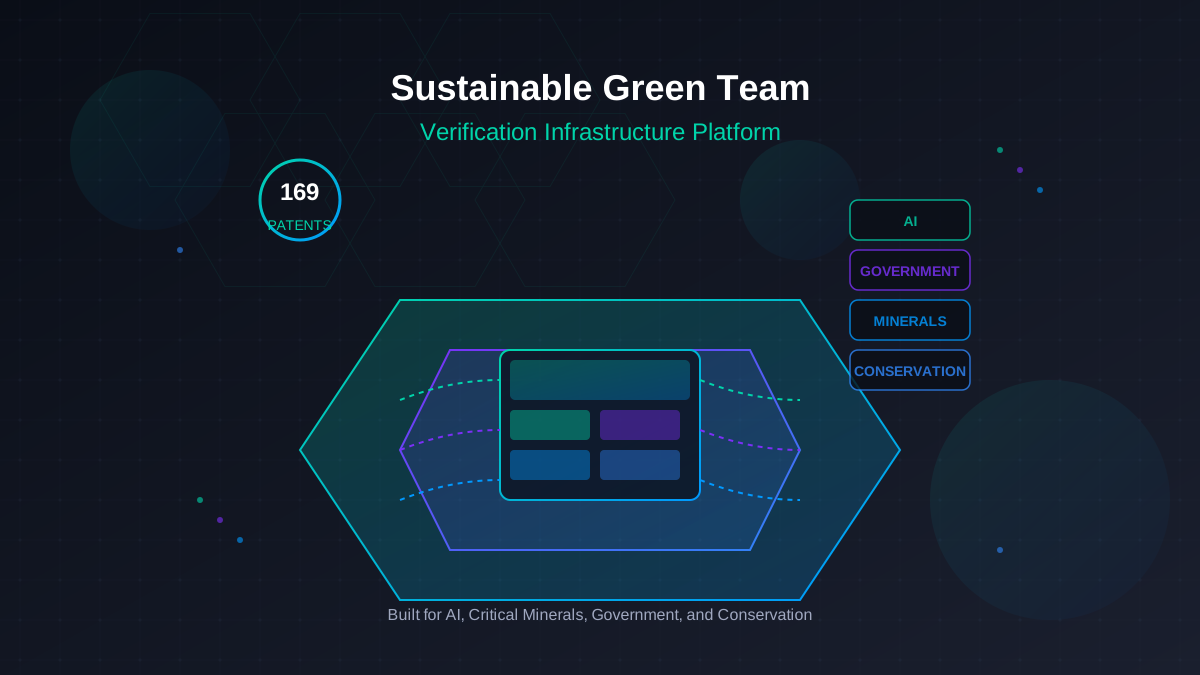
Over the past decade, we have witnessed how digital trust mechanisms (like cryptographic signatures, HTTPS) reshaped the internet economy. Now, the same script is playing out in the physical world. SGTM’s portfolio of 169 patents essentially builds a trust protocol for the physical world equivalent to ‘HTTPS.’ This is not merely a technological innovation but a fundamental restructuring of the business model. It means the company’s revenue engine will shift from project profits to platform transaction fees, certification fees, and potentially more importantly—data service fees. According to a Boston Consulting Group (BCG) report, by 2030, the market size for supply chain transparency and traceability solutions will exceed $100 billion, and SGTM is attempting to stake its claim in this market with its patent wall.
Five-Stage Automated Verification: How Does This ‘Physical Truth Infrastructure’ Work, and Why Is It Hard to Replicate?
The core of the Restore.Earth platform is breaking down the verification process of a physical event (e.g., planting a forest, mining a ton of cobalt) into five consecutive automated stages. The design philosophy of this process is ‘don’t trust, verify,’ aiming to exclude human intervention and subjective judgment as much as possible.
flowchart TD
    A[Physical Event Trigger<br>e.g., Planting Trees or Mining] --> B[Stage One: Data Capture<br>IoT Sensors GPS Satellite Imagery]
    B --> C[Stage Two: AI Preliminary Analysis<br>Pattern Recognition Anomaly Detection]
    C --> D[Stage Three: Multi-Source Verification<br>Cross-Referencing Weather Logistics External Data]
    D --> E[Stage Four: Mathematical & Logical Verification<br>Executing Preset Rules & Conditions]
    E --> F[Stage Five: Permanent Recording<br>Generating Immutable Proof<br>on Distributed Ledger]
    F --> G[Generating Trusted Output<br>Carbon Credits Origin Proof Outcome Reports]
The competitive barrier of this system lies not in any single technology but in the depth of integration and the breadth of patent protection. The market is not short of independent service providers offering satellite monitoring or blockchain notarization. However, linking the entire process from sensing to notarization into a closed, automated ‘pipeline’ and covering its specific implementation methods with patents creates a high barrier to imitation. For example, its patents may cover the complete process of how a specific type of AI model parses satellite imagery to identify tree species and health status and compares this parsed result with ground sensor data using a specific algorithm. This ’end-to-end’ patent protection makes it difficult for competitors to replicate a comparable experience without infringing.
More critically, this system produces not simple ‘data’ but ’evidence’ with legal and financial value. Under frameworks like the EU’s Critical Raw Materials Act and the US Inflation Reduction Act, verifiable traceability for battery minerals is becoming mandatory. SGTM’s platform precisely provides a compliant technological pathway. The table below compares key differences between traditional verification and Restore.Earth’s automated verification:
| Comparison Dimension | Traditional Manual/Paper-Based Verification | Restore.Earth Automated Verification |
|---|---|---|
| Time Cost | Weeks to months, reliant on on-site audits | Near real-time, automatically triggered and executed |
| Human Error/Fraud Risk | High, reliant on individual auditor integrity and capability | Very low, process enforced by code and algorithms |
| Scalability | Poor, costs increase linearly with project count | Excellent, platform can simultaneously handle millions of verification events globally |
| Evidence Form | Paper reports, photos, easily tampered | Encrypted digital sequence, permanently recorded on-chain, independently verifiable |
| Cross-Domain Application | Difficult, standards and processes vary widely across fields | Easy, underlying verification logic of the platform can be modularly applied to different industries |
Who Will Benefit, and Who Will Be Disrupted? The Industrial Shockwave of Verification Infrastructure
The deployment of this technology will create clear winners and losers. Winners will be market participants urgently needing to prove their compliance and authenticity, while losers will be legacy intermediaries profiting from information opacity or high verification costs.
Primary Beneficiaries: Critical Mineral and Green Technology Supply Chains. Take cobalt, lithium, and nickel needed for electric vehicle batteries as examples; their extraction is often linked to environmental damage and human rights issues. Automakers and battery manufacturers face immense brand and compliance pressure. SGTM’s platform can provide digital verification for every step from mine to refinery, ensuring that ‘green’ labels are名副其实. This not only meets regulations but can also become a premium selling point for products. Tesla emphasized the importance of supply chain traceability in its 2025 Impact Report, and demand for such technologies will only grow.
Impacted Sector: Voluntary Carbon Market (VCM). This market has long suffered reputational damage due to controversies over the ‘authenticity’ and ‘additionality’ of carbon credits. The real emission reduction effects of many carbon credit projects cannot be effectively verified. The emergence of Restore.Earth essentially provides the VCM with a technologically enforced ‘quality assurance’ mechanism. High-quality, highly verifiable carbon credits will command a premium, while ‘phantom credits’ will be exposed. This may temporarily reduce available credit supply due to market cleanup but will establish a healthy market foundation in the long term. According to McKinsey estimates, a more transparent and credible VCM could reach over $50 billion by 2030.
Potential Deep Integrators: Governments and Public Sectors. Governments invest heavily annually in infrastructure, agricultural subsidies, post-disaster reconstruction, and other programs, but outcome audits are often time-consuming, labor-intensive, and ineffective. This verification infrastructure could be used to automatically confirm public project progress and track the actual use and effectiveness of subsidy funds. For example, an agriculture department could use the platform to automatically verify whether farmers have implemented sustainable farming practices on protected land, thereby automatically disbursing subsidies. This would significantly improve governance efficiency and transparency in public fund usage.
mindmap
  root((Verification Infrastructure<br>Industrial Impact))
    (Beneficiaries)
      Brands & Manufacturers Seeking<br>Premium & Compliance
      Financial & Insurance Institutions<br>Needing Credible Data
      Government Departments Pursuing<br>Governance Modernization
      Developers of High-Quality Projects<br>(e.g., Carbon Credits)
    (Impacted Parties)
      Traditional Trade Intermediaries<br>Relying on Opaque Margins
      Developers of Low-Quality Projects<br>with Lax Verification Standards
      Inefficient Manual Audit Services Industry
      Data Fabricators & Fraudulent Actors
The Moat Built by 169 Patents: An Impenetrable Fortress or Paper Tiger?
The sheer number of patents is undoubtedly an important deterrent and negotiation chip, but their actual value depends on three key factors: quality, breadth, and execution.
First, patent quality lies in whether their claim scope is broad enough to effectively block competitors’ alternative designs. SGTM’s patents cover multiple layers of the ‘physical truth infrastructure,’ from underlying data fusion methods to upper-level business processes. This combination strategy makes it difficult for competitors to design functionally similar systems without touching its patent network. Second, patent breadth is reflected in their cross-domain application potential. These patents not only protect environmental project verification but can also extend to construction progress monitoring, insurance claim on-site inspections, etc., laying a legal foundation for platform expansion.
However, the ultimate value of patents lies in commercialization and execution. The challenge SGTM faces is converting technological advantage into market dominance. This requires strong business development capabilities, collaboration with industry standards organizations, and resources to handle potential legal challenges. History is full of companies with large patent portfolios that failed to commercialize successfully. SGTM’s advantage is that it is not a laboratory startup from scratch but has its original business as an initial application scenario and cash flow support, providing valuable buffer for technological iteration and market promotion.
The table below analyzes the strength of SGTM’s patent moat at different levels:
| Moat Level | Strength Analysis | Potential Risks |
|---|---|---|
| Legal Protection | High. 169 patents form a dense network, increasing difficulty for competitors to design around and litigation risk. | Patents may be challenged as invalid, especially for software and business method-related patents, with varying审查 standards across countries. |
| Technology Integration | Medium-High. Integrating multiple mature technologies into a seamless pipeline requires deep domain know-how, not mere technology stacking. | Large tech companies (e.g., cloud service providers) could catch up later with their engineering and data resources if they decide to invest heavily. |
| First-Mover Ecosystem | Medium. Being first to launch a complete platform offers opportunity to build deep ties with early customers, forming data and case library advantages. | Market education costs are high, requiring persuasion of conservative industries to change existing workflows. If推广 is too slow, imitators may catch up. |
| Data Network Effects | High Potential. The more verification events on the platform, the more accurate its AI models become, and the more credible the trust records, attracting more users. | Data advantage is不明显 before reaching critical mass. Needs to突破 the early adopter phase. |
Deep Implications for the AI and Tech Industry: Trusted Data Becomes the New Battleground
SGTM’s case reveals a broader trend: The next phase of AI competition will shift from algorithm competition to competition over ’trusted data pipelines.’ When AI is used in critical fields like autonomous driving, medical diagnosis, or financial risk control, the authenticity and integrity of the data its decisions rely on become paramount. Restore.Earth essentially provides AI with a dedicated pipeline to draw ’trusted data’ directly from the physical world.
This will give rise to a new class of infrastructure companies that do not sell AI models directly but sell ’trust in data.’ For tech giants like Apple, which极度重视 privacy and security ecosystems, such technology holds strategic appeal. Imagine future iPhone ‘Find My’ features or Apple Vision Pro’s spatial awareness data combined with such verification infrastructure, potentially开创ing entirely new定位 services or digital twin applications with far greater credibility than current levels.
Furthermore, this also poses a challenge to the open-source ecosystem. When core value comes from a closed, patent-protected end-to-end verification pipeline, platform openness will必然 be limited. Future models may emerge as ‘open-source algorithms, closed trust pipelines,’ where basic algorithms are公开, but access to high-quality, verifiable data sources requires payment. This will reshape the value distribution landscape of the tech industry.
The Next Three Years: What Key Development Indicators Should We Watch?
SGTM’s success or failure will become初步 apparent within the next 18-36 months. As investors and industry observers, attention should not仅 focus on its revenue growth but also on the following leading indicators:
- Platform Adoption Breadth: Beyond its original environmental领域, has it successfully entered at least one全新领域 (e.g., mining or government procurement)? Strategic partnership agreements with 1-2 industry leaders are more indicative than a hundred small projects.
- Patent Quality Validation: Have any competitors attempted to challenge its core patents? Or, has SGTM started generating revenue through patent licensing? This directly proves the market value of its intellectual property.
- Signs of Data Network Effects: Is the monthly growth rate of verification events on the platform showing an accelerating curve? Have financial institutions (e.g., banks, exchanges) started using its verification results as formal basis for credit or listing transactions?
- Standards Development Participation: Is the company actively participating in international standards organizations (e.g., IEEE, W3C) work on digital verification and traceability standards? Becoming a contributor or even leader in standards is key to巩固 long-term position.
According to Gartner predictions, by 2028, over 30% of critical raw material compliance claims will be mainstreamly verified by automated systems类似 to SGTM’s platform. Whether this prediction materializes depends on whether SGTM and its potential competitors can bridge the gap from ’technologically feasible’ to ‘commercially普及.’