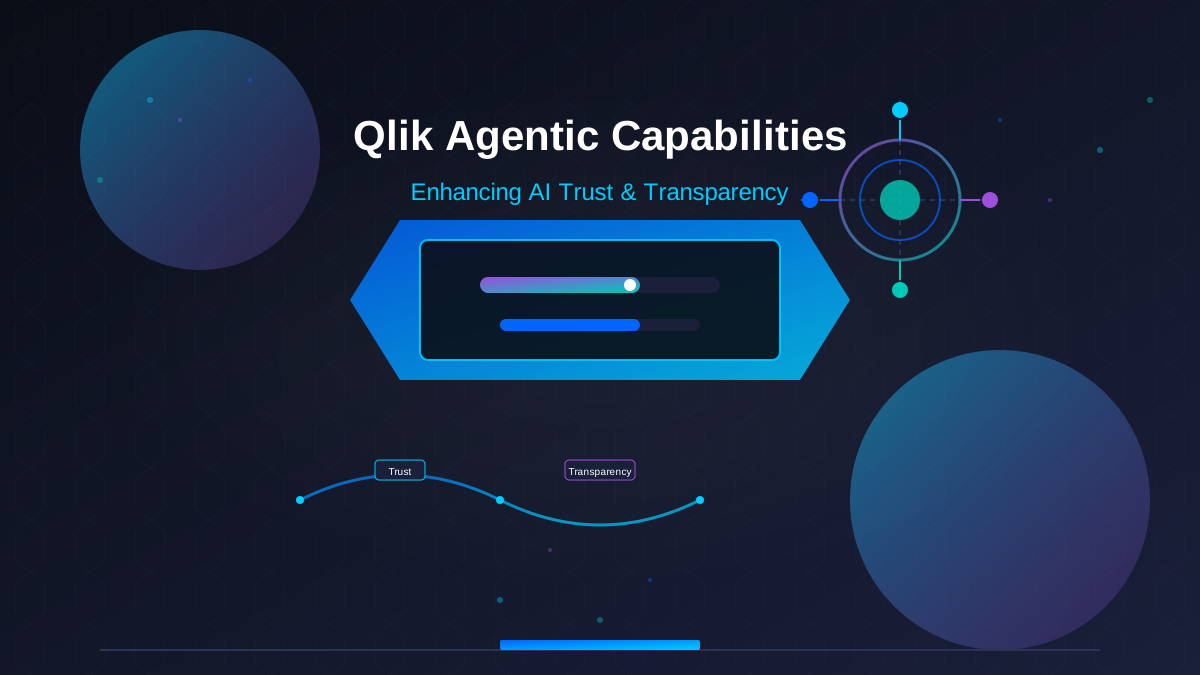
Has the AI Reckoning Arrived for Enterprises? Why Is Qlik Doubling Down on “Trustworthy AI” Now?
Yes, and it’s coming faster than many anticipated. The “AI reckoning” mentioned by Qlik CEO Mike Capone is not alarmist rhetoric but the harsh reality countless CIOs are facing: according to Gartner research, by the end of 2025, over 60% of enterprise AI projects failed to deliver expected business value, with nearly 80% of those failures attributed to “distrust in AI outputs” and “data infrastructure unable to support them.” Qlik’s latest launch precisely targets this multi-billion-dollar trust gap, attempting to reposition itself from a data visualization tool into the core engine for “trusted decision-making” in enterprises.
This move is both precise and risky. It’s precise because it captures the market’s inflection point from AI experimentation to AI production; it’s risky because it must convince the market that a traditional BI vendor can solve the trust and transparency issues that even AI-native companies struggle with. Capone’s argument is clear: the future winners won’t be companies with the most powerful algorithms, but those that enable enterprises to “confidently” delegate decision-making authority to AI. Underlying this is a battle over control and explainability. When AI recommendations directly trigger purchase orders or inventory adjustments, what enterprises need is no longer pretty charts, but a complete “decision traceability” mechanism. Through its new agent architecture, Qlik is attempting to become the standard-setter for this mechanism.
From “Viewing Reports” to “Automated Execution”: How Do Predict and Automate Agents Rewrite the Analytics Value Chain?
This duo extends the endpoint of the analytics value chain from “human decision-making” to “system automated execution.” Traditional BI tools (including Qlik’s own older versions) addressed “what happened” and “why it happened,” but stalled at the “so what should we do” step. The collaboration between Predict Agent and Automate Agent aims to bridge this final mile. Predict Agent is responsible for translating natural language questions into predictive models, e.g., “Which products in East China might face shortages next quarter?”; Automate Agent can then, based on prediction results, automatically create preventive replenishment work orders in ERP or ServiceNow, or even initiate supplier sourcing processes.
The industrial implications of this shift are profound. It means the role of data analytics departments will transform from a “cost center” (providing reports) to a “revenue-driving center” (directly optimizing operational efficiency). According to McKinsey simulations, combining predictive insights with workflow automation can save 15-25% of related costs in core processes like supply chain management. However, this also introduces new challenges: who is responsible for errors in automated decisions? Hence, the “explainability” emphasized by Qlik becomes a key selling point. Predict Agent not only provides answers but must also explain the basis and confidence intervals of predictions in a way business personnel can understand, which is the technical foundation for building trust.
The table below compares the differences between traditional BI, advanced analytics, and the new AI agent model:
| Dimension | Traditional BI (Descriptive Analytics) | Advanced Analytics (Predictive/Prescriptive) | Qlik’s New AI Agent Model (Agentic) |
|---|---|---|---|
| Core Output | Historical reports, dashboards | Predictive models, optimization recommendations | Executable decisions & automated workflows |
| User Interaction | Passive querying, drag-and-drop | Active questioning, parameter adjustment | Natural language conversation, goal setting |
| Value Realization Point | Post-mortem review | Pre-planning | Real-time action & execution |
| Trust Building Method | Data source labeling | Model accuracy metrics | Decision process explainability, traceability |
| Primary Risk | Insight-action disconnect | Recommendations not adopted | Potential error costs of automated actions |
flowchart TD
    A[Business User Poses<br>Natural Language Question] --> B{Predict Agent<br>Parses & Models}
    B --> C[Generates Predictions &<br>Explanatory Insights]
    C --> D{Does It Trigger<br>Pre-set Action Conditions?}
    D -- Yes --> E[Automate Agent<br>Initiates Corresponding Workflow]
    E --> F[Connects to External Systems<br>e.g., ERP, ServiceNow]
    F --> G[Automatically Executes Tasks<br>e.g., Creates Work Orders, Adjusts Orders]
    D -- No --> H[Provides Insight Report<br>for Manual Decision]
    G --> I[Results Feed Back to<br>Qlik Platform]
    I --> J[Continuous Learning &<br>Model Optimization Loop]
Alliance with ServiceNow: Strengthening Weaknesses or Building a New Moat?
This is a strategic move to build an ecosystem moat. The partnership with ServiceNow goes far beyond adding a few data connectors. At its core, Qlik is injecting its analytical intelligence directly into the central nervous system of enterprise IT and business workflows—ServiceNow’s Workflow Data Fabric. This addresses the classic “last mile” problem in AI applications: the disconnect between analytics platforms and execution systems.
For Qlik, this means the output of its analytics engine no longer requires manual translation and input to become the fuel driving daily enterprise operations. For example, if Predict Agent identifies a potential failure risk in a server cluster, Automate Agent can, through this integration, directly generate a high-priority repair ticket in ServiceNow IT Service Management and assign it to the appropriate engineer. This seamless linkage significantly enhances the “timeliness” and “accuracy” of analytical actionability, which are key reasons enterprises pay for AI.
From a competitive landscape perspective, this move directly targets giants attempting to build closed-loop ecosystems, such as Microsoft (connecting Dynamics 365 via Power Platform) and Salesforce (embedding Einstein AI into CRM processes). Qlik’s choice to ally with the neutral process management leader ServiceNow, rather than building its own process engine, is a more agile strategy. It acknowledges its own shortcomings in the “execution” domain and rapidly gains a ticket to the trillion-dollar enterprise process automation market through partnership. This also foreshadows that competition in the enterprise software market will increasingly take the form of “alliance versus alliance.”
Data Governance and Transparency: Evolving from Technical Issues to Strategic Necessities
Qlik’s alignment of data quality, governance, and AI transparency highlights the true bottleneck for current enterprise AI success. Many companies mistakenly believe that purchasing the most advanced AI models will yield intelligence, overlooking the ironclad rule of “garbage in, garbage out.” Qlik’s enhancement of “declarative pipelines” and real-time data routing capabilities aims to ensure the data fed to AI is clean, timely, and compliant. The underlying industry trend is: data governance is evolving from a back-office IT control function into a core competency in the AI era.
AI transparency (solving the “black box” problem) is another layer of strategic necessity. With regulations like the EU’s AI Act coming into effect, enterprises using unexplainable AI for critical decisions will face legal and reputational risks. Qlik’s requirement for its AI agents to provide explanations is not only to build trust but also for compliance. This will force the entire industry to raise standards for AI explainability. In the future, AI tools unable to provide decision traceability reports may be excluded from procurement lists in sensitive fields like finance, healthcare, and recruitment.
The table below lists key areas enterprises must strengthen in data and AI governance in the AI agent era:
| Governance Area | Traditional Challenges | New Requirements in the AI Agent Era | Qlik’s Corresponding Capabilities |
|---|---|---|---|
| Data Quality | Inconsistency, incompleteness | Timeliness, fitness for prediction | Real-time data routing, declarative pipelines |
| Data Lineage | Tracking ETL processes | Tracking data used for AI model training and decisions | Integration with ServiceNow Data Catalog, enhanced visibility |
| Model Explainability | Often overlooked | Key for legal compliance and trust building | Predict Agent provides prediction explanations and confidence intervals |
| Decision Auditing | Recording manual decisions | Recording autonomous decisions and actions of AI agents | Complete execution logs of automated workflows |
| Ethics & Bias | Post-hoc detection | Embedding safeguards and correction mechanisms during operation | Constraining AI agent behavior scope through governance frameworks |
Who Will Be Impacted? Redistribution of Winners and Losers in the Industry Chain
Qlik’s offensive will trigger chain reactions in the enterprise software market, redistributing winners and losers.
Directly Pressured Competitors:
- Traditional BI Giants (Tableau, Power BI, Looker): If they cannot quickly shift product focus from “visualization storytelling” to “agentic decision-making,” they risk marginalization in the advanced analytics market. Their advantage lies in vast user bases, but their disadvantage is that core architectures are not designed for automated execution.
- Pure-play MLOps Platforms: Platforms focused solely on machine learning model deployment and management may find their value overshadowed by “analytics + agent” platforms integrating end-to-end workflows. Enterprises may prefer a unified platform handling data, analytics, prediction, and action simultaneously.
Potential Beneficiaries:
- System Integrators & Consulting Firms: Implementing such complex AI agents and automated workflows requires extensive process redesign and system integration services. This creates new business opportunities for companies like Accenture and Deloitte.
- Other Process Automation & RPA Vendors: Such as UiPath and Automation Anywhere. Qlik’s partnership with ServiceNow validates the market for “analytics-driven automation,” but not all enterprises use ServiceNow. This opens imagination for alliances between other automation platforms and analytics tools, potentially fostering new collaborative ecosystems.
Cautious Observers to Watch:
- Major Cloud Providers (AWS, Azure, GCP): They possess complete stacks from data and AI to applications. Qlik’s move may prompt them to accelerate integration of their own analytics services (e.g., QuickSight, Synapse) with workflow automation tools (e.g., AWS Step Functions), leveraging their cloud infrastructure advantages for counterattacks.
timeline
title Evolution of Enterprise Analytics and AI Platform Competitive Landscape
    section 2010s : Visualization Dominance
        Traditional BI competition<br>focus: chart aesthetics & interactivity
        Tableau, QlikView, Power BI rise
    section Early 2020s : Cloud & AI Infusion
        Cloud-native architecture &<br>basic ML features become standard
        Giant acquisitions & integration<br>(Salesforce buys Tableau, Google buys Looker)
    section Mid-2020s : Trust Crisis Emerges
        Poor ROI in enterprise AI investments<br>black box problem gains attention
        Explainable AI (XAI)<br>becomes an emerging topic
    section 2026 & Beyond : Agentic & Action Era
        AI agents directly drive<br>business processes & decisions
        Competition keys:<br>ecosystem integration, trust mechanisms,<br>decision traceability
What Market Landscape Will We See in the Next Three Years?
Over the next three years, the enterprise AI market will sharply differentiate around the new axis of “trustworthy agents.”
First, integration and stratification will occur simultaneously. The market will see integrated platforms like Qlik offering “end-to-end trusted decision chains.” Simultaneously, it will foster deep-tech companies focusing on specific problems within the trust loop, such as independent service providers specializing in AI decision auditing, bias detection, or explanatory report generation. Platforms and point solutions will coexist, but platforms will occupy the high ground of the value chain.
Second, a “data product” mindset will become mainstream. Merely having data lakes or warehouses will no longer suffice. Enterprises need to package cleaned data with clear lineage and quality labels as “products” for direct consumption by AI agents. This will push data mid-platform architectures toward more productized, API-driven evolution. According to Forrester predictions, by 2028, over 70% of enterprises will establish “data product manager” roles specifically responsible for building such AI-ready data assets.
Third, new evaluation standards and procurement metrics will emerge. When procuring AI/analytics tools, enterprises will no longer just compare processing speed or model counts. Metrics directly related to trust and action effectiveness, such as “mean time to explanation,” “decision trace success rate,” and “automated action accuracy rate,” will become important selection criteria. This will force all vendors to redesign their product value propositions and marketing narratives.
In summary, Qlik’s launch is not just a product announcement; it’s more like a starting gun, declaring that the enterprise AI race has entered its second half. The first half competed on whose technology was flashier and models larger; the second half’s decisive factor lies in who can solidly solve trust issues, seamlessly and reliably embedding AI into the core gears of enterprise operations. For Taiwanese enterprises and tech players, this is both a warning and an inspiration: while chasing the AI wave, perhaps it’s more crucial to re-examine their own data foundations and process health, because future AI value will be firmly built upon these “boring” yet vital foundations.
FAQ
What key enterprise pain points do Qlik’s new AI agents primarily address? They primarily address the dilemma of enterprises failing to achieve expected returns on AI investments, with the core issues being lack of trust in AI decisions, poor data quality, chaotic governance, and AI models being opaque black boxes.
How do Predict Agent and Automate Agent collaborate? Predict Agent is responsible for receiving questions in natural language, building models, and generating predictions; Automate Agent can then automatically trigger complex workflows in external systems based on prediction results, achieving seamless linkage from insight to action.
What is the strategic significance of the partnership with ServiceNow for Qlik? This partnership embeds Qlik’s data analytics engine deep into ServiceNow’s workflow data fabric, directly enhancing data quality for its AI agents and opening up a vast entry point into the enterprise process automation market for Qlik.
How does Qlik’s move impact competitors like Tableau and Power BI? It elevates the competition from visualization reporting to intelligent decision-making and automated execution, forcing competitors to follow suit by strengthening AI agents and trust mechanisms, or risk losing influence in the advanced analytics market.
How should enterprises evaluate whether to adopt such AI agent solutions? Enterprises should first assess their own data governance maturity and existing workflow systems. If foundations are solid, adopting such solutions can significantly accelerate decision cycles; if foundations are weak, data quality must be strengthened first, otherwise AI agents will struggle to be effective.
Further Reading
- Gartner Report: Predicts 2026: Data and Analytics Strategies to Achieve Business Outcomes, delving into the main causes of AI project failures and the criticality of data governance.
- McKinsey: “The economic potential of generative AI: The next productivity frontier,” analyzing the value creation potential of AI automation in specific business processes.
- EU Official Document: “Regulation (EU) 2024/… of the European Parliament and of the Council laying down harmonised rules on artificial intelligence (AI Act),” understanding the regulatory background driving AI transparency demands.
{
  "image_prompt": "A futuristic and professional illustration in a corporate boardroom setting"
}