From “AI Tool” to “AI Colleague”: Why This Paradigm Shift Cannot Be Ignored?
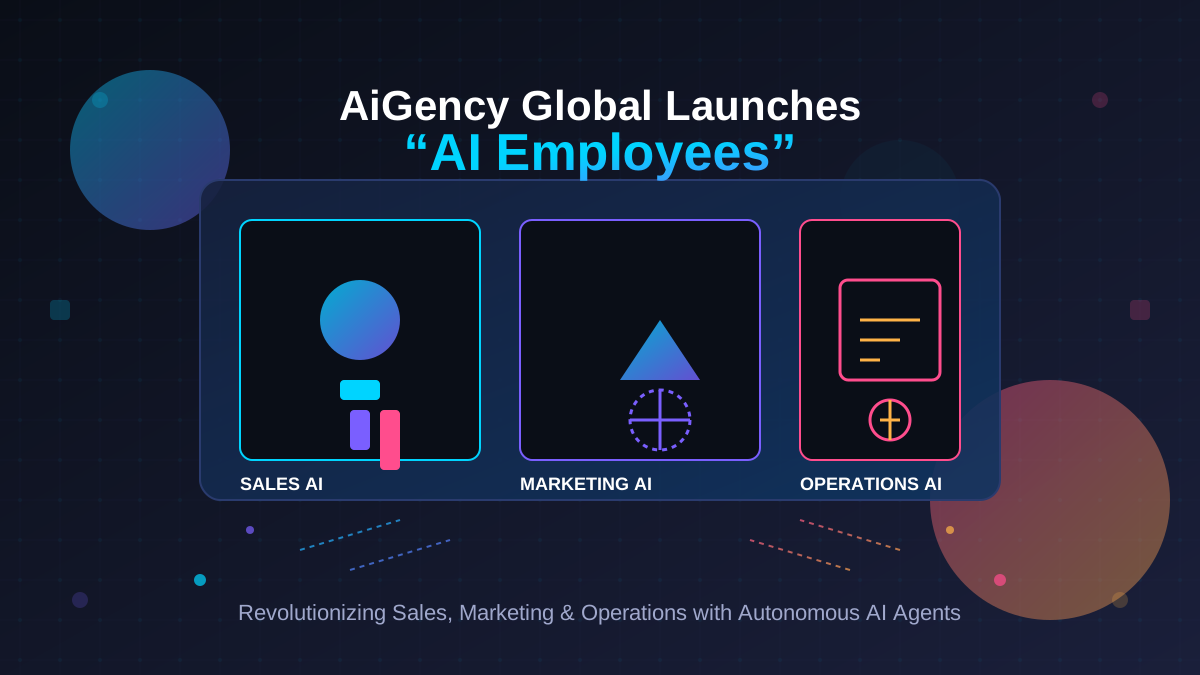
Simple answer: because it directly touches the ’execution core’ of business operations. Over the past decade, AI applications, whether chatbots or data analytics platforms, have mostly played the roles of ‘advisors’ or ‘filters’—they provide information, suggestions, or preliminary classifications, but the final decisions and execution remain firmly in human hands. The trend represented by AiGency Global is about granting AI a certain degree of ’execution authority,’ allowing it to complete entire work items directly within enterprise systems (such as CRM, ERP, or marketing automation platforms) within predefined rules and scopes. Examples include conducting initial outreach from a list of potential leads, responding to standard customer service tickets, or reviewing routine expense reimbursements based on rules. This means AI is moving from ’logistical support’ to ‘frontline combat,’ where its success or failure will directly impact key performance indicators (KPIs) like revenue, costs, and customer satisfaction. The industrial significance of this shift lies in the fact that a company’s ’execution bandwidth’ can be expanded for the first time at near-zero marginal cost. The impact on competitive landscapes, organizational design, and even the entire white-collar job market will be structural rather than incremental.
We are at a critical inflection point. According to a McKinsey 2025 research report, generative AI technology is projected to add $2.6 to $4.4 trillion annually to the global economy by 2030, with about 75% of that value concentrated in four major areas: customer operations, marketing and sales, software engineering, and R&D—precisely the main battlefields targeted by ‘AI employees’ like those from AiGency. This is not about ‘another productivity tool’; it is about reshaping the unit of value creation. When a ‘sales development representative’ or ‘customer service specialist’ can be subscribed to, deployed, and managed as a software service (SaaS), the logic of business growth will shift significantly from ‘recruiting and training human resources’ to ‘integrating and tuning AI workflows.’
Market Impact: Who Wins? Who Will Be Forced Out?
Winners will be agile enterprises that can quickly restructure workflows and embrace human-machine hybrid teams. Losers will be traditional companies that view AI only as point solutions and fail to adapt organizationally.
Let’s use a table to analyze the opportunities and threats faced by different market participants:
| Market Participant Type | Potential Opportunities | Main Threats Faced | Key Success Factors |
|---|---|---|---|
| Small and Medium Enterprises (SMEs) | Access professional functions previously affordable only to large corporations (e.g., 24/7 multilingual customer service, data-driven marketing analysis) at manageable costs, enabling a leap in competitiveness. | Inability to effectively define processes and manage AI outputs may lead to inconsistent customer experiences or operational chaos. The cost of wrong implementation decisions is higher with limited resources. | Clear process mapping, choosing highly customizable solutions with strong support, focusing on piloting a single high-return process. |
| Large Enterprises | Automate repetitive tasks at scale, freeing tens of thousands of employees for innovation and strategic work, while achieving unprecedented granularity and consistency in operational data. | Organizational inertia and technical debt from existing IT systems may severely slow integration. Departmental silos could lead to ‘islanded’ AI employees, failing to realize cross-functional synergy value. | Strongly driven transformation office from top leadership, investment in modernizing existing ERP/CRM systems, establishing a unified AI governance and ethics framework. |
| B2B Software Vendors (e.g., Salesforce, SAP) | Deeply integrate AI employee capabilities into their own platforms, increasing customer stickiness and average contract value (ACV), transitioning from ‘system providers’ to ‘workforce providers.’ | Risk of being ‘bypassed’ by agile startups like AiGency, which offer cross-system, optimized dedicated AI employees that could erode their platform’s core position. | Accelerating open APIs and partnership ecosystems, acquiring technology and talent quickly through acquisitions, offering AI capabilities as native features rather than add-on modules. |
| Human Resources and Consulting Services | Emerging demand for ‘AI workforce management’ consultants to help design human-machine teams, evaluate AI employee performance, and manage related change. Traditional recruitment services may shrink. | Demand for basic recruitment and compensation management services may decline significantly. Must demonstrate unique human insight value in the AI era. | Developing digital workforce strategy consulting capabilities, shifting service focus to organizational design, change management, and employee reskilling/upskilling. |
This landscape will evolve faster than many expect. Goldman Sachs research indicates that generative AI could affect 300 million full-time jobs globally. Products like AiGency’s do not directly eliminate these positions but ‘atomize’ and ‘automate’ them, making businesses prefer subscribing to more AI employee licenses over hiring new people when adding similar capacity in the future. This will have a profound ‘chilling effect’ on the job market, especially for entry-level white-collar roles.
Product Strategy Analysis: How Do AI Employees Actually ‘Go to Work’?
This is not just API calls; it’s the complete encapsulation of roles, responsibilities, and workflows. AiGency Global’s key insight is that businesses are not buying ‘AI capabilities’ but a ‘role’ that delivers specific business outcomes. The product strategy behind this is highly ambitious: it attempts to create a new software category—‘deployable digital labor.’ To achieve this, its product architecture must solve three core problems: 1) Contextual Understanding (understanding domain-specific knowledge and rules), 2) System Operation (safely interacting with enterprise software), and 3) Autonomous Decision-Making (making reasonable judgments within boundaries).
graph TD
    A[Enterprise Adopts AI Employee] --> B{Choose Deployment Mode}
    B --> C[Dedicated Mode<br>e.g., AI Sales Development Rep]
    B --> D[Shared Mode<br>e.g., AI Administrative Assistant]

    C --> E[Deep Integration with Single System<br>e.g., Salesforce]
    D --> F[Cross-System Task Execution<br>e.g., Calendar, Email, Expense Systems]

    E --> G[Execute High-Frequency Repetitive Tasks<br>Lead Screening & Initial Outreach]
    F --> H[Execute Cross-Department Support Tasks<br>Meeting Scheduling, Report Compilation]

    G --> I[Output: Qualified Lead List]
    H --> J[Output: Completed Administrative Processes]

    I --> K[Human Team Takes Over<br>for Deep Negotiation & Closing]
    J --> L[Human Employees Gain More<br>Time for Strategic Work]

    K & L --> M[Common Goal: Enhance Overall<br>Team Productivity & Business Outcomes]
The advantage of this architecture is the ‘out-of-the-box’ experience. Enterprises do not need to train a large language model (LLM) from scratch but configure an AI role pre-trained for ‘sales development’ or ‘frontline customer service’ and connect it to their own data sources and systems. This significantly lowers technical barriers and time-to-market. However, the real challenge lies in ‘boundary management’: the decision scope of AI employees must be clearly defined, as any ambiguity could lead to errors or risks. For example, when should an AI sales employee transfer a challenging lead to a human colleague? This requires fine-grained rules and ongoing supervised learning.
From a tech stack perspective, such products typically employ a hybrid architecture: combining foundational large models (e.g., GPT, Claude) for general understanding, specialized models fine-tuned for vertical domains, RPA (Robotic Process Automation) technology for system operations, and a monitoring layer for security and compliance. According to data from AI infrastructure company Scale AI, the cost of data annotation, testing, and security safeguards needed for an AI agent capable of reliably performing business tasks could be over 10 times higher than that for a basic chatbot. This also explains why such products are usually priced as enterprise subscriptions rather than consumer-grade pricing for the mass market.
Competitive Landscape: This Is an Arms Race Between Platforms and Startups
Giants seek to platformize capabilities, while startups bet on vertically integrated deep experiences. The winning model of the future may be ’the best application within a platform.’
AiGency Global is not an isolated case. This is a rapidly heating track. We can roughly categorize competitors into three types:
- Cloud and Productivity Platform Giants: Such as Microsoft (evolving toward department-specific Copilots through the Microsoft 365 Copilot ecosystem), Salesforce (Einstein AI is becoming more proactive and actionable), Google (integrating Gemini’s ‘assistant’ features into Workspace). Their advantage lies in unparalleled ecosystem integration and an existing enterprise customer base.
- Vertical AI Startups: Such as Gong focused on AI sales (expanding from conversation analytics to prediction and coaching), Intercom’s Fin focused on AI customer service, and numerous AI agents targeting specific fields like law, finance, and healthcare. Their advantage lies in deep domain knowledge and product flexibility.
- Foundation Model Providers and AI Development Platforms: Such as OpenAI (encouraging developers to build specialized agents via Assistants API and the GPT Store), Anthropic, and framework providers like LangChain. They provide the ‘arsenal’ for enterprises or developers to build their own AI employees.
The future competitive key will be ‘workflow occupancy.’ Whoever can more seamlessly and intelligently occupy critical workflow nodes in the enterprise’s core value chain will build higher switching costs. This is not just a technology battle but a battle over the depth of understanding of business processes. For example, if an AI sales employee can not only make outbound calls but also adjust scripts based on real-time conversation sentiment, automatically update the CRM, and coordinate with marketing systems to adjust the customer’s nurturing path, its value far exceeds that of a point solution.
The table below compares the strategic paths and potential weaknesses of different types of competitors:
| Competitor Type | Core Strategy | Key Assets | Potential Weaknesses |
|---|---|---|---|
| Platform Giants (e.g., Microsoft) | Ecosystem Bundling: Offer AI employee capabilities as a natural extension of productivity suites (e.g., M365), enabling seamless data flow. | Existing enterprise customer relationships, unified data and identity layers requiring no extra integration, powerful distribution channels. | Innovation speed may be slower, must consider compatibility for a vast existing customer base, difficult to achieve extreme depth optimization for specific industries. |
| Vertical Startups (e.g., AiGency) | Depth Optimization: Choose a few high-value functions (sales, marketing, operations) to perfect, offering superior specialization and ROI compared to general platforms. | Excellent experience from product focus, deep understanding of vertical processes, agile development and customization capabilities. | Risk of platform giants replicating features, need to convince enterprises to adopt another independent system, challenges in knowledge accumulation when expanding to new domains. |
| Foundation Model/Platform Providers | Empower the Ecosystem: Provide the best ‘brains’ (foundation models) and ’toolchains’ (development frameworks) for partners and customers to build countless AI employees. | Technological leadership, developer community, flexible neutral stance. | Further from final business value, reliant on ecosystem partner success; face homogenized model competition, profits may be squeezed by the application layer. |
In this race, it is unlikely that a single winner will take all. Instead, we will see a layered ecosystem: the foundation model layer provides intelligence, the platform layer provides integration environments and distribution, and vertical application layers like AiGency provide immediate operational capability. Enterprise procurement strategies will also become hybrid: acquiring basic AI capabilities from platform providers and purchasing ‘special forces AI employees’ for critical missions from vertical startups.
Industry Inflection: Will Human Resources Become the Center of Technology Strategy?
When labor can be ‘downloaded,’ HR’s function will shift from administrative management to architecting and optimizing the performance of ‘human-machine hybrid intelligence.’
One of the most profound impacts of this wave of AI employees is that it will completely change the definition and operation of ‘human resources.’ Traditional HR manages the recruitment, compensation, development, and retention of ‘human employees.’ In the future, the HR department (perhaps renamed ‘Workforce Resources Department’) will need to manage both ‘biological intelligence’ and ‘digital intelligence’ simultaneously. This is an unprecedented challenge and means HR will leap from a back-office support function to the core of corporate technology and operational strategy.
timeline
title AI Employee Evolution and HR Function Transformation Timeline
    section 2025-2027 : Trial and Parallel Period
        Enterprises pilot AI employees on non-core tasks<br>HR begins learning to evaluate AI performance metrics
        : Emergence of first 'AI Trainer' and<br>'Human-Machine Collaboration Process Designer' roles
    section 2028-2030 : Scaling Integration Period
        AI employees take on large volumes of rule-based work<br>HR systems integrate AI workforce management modules
        : HR core KPIs shift toward<br>'Hybrid Team Productivity' and 'Skill Transformation Success Rate'
    section 2031 Onward : Ecosystem and Strategic Period
        AI employees possess limited autonomous learning and collaboration capabilities<br>HR focuses on organizational design, culture, and strategic talent planning
        : 'Chief Workforce Officer' becomes a<br>standard executive-level position in corporations
This transformation will manifest in several specific aspects:
- Evolution of Recruitment: Recruitment for human employees will focus more on ‘high-order skills’ that cannot be automated—such as complex problem-solving, creativity, empathy, and strategic thinking. Simultaneously, enterprises will begin ‘procuring’ or ‘subscribing to’ AI employees, with evaluation criteria including task completion rates, accuracy, integration costs, and return on investment.
- Shift in Training: Training focus will shift significantly from ‘skill teaching’ to ‘human-machine collaboration coaching.’ Employees need to learn how to effectively instruct and supervise AI colleagues, how to decompose high-order tasks into AI-executable subtasks, and how to interpret and verify AI outputs.
- Complexity of Performance Management: How to fairly evaluate the outcomes of a project completed jointly by humans and AI? How to set ‘performance goals’ for AI employees? How to design incentive mechanisms that encourage human employees to actively embrace and enhance the effectiveness of AI colleagues? These will all be new management challenges.
- Restructuring of Cost Models: Labor costs will shift from primarily fixed costs based on ‘headcount’ to a hybrid model combining fixed (core human team) and variable (scalable AI subscriptions) costs. This enables businesses to operate with greater flexibility and efficiency.