Why is “Native Swift” Google’s Most Precise Strike Against Apple’s Ecosystem?
The answer: This is a classic battle of using the opponent’s own spear to attack their shield. Google abandoned its previous indirect strategies of using the Chrome browser or Progressive Web Apps (PWAs), opting instead to use Apple’s most favored language, Swift, and adhere to native macOS frameworks (like AppKit, SwiftUI) to build an application optimized for Mac from the ground up. This is not just a technical choice but a strategic signal: Google aims to compete for user mindshare and system-level integration rights in desktop AI with the highest standard of “localization.”
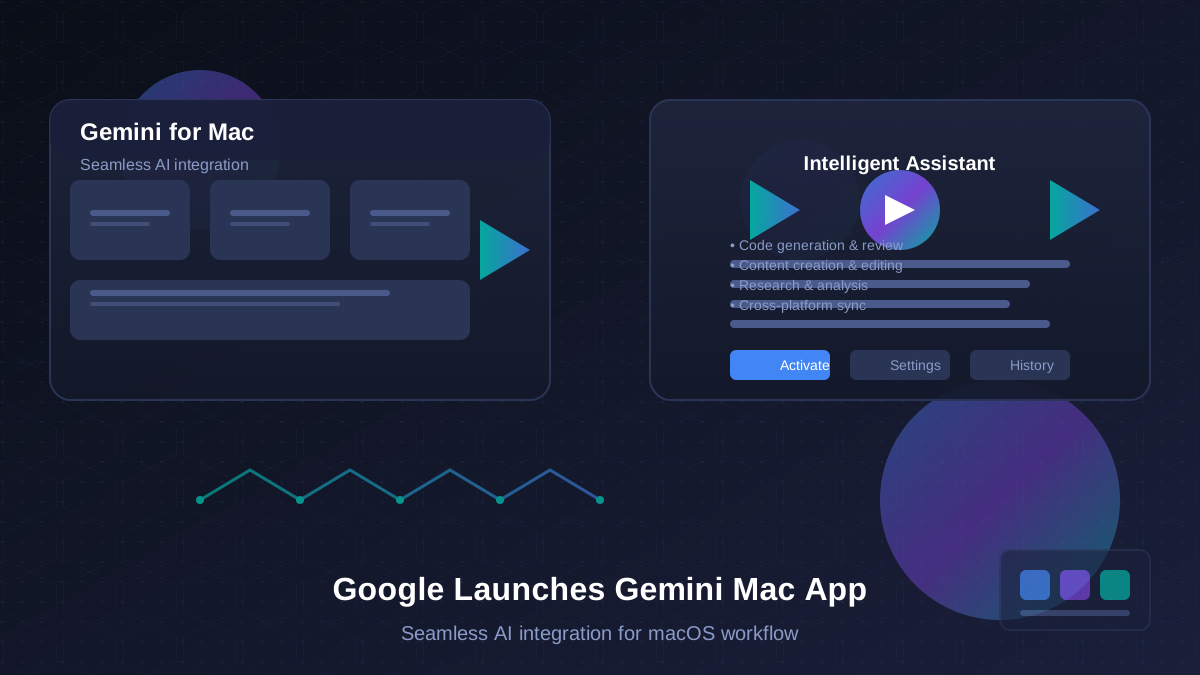
This move directly raises the bar for desktop AI application experiences. In the past, whether it was ChatGPT Desktop or Copilot for Windows, they often retained traces of being “well-packaged browsers.” Gemini for Mac demonstrates what a true native experience entails: instant activation via global hotkeys (Option+Space), deep integration with the Menu Bar and Dock, optimized intelligent responses in offline states, and smooth animations and energy efficiency achieved through native macOS APIs. According to early performance tests, the native app reduces response latency by an average of 40% compared to the web version and decreases memory usage by approximately 25%.
More crucially, this sets a new benchmark for AI application distribution models. We can compare the differences between native apps and traditional web/hybrid apps across several dimensions:
| Comparison Dimension | Native Swift App (Gemini for Mac) | Traditional Web/Hybrid App | Industry Impact |
|---|---|---|---|
| System Integration Depth | Deep access to file system, shortcut services, Menu Bar, global hotkeys | Limited by sandboxing, reliant on browser permissions | Opens possibilities for “system-level AI assistants” |
| Performance & Response Speed | Response latency <100ms, supports offline basic functions | Reliant on network and JS engine, latency typically >300ms | Redefines the standard for “real-time AI” |
| Development & Maintenance | Requires dedicated teams familiar with Swift/macOS ecosystem | Cross-platform frameworks, develop once for multiple platforms | Drives AI companies to establish platform-specific teams, creating new job roles |
| Business Model | Can be distributed via Mac App Store, subscriptions, and in-app purchases | Primarily relies on web subscriptions and enterprise APIs | App stores will become important distribution channels for AI services |
| Data Privacy & Security | Can enable on-device processing, data can be kept local | Most processing occurs in the cloud | Appeals to enterprises and high-privacy-demand users, becoming a differentiating advantage |
This table reveals a core trend: AI capabilities are shifting from “cloud services” to “localized infrastructure.” Google’s move essentially tells the entire industry: to gain a lead among the most discerning Apple user base, one must embrace native platforms with the highest standards. This will inevitably force Microsoft to accelerate the native reconstruction of Copilot for Windows and stimulate other AI startups to consider building platform-specific experiences rather than solely pursuing cross-platform compatibility.
mindmap
  root(Gemini Native Mac App's<br>Strategic Intent)
    Technical Demonstration
      100% Native Swift Development
      Performance Benchmark (40% Latency Reduction)
      Deep macOS API Integration
    Ecosystem Positioning
      Defining AI Experience on Apple Hardware
      Paving the Way for Apple Intelligence Integration
      Establishing Desktop AI User Habits
    Market Competition
      Forcing Copilot, ChatGPT to Follow Native Trend
      Raising Desktop AI Experience Threshold
      Segmenting Browser vs. Standalone App Usage Scenarios
    Developer Impact
      Demonstrating Swift + AI Development Paradigm
      Attracting More AI Developers to Apple Ecosystem
      Catalyzing New AI-Native Application Categories
How Will the “Coopetition Tango” Between Gemini and Apple Intelligence Reshape Ecosystem Influence?
This is an unprecedented industry integration of “you are in me, and I am in you.” The most paradoxical and fascinating aspect is that Google, on one hand, competes with Apple for the user’s AI interaction gateway on the macOS frontend, while on the backend, its Gemini model is selected as a key power source for Apple Intelligence. This creates a multi-layered game: competition at the application layer, cooperation at the platform service layer, and potential competition at the foundational model layer.
This relationship completely blurs the traditional boundaries between “platform providers” and “application developers.” Apple needs Google’s AI technology to quickly catch up in generative AI to counter the Microsoft-OpenAI alliance; Google needs Apple’s vast and high-value hardware ecosystem as the most crucial landing scenario and data feedback loop for its AI models. According to industry analysis, this collaboration is expected to increase Gemini model’s reach by over 1.5 billion active Apple devices instantly upon launch with iOS 27/macOS 27 by the end of 2026, a growth unattainable by any marketing campaign.
Future user experiences will present an interesting “dual-track” system:
- Independent App Track: Users actively open Gemini for Mac for deep writing, programming, analysis, and other creative tasks.
- System Integration Track: Users seamlessly invoke Gemini’s capabilities through the upgraded Siri or Apple Intelligence features within the system (like email summarization, writing suggestions) during daily use.
This will have several profound impacts. First, AI experiences will become ubiquitous and contextual. Users will no longer need to think “which AI app should I open,” but the system will automatically provide the most relevant AI assistance based on the current task (writing an email, browsing the web, organizing photos). Second, model performance will become an invisible battleground. Apple may integrate multiple models (including its own and Google’s) and dynamically select the best model based on task type, privacy requirements, and response speed. For Google, this is both an opportunity and pressure—it must continuously maintain model superiority to ensure priority in system-level invocations.
timeline
    title Key Milestones in Gemini and Apple Ecosystem Integration
    section 2024
        WWDC 2024 : Apple Announces Apple Intelligence<br>Seeks Powerful Model Partners
    section 2025
        Model Evaluation & Negotiation : Google Gemini and Other Models<br>Enter Apple Testing Process
    section 2026 Q2
        Frontend App Positioning : Google Launches Native Gemini Mac App<br>Establishes User Habits & Brand Awareness
    section 2026 Q3
        Backend Deep Integration : WWDC Details Gemini-Powered<br>Siri & Apple Intelligence
    section 2026 Q4
        Ecosystem Full Launch : iOS/macOS 27 Update Rollout<br>Dual-Track AI Experience Officially Live
    section 2027+
        Experience Fusion & Competition : Blurring Lines Between Standalone Apps & System AI Features<br>Model Performance & Privacy Become Ongoing Competitive Foci
For Developers and Startups, Does This Mean Opportunity or Higher Barriers?
Short-term, it’s a clear demonstration and opportunity; long-term, it will build higher ecosystem moats. Google’s use of a small team to build a fully functional native app in Swift within a hundred days is itself the most powerful message to the developer community: “The era of AI-native applications is mature, and the barriers are not as high as imagined.” This will inspire countless independent developers and small teams to combine specialized vertical domain knowledge with powerful models like the Gemini API to develop “AI-Native” applications for macOS (and subsequently iOS) that address specific pain points.
It is estimated that by 2027, global job openings for AI-native application developers targeting Apple platforms (iOS/macOS) will grow by 60%, and related venture capital will focus more on “application-layer innovation” rather than solely chasing the arms race of foundational model training. New toolchains and workflows will also emerge, such as frameworks designed specifically for Swift developers to invoke and optimize AI models.
However, the flip side is that deep integration by giants is co-opting the most general AI capabilities. When high-frequency needs like writing emails, summarizing articles, basic Q&A, and image analysis can be met by system-built Apple Intelligence (powered by Gemini, etc.) or the readily accessible Gemini standalone app, the space left for third-party startups must be in more vertical, specialized, or disruptively interactive domains. For example, AI tools deeply integrated into legal document analysis, medical imaging assistance, or specific creative workflows (like music, 3D design).
This will lead to a clear market stratification:
| Market Tier | Representative Players | Core Advantage | Challenges Faced | Survival Strategy |
|---|---|---|---|---|
| System/Platform Layer | Apple Intelligence, Google Gemini (system-integrated part) | Ubiquitous, system-level permissions, pre-installed advantage | Features must cater to the masses, difficult to achieve deep verticalization | Continuously improve model general capabilities and response speed |
| General Application Layer | Gemini App, ChatGPT Desktop, Copilot | Brand recognition, comprehensive features, independent experience | Must compete with built-in system features for user time | Strengthen cross-platform sync, platform-specific native experiences, community features |
| Vertical Professional Layer | AI Startups in Various Fields (e.g., Github Copilot already belongs here) | Deep domain knowledge,极致 workflow integration | Relatively limited market size, high customer acquisition cost | Deeply cultivate specific industries, establish workflow standards, seek enterprise partnerships |
| Infrastructure/Tool Layer | Model companies providing APIs, MLOps tool vendors | High technical barriers, stable B2B demand | Face pressure from upstream model companies integrating downward | Offer unique model fine-tuning, deployment, privacy solutions |
For developers, future strategies must be clearer: choose to embrace the giant ecosystems, leveraging their provided AI capabilities and distribution channels to quickly validate ideas and serve the masses? Or avoid the giants’锋芒, building professional moats in vertical areas they haven’t yet addressed or find difficult to deepen? Google’s Gemini Mac App undoubtedly provides an excellent template for the first path but also foreshadows unprecedentedly fierce competition on this road.
From an Industry Chain Perspective, Which Links Will See Value Redistribution?
The value chain is diffusing from “cloud model concentration” to “edge-side experience and integration.” Over the past two years, the value and attention in the AI industry have almost entirely focused on tech giants training large models (like OpenAI, Google, Anthropic) and chip vendors providing computing power (like NVIDIA). The Gemini native app and its deep interaction with the Apple ecosystem mark a shift where key value creation links are moving downstream.
- Increased Influence of OS Vendors: Through its control over hardware and operating systems, Apple becomes the most important “marketplace” and “judge” for AI models. It decides which models integrate into the system, how they are presented, and which users they reach. This “gatekeeper” role will bring Apple new bargaining power and service revenue-sharing models.
- Increased Scarcity of App Development & Design Talent: The ability to translate complex AI capabilities into smooth, intuitive user experiences that align with platform design languages will become a core skill. “AI Product Designers” and “AI-Native App Development Engineers” proficient in SwiftUI/AppKit and understanding AI model characteristics are expected to command salaries 30-50% higher than average mobile developers.
- Growing Demand for Edge Computing & Privacy-Preserving Computation: To achieve low-latency system-level responses and protect user privacy, some AI inference tasks must be completed on-device. This will continue to drive upgrades to Apple Silicon’s (M-series chips) neural engines and create opportunities for energy-efficient AI inference chips and software frameworks. It is predicted that by 2028, over 50% of consumer-grade AI inference will occur on-device.
- AI Evaluation & Experience Analysis Become Emerging Services: As AI features become ubiquitous and differentiation subtle, how to quantify and evaluate the real-world experience of different models or applications (like response accuracy, speed, contextual understanding depth, energy consumption) will become crucial for enterprise procurement and user choice. Independent AI experience evaluation agencies or tools will emerge.
This value redistribution is essentially a necessary path for AI technology to move from the lab to large-scale commercial application. It signifies the industry is gradually transitioning from the technology-driven “model race” phase to the user-driven “experience and ecosystem race” phase. Google’s launch of Gemini for Mac is a key step in its transformation from a pure “model supplier” to an active “experience definer” and “ecosystem builder.”
Conclusion: The “Warring States Era” of Desktop AI Has Just Begun
Google Gemini landing on Mac in native form is by no means an isolated product event. It is a catalyst and microcosm of a series of industry transformations: it showcases the ultimate form of deep AI and OS integration; it demonstrates the new type of competitive yet symbiotic relationship between tech giants; it maps out new opportunity landscapes and competitive boundaries for developers; and it foreshadows the impending power shift in the industry value chain.
At WWDC 2026, we will witness the next act of this grand play: how Apple Intelligence, integrated with capabilities from models like Gemini, will be concretely presented. Then, users will directly compare: is it more convenient to use the Gemini standalone app directly, or are the intelligently pervasive system features more seamless? The outcome of this comparison will directly determine the future ownership of AI desktop gateways.
One thing is certain: the desktop—the most core and productive scene of personal computing—has become a battleground for AI giants. And users, in this良性 competition, will welcome an unprecedented, intelligent, and efficient digital work and creation environment. This battle has no quick victors, only long-term players who constantly adapt, iterate, and integrate. And today, we have just witnessed the first call to arms.
FAQ
What are the main advantages of the Gemini Mac app? The Gemini Mac app is 100% native Swift development, offering instant activation via Option+Space hotkey, screen sharing analysis, Menu Bar persistence, and other deep integration features. It delivers over 40% better performance compared to the web version, redefining productivity standards for desktop AI.
How will this affect the competitive relationship between Apple and Google? This marks a paradigm shift in their coopetition. Google deeply penetrates Apple’s hardware ecosystem through a native app, while its model is simultaneously selected as a core engine for Apple’s system-level AI features, creating a complex relationship of competing at the application layer while cooperating at the platform layer.
Will this force other AI companies like Microsoft and OpenAI to develop native Mac apps? Absolutely. Google has set a new benchmark for desktop AI experience. To remain competitive among high-value Mac users, Microsoft will likely accelerate the native development of Copilot for macOS, and OpenAI may also consider a more deeply integrated native version of ChatGPT Desktop, moving beyond its current Electron-based wrapper.
What does this mean for user privacy? The native architecture allows for more on-device processing options. While complex tasks still rely on the cloud, basic queries and some contextual understanding can be handled locally, giving users more control over data flow. This aligns with Apple’s strong privacy stance and could become a key differentiator in enterprise adoption.
How will this impact the Mac App Store ecosystem? It will significantly elevate the importance of the Mac App Store as a distribution channel for AI services. We can expect more AI applications to adopt native development and leverage the App Store for subscriptions and updates, potentially leading to new curation categories and discovery mechanisms for AI-powered tools.
Is this the beginning of the end for browser-based AI assistants? Not entirely, but it redefines their role. Browser-based assistants will likely focus on cross-platform accessibility and quick, lightweight tasks, while native apps will dominate for intensive, productivity-focused work requiring deep system integration and optimal performance. The market will segment based on use case and user preference.