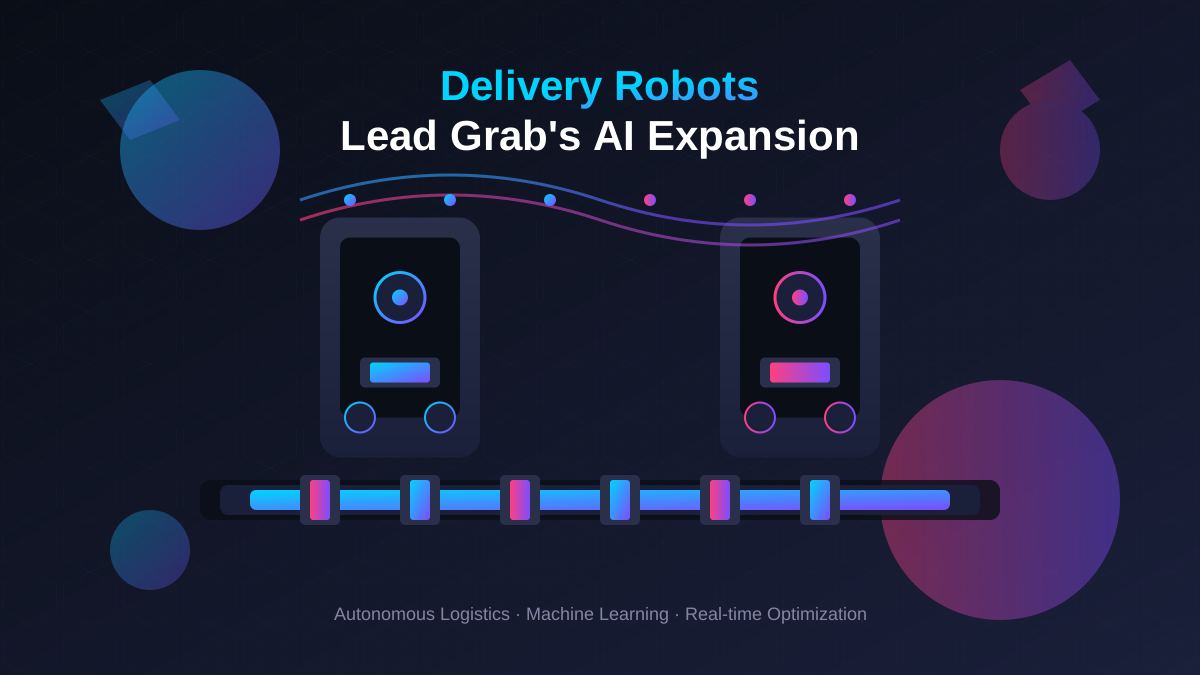
From “Delivery” to “Delivering Efficiency”: What Future Does the Carri Robot Reveal for Platforms?
The emergence of Carri directly addresses an increasingly acute pain point in the platform economy: the ceiling of human efficiency. When subsidy wars become unsustainable and user growth slows, a platform’s profitability depends on its ability to extract more value from every minute of driver work time and every customer interaction. The “10% wasted driver work time” highlighted by Grab co-founder Anthony Tan is not just a loss of driver income; it represents idle capacity and depreciation of the platform’s core asset (transportation power). Carri’s strategic positioning is crystal clear—it is not a flashy showcase but a precise scalpel targeting the chronic issue of “waiting time.” This indicates that Grab’s AI strategy has entered the “deep end,” moving from optimizing algorithm-based matching within the app (virtual layer) to optimizing the physical processes of food pickup and handover (physical layer). This leap in complexity increases exponentially, but it also means that once successful, the competitive moat will be upgraded from code-built cement to reinforced concrete mixed with hardware, software, and on-site workflows.
Looking deeper, Carri represents Grab’s significant bet on the “AI-human collaboration” model. Tan’s emphasis on “assisting, not replacing” stems from both considerations of stabilizing the existing ecosystem of driver partners and pragmatic business judgment. In the highly complex demographic and urban environments of Southeast Asia, the cost and risk of full automation are extremely high. The “augmenting humans” approach allows Grab to inject AI productivity into the existing network with lower friction while collecting valuable real-world operational data, paving the way for higher levels of automation in the future. This is a clever strategy of “advancing while having a fallback.”
Grab’s AI Blueprint: Ecosystem Deepening or Risk of Overextension?
GrabX 2026 unveiled over 13 new AI experiences at once, spanning consumers, travelers, merchants, and drivers, showcasing its ambition to position AI as the “operating system” of the entire super app. We can quickly grasp the full scope and strategic intent of its AI expansion through the following table:
| Target Audience | Key New AI Features | Core Pain Points Addressed | Strategic Intent Analysis |
|---|---|---|---|
| Consumers | Group Ride (AI carpooling), GrabMore (multi-merchant order consolidation), Grab AI Shopping Assistant | Delivery fee sensitivity, time-consuming shopping decisions, need for personalized recommendations | Increase order frequency and average order value. Lower usage barriers and costs through AI, “locking” users deeper into the ecosystem for more consumption. |
| Travelers | Personalized Travel Companion, Discover by Grab for local exploration, GrabPay for Travel | Cumbersome cross-border travel planning, inconvenient payments, difficulty finding local experiences | Capture the high-value travel economy. Extend local service advantages to inbound tourists, create new revenue growth drivers, and enhance international brand image. |
| Merchants/Drivers | Carri delivery robot, Virtual Store Manager, Cloud Printer | Low driver efficiency, crude in-store operations management, error-prone order processing | Empower partners, improve end-to-end efficiency. Reduce operational costs and error rates for partners through tools, thereby enhancing overall platform service quality and reliability. |
This blueprint appears comprehensive but hides immense execution challenges. Grab is attempting to replicate its past success model in ride-hailing and food delivery across multiple fronts simultaneously using AI. This requires astonishing technical integration capabilities, data processing scale, and deep understanding of different verticals (e.g., travel, retail, finance). The risk is that resources may be overly dispersed, resulting in each AI feature being “present” but not “excellent,” failing to create truly killer experiences. Especially when facing opponents specialized in specific domains like Gojek, Traveloka, and even TikTok expanding aggressively in Southeast Asia, whether Grab’s “universal AI assistant” strategy can gain an advantage in every细分战场 remains unknown.
However, from a positive perspective, this is precisely where the data advantage of a super app lies. Grab possesses cross-scenario behavioral data of users from mobility, dining, shopping to payments, which is unmatched by any single-service provider. The power of its AI will likely ultimately manifest in “cross-scenario intelligent prediction and recommendation”—for example, proactively recommending and pre-ordering a lunch set before your break based on your commute route and past dietary preferences; or automatically arranging airport pickup and recommending nearby restaurants after you book a hotel. This seamless, anticipatory service orchestration is the ultimate value of Grab’s AI ecosystem.
The Investment Boom in Real-World AI: Precursor to a Bubble or Dawn of an Industrial Revolution?
Grab’s bet on Carri is not an isolated case; it is riding a global trend. Barclays’ report notes that robots and drones could potentially reduce delivery costs to as low as $1 per order, a figure with disruptive appeal to current labor cost structures. According to PYMNTS’ March observations, venture capital is flowing heavily into “real-world AI” companies—those building systems that operate in the physical world. The rise of this boom is driven by the maturation of several key conditions:
- Breakthroughs in AI Perception and Decision-Making: Advances in computer vision, sensor fusion, and edge computing enable robots to better understand and respond to chaotic real-world environments.
- Declining Hardware Costs: Economies of scale in key components like radar, cameras, and chips make commercial robots increasingly economically viable.
- Urgency of Business Models: Many regions globally face labor shortages and rising costs, shifting corporate demand for automation solutions from “nice-to-have” to “essential for survival.”
We can use a simple flowchart to understand how real-world AI (like Carri) creates a value loop:
flowchart TD
    A[Driver arrives at complex pickup point<br>e.g., large mall] --> B{Traditional Process}
    B --> C[Driver gets off to find restaurant<br>may get lost or wait]
    C --> D[Takes ~5-10 minutes<br>Driver loses income opportunity]
    D --> E[Platform capacity sits idle<br>Customer wait time lengthens]

    A --> F{Process with Carri}
    F --> G[Driver waits at pickup point<br>summons Carri via App]
    G --> H[Carri autonomously navigates to restaurant<br>picks up food and returns]
    H --> I[Hands over food to driver<br>driver stays put]
    I --> J[Driver immediately heads to next destination<br>platform capacity turnover improves]
    J --> K[Customer receives food faster<br>satisfaction increases]
The core of this loop lies in transforming uncertain “waiting time” into predictable, parallel-processable “robot task time.” According to industry estimates, effectively saving that 10% of wasted work time could unlock potential capacity value worth hundreds of millions of dollars annually across Grab’s millions of drivers. This does not even include the order volume growth and customer retention improvements from faster deliveries.
However, the path to real-world AI adoption is far from smooth. The following table compares its main challenges and potential response directions:
| Challenge Category | Specific Difficulties | Potential Impact on Grab | Possible Coping Strategies |
|---|---|---|---|
| Technology & Environment | Stable navigation in dynamic, unmapped indoor environments; safe interaction with pedestrians and other robots. | High initial failure rates, affecting service reliability and potentially triggering PR crises. | Adopt a “hybrid navigation” strategy combining pre-built maps with real-time sensing, with low-speed operation and strict obstacle avoidance rules. |
| Business Integration | Persuading restaurants to cooperate, altering their food prep workflows to accommodate robots; coordinating with mall property management. | Slow rollout speed, difficulty achieving network effects, limited to few partner locations. | Offer incentive schemes (e.g., traffic prioritization) to cooperating restaurants; form strategic partnerships with large property groups for design-level integration. |
| Cost & Scale | High costs per robot for acquisition, maintenance, charging/battery swap, and remote monitoring. | Difficult to achieve profitability short-term, potentially dragging overall financial performance. | Prioritize deployment in high-order-density, high-time-cost scenarios (e.g., CBD office areas) to maximize ROI. |
| Social Acceptance | Public perception of robots occupying public space; privacy (cameras) and safety concerns. | Face community resistance or regulatory scrutiny, causing project delays. | Conduct public education and experience campaigns; design friendly appearance (e.g., Carri’s name and look); establish transparent data usage policies. |
The Southeast Asian Tech Arena: What Chain Reactions Will Grab’s AI Arms Race Trigger?
Grab’s move undoubtedly drops a bombshell in the Southeast Asian tech circle. Competition in this market has always been fierce, from early ride-hailing subsidy wars to cutthroat food delivery platform battles; now the flames have clearly spread to the AI domain. Grab’s comprehensive AI push will force its main competitors to respond.
For Gojek, which also possesses a super app ecosystem and data, it will inevitably accelerate its own AI deployment. The competitive focus may lie in who can faster empower its vast network of “GoTroops” drivers and merchant partners with AI, creating more significant efficiency improvement cases. For specialists like Foodpanda and ShopeeFood, the pressure is more direct. They may choose to partner with third-party robotics companies or focus on developing more specialized AI tools in specific verticals (e.g., grocery delivery) to compete through differentiation.
On a macro level, Grab is setting a new “intelligent platform” threshold. In the future, merely providing basic matching and payment functions will no longer suffice. Platforms must demonstrate their ability to create additional value for all participants (users, drivers, merchants) through AI. This will accelerate tech investment across the region and likely trigger a new wave of talent wars, especially for AI engineers, machine learning experts, and robotics specialists.
Furthermore, regulators will be pushed to a new frontier. As AI begins to handle financial credit (like Cash Loan) at scale, impact the job market (human-robot collaboration), and navigate public spaces, how Southeast Asian governments formulate “AI governance frameworks” that both encourage innovation and mitigate risks will become a key variable influencing the direction of this race. As a first mover, Grab’s interaction experience with regulators will also provide crucial reference for the entire industry.
Conclusion: This Is Not Just a Grab Product Launch, but a Signal of Paradigm Shift in the Platform Economy
Grab’s AI feast in the spring of 2026 should not be simply viewed as a tech showcase by one company. It is a strong industry signal, announcing that platform economy competition has entered a new stage: from capital-driven scale expansion to intelligence-driven精细化运营 and ecosystem value extraction.
The Carri robot symbolizes a critical step of AI moving from the virtual to the physical world, while the dozen-plus AI services surrounding it demonstrate the ambition to permeate data intelligence into every touchpoint of user life. The key to success will lie in whether Grab can connect these scattered AI “dots” into smooth experience “lines,” ultimately weaving an inescapable service “net.”
For investors, the focus should no longer be solely on GMV or monthly active user growth, but also on deeper operational health metrics like AI feature penetration rate, driver efficiency improvement indicators, and user cross-service usage rate. For consumers and partners, we are entering an era of more convenient yet more “omniscient” super platforms. How to enjoy the convenience while examining its long-term impact on data privacy, market competition, and even social structure is an issue everyone must begin to ponder.
Grab’s AI expansion journey has just begun, but it has already painted a clear picture of the future: where platforms are no longer mere intermediaries but, through artificial intelligence, become “digital brains” that proactively plan, predict, and optimize our physical lives. The success or failure of this experiment will define the landscape of the tech industry for the next decade.
FAQ
What is the main purpose of Grab launching the delivery robot Carri? The main purpose of Carri is to assist drivers, not replace them. It aims to solve the problem where drivers waste about 10% of their work time searching for restaurants inside malls or waiting for customers downstairs. By having the robot handle food pickup and handover, drivers can move to the next order faster, improving overall operational efficiency and driver income.
What aspects does Grab’s current AI expansion cover? This expansion covers three major aspects: consumers, travelers, and merchants/drivers, with over 13 new AI experiences launched. These include carpool optimization, multi-merchant delivery fee consolidation, AI shopping assistant, personalized travel companion, and virtual store manager, showing its intent to deeply integrate AI into various vertical services.
Why is real-world AI gaining investor favor in 2026? Investment trends are shifting from pure software AI to systems that can operate in the physical world. Barclays’ report notes that robots and drones could potentially reduce delivery costs to as low as $1 per order. This significant potential for cost and efficiency optimization is attracting substantial venture capital.
How does Grab’s AI strategy impact competition in Southeast Asian tech? By strengthening its super app ecosystem moat with AI, Grab intensifies competition with regional rivals like Gojek and Foodpanda. This move also sets a new service standard, potentially forcing competitors to follow suit in investing in AI and automation, accelerating the tech arms race across the region.
What are the main challenges facing AI delivery robots? Main challenges include reliable navigation and interaction in complex physical environments (like crowded malls, office buildings), integration with existing merchant workflows, high initial deployment and maintenance costs, and public concerns about robot acceptance and safety.