Why Has “Developability” Assessment Suddenly Become a Fiercely Contested Arena?
Simple answer: because people are scared of burning money. For biologic drugs, especially antibody therapeutics, up to 30% of late-stage clinical failures can be attributed to manufacturing and product quality issues. These problems often only surface after hundreds of millions of dollars and several years have been invested. The core value of platforms like Biointron’s lies in pushing the point of failure extremely early, using relatively minimal testing costs to avoid catastrophic late-stage losses. This is not just technical optimization; it’s financial engineering for risk management.
Over the past decade, antibody drugs have become the dominant force in the biopharmaceutical field, but their complex molecular structures present extremely high production barriers. An antibody that performs excellently in the lab may exhibit aggregation, instability, or purification difficulties during scale-up production. In traditional workflows, these “developability” screenings often occur only after a lead candidate is identified, leading to many projects being abruptly halted after preclinical or Phase I trials, with all prior investments lost.
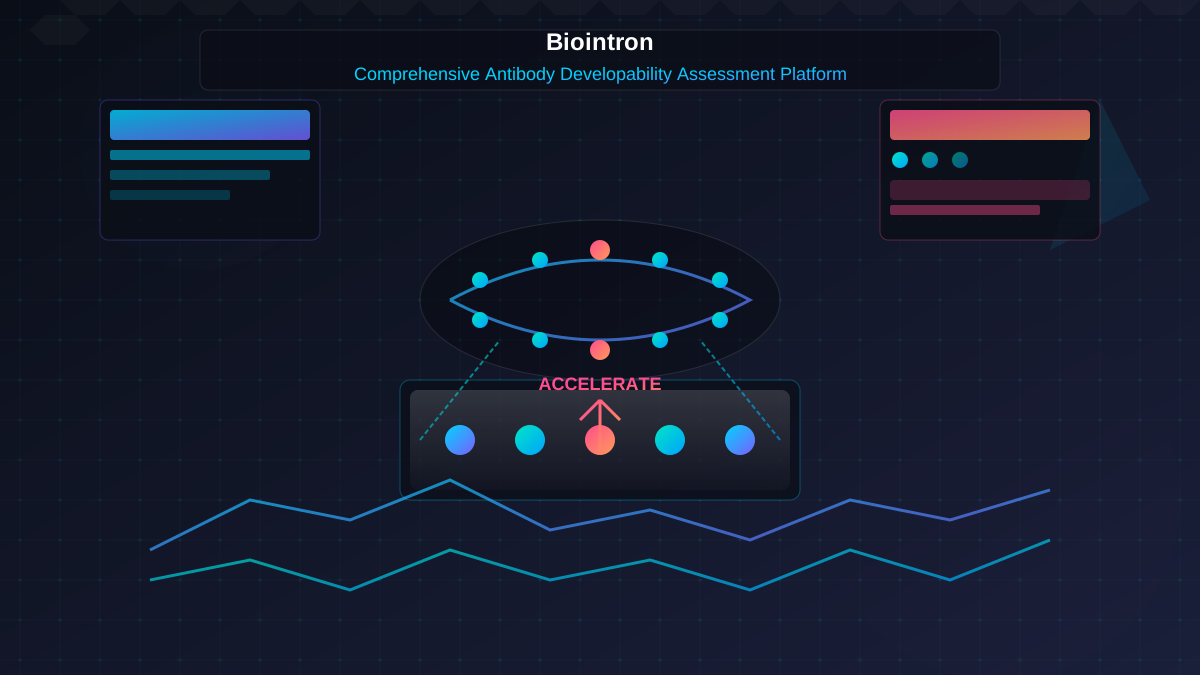
According to industry data, the antibody optimization services market reached approximately $3 billion in 2025 and is growing at over 8% annually. This growth momentum directly stems from pharmaceutical companies’ relentless pursuit of R&D efficiency. The table below compares key differences between traditional and emerging assessment models:
| Comparison Dimension | Traditional Developability Assessment | Emerging Platform Model Represented by Biointron |
|---|---|---|
| Intervention Point | After lead candidate identification (preclinical) | Early in the discovery phase, even parallel with functional screening |
| Throughput & Speed | Low throughput, weeks to months | High throughput (>3000/batch), single analysis in 3-5 days |
| Data Dimensions | Limited, focusing on few key parameters | Comprehensive, covering thermal stability, self-interaction, hydrophobicity, aggregation risk, non-specific binding, etc. |
| Decision Basis | Primarily based on empirical judgment | Data-driven quantitative metrics |
| Core Cost | High risk of late-stage failure | Relatively low cost of early screening |
The essence of this shift is moving drug development from an “art” towards an “engineering discipline.” The driving forces behind it are instrument automation (e.g., Biacore, Carterra), microfluidic technology, and most importantly—the maturation of data science and AI. The vast, multi-dimensional biophysical data generated by such platforms is the perfect fuel for training AI models to predict antibody behavior.
timeline
    title Evolution of Antibody Drug Development Process and Risk Point Shift
    section Traditional Process (High Risk Back-Loaded)
        Early Discovery : Functional activity screening<br>Select lead molecule
        Preclinical Development : Conduct developability assessment<br>High failure rates manifest at this stage
        Clinical Trials : Invest heavily in human trials<br>Manufacturing issues may cause late-stage failure
    section Emerging Platform-Driven Process (Risk Front-Loaded)
        Early Discovery : Functional screening and developability assessment in parallel
        Lead Optimization : Select easy-to-develop molecules based on data<br>Failure point significantly advanced
        Late-Stage Development : Molecules entering clinical trials<br>Manufacturing risk already significantly reduced
Who Are the Biggest Winners and Potential Losers in This Efficiency Revolution?
The biggest winners are undoubtedly small and medium-sized biotech companies with limited resources. In the past, comprehensive developability assessments required building expensive in-house teams and equipment, often the privilege of large pharmaceutical companies. Now, through professional platform services from CROs (Contract Research Organizations), startups can also affordably access assessment capabilities comparable to big pharma. This democratizes competition in early-stage drug discovery, allowing innovation to emerge from garages or university labs, not just from giants’ R&D centers.
Another hidden winner is companies focused on AI-driven drug design. Firms like Absci or Generate Biomedicines, whose AI platforms aim to design proteins (including antibodies) with desired properties from scratch. The empirical data provided by platforms like Biointron is the critical feedback loop for validating and iterating AI design models. Their combination will create a flywheel of “AI design” → “high-throughput experimental validation” → “data feedback to optimize AI,” greatly accelerating the process of rational drug design.
So, who are the potential losers? First, conservative pharmaceutical companies still reliant on traditional, slow development processes. When competitors can screen for higher-quality candidates faster and at lower cost, their R&D pipeline competitiveness faces direct threats. Second, traditional analytical CROs offering only single, non-integrated testing services. One-stop, high-throughput, data-integrated platform services are reshaping the CRO industry’s value chain, making fragmented service models difficult to survive.
Capital flow in the investment market also confirms this trend. Venture capital in biotech is increasingly directed towards companies with built-in computational platforms and data-driven approaches. According to a CB Insights report, the proportion of funding raised by biotech startups involving AI and computational platforms continued to climb in 2025. Investors realize that mere “lab discovery” stories are no longer compelling; R&D engines combining “computation and data intelligence” are the key to long-term success.
Is This Just Lab Automation, or a Critical Piece of AI-Driven Drug Discovery?
Many may view this as merely advanced laboratory automation. But that underestimates its strategic significance. This platform is actually an indispensable bridge between “wet lab” (laboratory experimentation) and “dry lab” (computational simulation). The high-quality, standardized data it generates is the foundation for training and validating AI models to predict antibody developability.
Currently, AI applications in antibody discovery have expanded from sequence generation to more complex property prediction, such as:
- Affinity maturation: Predicting the impact of point mutations on binding strength.
- Immunogenicity prediction: Identifying sequence fragments that may trigger human immune responses.
- Developability prediction: Exactly what Biointron’s platform validates—predicting molecular stability, solubility, aggregation propensity, etc.
Without vast amounts of real-world experimental data, these AI models are castles in the air. Biointron’s platform generates such data at an industrial scale, enabling exponential acceleration in AI model iteration. We can foresee future collaboration models: AI companies design thousands of virtual antibody candidates → CRO platforms perform high-throughput synthesis and developability screening → Data is fed back to optimize AI design algorithms → Generate the next round of better candidates.
mindmap
  root((AI-Driven Antibody Discovery Ecosystem))
    Data Generation Layer
      Biointron-style High-Throughput Experimental Platforms
        Generate Standardized Biophysical Data
        Validate AI Predictions
    Computation & Design Layer
      AI/ML Models
        Sequence Generation & Optimization
        Developability Prediction
        Immunogenicity Assessment
      Molecular Dynamics Simulation
    Application & Value Layer
      Accelerate Candidate Drug Nomination
      Reduce Clinical Failure Risk
      Enable Rational Drug Design
      Attract Capital to Computational Biotech
Once this flywheel fully spins, it will have a disruptive impact on the economics of drug development. Industry estimates suggest the average cost to bring an antibody drug to market now exceeds $2 billion, with most consumed in late-stage clinical trials. Through extreme front-end screening and optimization, even a few percentage points increase in clinical success rates could save astronomical sums in total societal costs. This is not just a business opportunity but a critical technological pathway to improving global healthcare accessibility.
What Hardware and Software Convergence Trends Does the Platform’s Tech Stack Reveal?
Delving into the technologies mentioned in Biointron’s platform—Biacore (Surface Plasmon Resonance), Carterra (High-Throughput Microarray SPR), Differential Scanning Fluorimetry (DSF)—we see a clear trend: Modern biological R&D platforms are essentially deep integrations of precision instruments, automation robotics, microfluidic chips, and data analysis software.
Take Carterra as an example. Its LSA platform can perform up to 384 antibody-antigen binding kinetic analyses simultaneously on a single microfluidic chip, compressing work that previously took weeks into hours. This is not just “faster”; it enables experimental scales and data densities previously impossible. This high-throughput capability directly creates corresponding massive-scale data management and analysis demands.
Therefore, half the competitiveness of such platforms is built on the invisible software and data pipelines. This includes:
- Laboratory Information Management System (LIMS): Tracking tens of thousands of samples and their metadata.
- Automated Data Processing Pipelines: Converting raw instrument data into standardized analysis results.
- Visualization and Reporting Tools: Enabling biologists to intuitively understand complex multi-parameter data.
The next frontier will inevitably involve correlating these analysis results with upstream genomic data, protein structural data, and downstream in vivo efficacy and toxicology data. This requires robust cloud infrastructure and cross-disciplinary data standards. Notably, Amazon AWS, Google Cloud, and Microsoft Azure have all launched specialized cloud services and AI toolchains for the biotech sector, aiming to capture the value from this data deluge.
| Tech Stack Layer | Key Components | Role in Platform | Future Evolution Direction |
|---|---|---|---|
| Hardware & Sensing Layer | Biacore, Carterra, DSF instruments, automated liquid handling robots | Execute physical experiments, generate raw signal data | Higher throughput, lower cost, more miniaturized sensing technologies |
| Control & Automation Layer | Equipment control software, experimental workflow orchestration software | Ensure accuracy and repeatability of experimental processes | Full laboratory automation, unmanned operation |
| Data Processing & Analysis Layer | Proprietary analysis algorithms, data pipelines, LIMS | Transform raw data into biological insights | Embed more AI models for real-time analysis and prediction |
| Integration & Insight Layer | Data visualization dashboards, reporting systems, APIs | Deliver results to clients and enable data integration | Deep integration with clients’ internal R&D platforms, forming collaborative ecosystems |
This convergence means that future biotech leaders must be proficient in biology, engineering, and information science. Pure biologists or pure software engineers will struggle to independently manage such systems. Cross-disciplinary integration of talent structures will be key to corporate success.
What Opportunities Does This Present for Taiwan’s Biotech and Technology Industries?
Taiwan possesses a solid ICT (Information and Communication Technology) industry foundation and a thriving biotech and healthcare industry. The trend revealed by Biointron is an excellent convergence point for both. Taiwan’s opportunity lies not in replicating an identical CRO platform, but in leveraging our hardware manufacturing and system integration strengths to enter specific links in this value chain.
Opportunity One: Become a smart manufacturer of key instruments and consumables. High-throughput screening relies on vast quantities of microfluidic chips, specialized biosensor chips, and high-precision automation modules. Taiwan’s accumulated expertise in semiconductor manufacturing, precision machinery, and optics can be translated into competitiveness in producing such “life science tools.” What’s needed is more active cross-disciplinary collaboration, enabling engineers to understand biologists’ needs.
Opportunity Two: Develop vertical-specific AI analysis software and data services. Antibody development for diseases common in Asian populations (e.g., specific cancer subtypes, hepatitis) presents unique developability challenges and data needs. Taiwan’s research institutions and companies can accumulate proprietary data in relevant fields, developing predictive models or analysis services with regional characteristics, becoming leaders in niche markets.
Opportunity Three: Leverage platform service models to upgrade the competitiveness of local new drug R&D companies. Many Taiwanese biotech companies are at critical stages of antibody drug development. Actively embracing such external professional platform services can compensate for their own scale and equipment limitations, allowing limited resources to focus more on core target selection and clinical development, competing with international giants through “virtual integration.”
However, challenges are evident. This requires long-term capital investment in basic R&D infrastructure, not just pursuing short-term drug approvals. It also requires establishing mechanisms for cultivating and circulating talent across biology, information technology, and engineering. Furthermore, regulations need to encourage data sharing and collaboration while protecting intellectual property. The government’s role should shift from mere subsidizer to builder of ecosystem infrastructure and facilitator of international cooperation.
Internationally, institutions like EMBL-EBI have established public protein databases, becoming cornerstones for global academic and industrial R&D. Whether Taiwan can establish internationally credible specialized databases or assessment standards in specific fields will be a long-term strategy to enhance industrial influence.
Conclusion: This Is Not Just Company News, But a Clarion Call for Industry Infrastructure Upgrade
Biointron’s news is far more than a CRO launching a new service. It is a strong industry signal: biopharmaceutical R&D is undergoing an infrastructure upgrade driven by “datafication” and “automation.” This upgrade will redefine efficiency standards, competitive thresholds, and value distribution in R&D.
The future winners in drug discovery will be organizations that best integrate three capabilities: “computational design,” “high-throughput experimentation,” and “intelligent data analysis.” The entire industry chain will become flatter, more agile, and more reliant on professional specialization and data flow. For investors, the focus should shift more from the success or failure of single drugs to platform companies providing critical R&D infrastructure and tools. For practitioners, continuous learning and embracing cross-disciplinary skills are essential to staying relevant in this rapidly evolving field.
This silent revolution has just begun. When AI-designed antibodies are validated and optimized through fully automated platforms and finally enter clinical trials at unprecedented speeds, looking back at today, we will recognize that platforms like Biointron are crucial components laying that ultra-high-speed R&D track.
FAQ
What is antibody developability assessment? Developability assessment is the systematic analysis of the biophysical and biochemical properties of antibody drug candidates to determine their suitability for large-scale production and clinical use, aiming to screen out molecules likely to fail due to stability, aggregation, or manufacturing issues before investing huge clinical trial funds.
How does Biointron’s platform accelerate drug development? The platform integrates high-throughput antibody production with a battery of standardized tests, generating comprehensive developability data within days. This enables early identification and prioritization of candidates with the highest likelihood of successful scale-up and clinical progression, compressing timelines and reducing late-stage attrition risks.