This Is Not Just a Social Problem, But a Tech Industry’s $100 Billion Gap: Who Will Fill It?
Answer Capsule: The explosive growth in elderly identity theft losses exposes a massive gap between ’ease of use’ and ’top-tier security’ in current consumer tech products. This $20.9 billion (and growing) ‘security gap’ is attracting a full-scale race from Silicon Valley giants to startups. The winners won’t be traditional cybersecurity firms, but platforms that can seamlessly weave deep security into everyday life experiences.
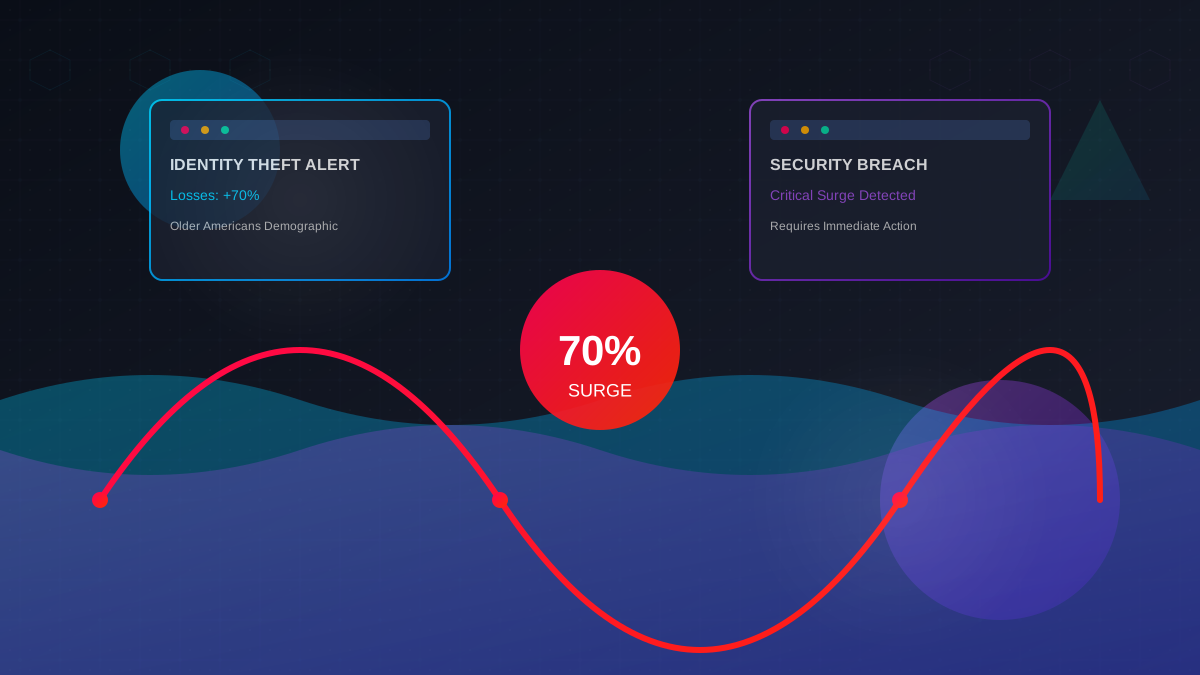
When losses surge 70% year-over-year, we are no longer facing isolated crimes but an industry-level systemic failure. Traditional enterprise-centric cybersecurity thinking is completely inadequate against targeted attacks occurring on personal phones, home networks, and social media. The challenges for elderly users are multidimensional: they may be long-term users of tech products but lack the ability to recognize AI-driven deepfake voice scams or real-time variants of phishing texts; they possess high-value assets (retirement funds, property) but use relatively weak protective tools like static passwords.
The allure of this market lies in its clear willingness to pay and high retention. Once trust is established, this becomes a high lifetime value (LTV) subscription service market. We can see three main strategic fronts:
- Hardware Integration Camp: Represented by Apple, which embeds security at the device level through Secure Enclave and UWB chips, creating a ‘circle of trust’ from iPhone to HomePod.
- AI Software-as-a-Service Camp: Such as Google’s Advanced Protection Program extensions or startups like Aura and IdentityForce, which use machine learning to analyze behavioral patterns and provide fraud alerts.
- Telecom and Financial Gateway Camp: Telecom carriers and banks control the most critical transaction and communication nodes and are actively integrating third-party AI detection tools to intervene at the moment of fraud.
The table below compares the pros, cons, and key players of these three strategies:
| Strategy | Representative Players/Ecosystems | Core Advantage | Potential Weakness | Target Market |
|---|---|---|---|---|
| Hardware-Integrated Protection | Apple (integrating iOS/macOS/watchOS/HomeKit) | End-to-end encryption, chip-level security, seamless user experience | Closed ecosystem, limited cross-platform protection; higher cost | High-income families deeply embedded in the Apple ecosystem |
| AI Software-as-a-Service | Google (Advanced Protection), Aura, LifeLock | Cross-platform, AI continuous learning, broad monitoring scope (dark web, credit) | Relies on user subscription and setup; ‘software layer’ protection delays | Families using mixed-brand devices, users already risk-aware |
| Telecom/Financial Node Protection | Verizon (ThingSpace security solutions), Chase, Bank of America | Can directly intercept at transaction/communication ‘channels,’ maximum authority | Innovation pace may lag behind pure tech companies; significant privacy controversies | Mass market, especially users reliant on a single primary bank or telecom carrier |
The essence of this race is competing for the role of ‘Family Chief Security Officer.’ It’s not just about fraud prevention, but about who can become the trusted hub managing all digital identities in a household—from bank accounts to smart locks.
AI Is a Double-Edged Sword: As Attack Tools Democratize, How Should Defenders Build ‘Smart Shields’?
Answer Capsule: Criminal groups use generative AI to create highly convincing phishing content and fake audio, multiplying fraud efficiency. This forces defenders to develop more proactive, context-aware AI ‘smart shields.’ Future security AI will not just alert after the fact but will understand ‘your’ behavioral baseline and intelligently intervene during anomalies as a personal guardian.
The escalation of attacks is phenomenal. In the past, typos and poor grammar were clues to identify phishing emails. Now, generative AI can instantly produce grammatically perfect messages with tones tailored to the target (e.g., mimicking their children). Deepfake audio technology can forge a relative’s urgent money plea call using just a few seconds of social media voice samples. FBI reports indicate that such AI-driven ‘social engineering’ attacks have particularly high success rates among elderly victims.
Defensive AI must therefore evolve to the next stage: from ‘pattern matching’ to ‘intent understanding.’ This isn’t just analyzing whether an email is malicious, but building a digital behavioral twin model of the user. For example:
- Transaction Behavior Baseline: When, to whom, and how much money is typically transferred?
- Communication Patterns: Frequency of calls with family, commonly used communication apps?
- Device Usage Habits: Typical locations for logging into online banking?
When a transfer request occurs, the AI ‘smart shield’ needs to conduct real-time multidimensional risk assessment, not just check passwords. The diagram below depicts how next-generation AI-driven identity protection operates dynamically:
sequenceDiagram
    participant U as User
    participant A as AI Smart Shield
    participant B as Bank/Transaction System
    participant T as Trusted Contact (e.g., Family)

    U->>B: Initiates large transfer to new account
    B->>A: Triggers risk assessment request
    Note over A: Multidimensional Real-time Analysis
    A->>A: 1. Compare payee risk database<br>2. Analyze device/location anomalies for this operation<br>3. Check recent exposure to high-risk links
    alt High Risk Score
        A->>T: Sends lightweight verification request<br>(e.g., "Father is making a transfer, are you aware?")
        T-->>A: Replies confirm or deny
        A->>B: Provides risk recommendation (block/allow/enhanced verification)
        B->>U: Executes corresponding action (e.g., requires physical security key verification)
    else Low Risk Score
        A->>B: Recommends allowance
    end
The key to this protection is ’low friction, high security.’ For elderly users, frequent complex verifications lead to frustration and even abandonment. The ideal AI shield should be invisible in 99% of normal situations but decisively and cleverly intervene during that 1% of critical risk moments. This requires extremely high accuracy, as false alarms themselves can destroy trust.
Therefore, we foresee a new technological convergence point: edge AI computing and privacy-preserving technologies (like federated learning). To build accurate behavioral models without uploading all private data to the cloud, future security solutions will rely more on device-local AI chips (like Apple’s Neural Engine, Qualcomm’s AI Engine) for initial analysis, uploading only anonymized risk indicators. This protects privacy while enabling real-time protection.
Apple, Google, Samsung: How Consumer Giants Are Turning ‘Security’ into the Next Ecosystem Lock-in Weapon
Answer Capsule: For consumer tech giants, security is no longer an optional feature on a checklist but a core strategy for ecosystem lock-in. Apple, leveraging its hardware-software integration, is deepening security into a ‘frictionless experience.’ Google is building cross-brand protection through the Android system layer and Google One subscription services. Samsung attempts to combine its enterprise-grade Knox security with smart home devices. This competition will redefine what ‘premium’ devices entail—top-tier security护航 will be as important as top-tier processors.
The second half of the ecosystem war is about who can provide a ’trustworthy digital life.’ Elderly users and their families are precisely the demographic with the most urgent need for ’trustworthiness’ and the highest willingness to pay. The strategic paths of the giants are already clear:
Apple’s ‘Walled Garden’ Evolution: Apple’s strategy has always been to control critical paths. From Touch ID/Face ID biometrics to iMessage’s end-to-end encryption, security is a natural advantage of a closed ecosystem. Next, we expect Apple to integrate ‘security’ with ‘health’ and ‘home’ data flows. Imagine a scenario: when a HomePod detects a suspected deepfake distress call, it could not only alert but also cross-reference the user’s real-time heart rate data from an Apple Watch (elevated due to stress) with typical heart rate patterns when receiving family calls, providing more accurate risk assessment. This is a data闭环 that competitors find extremely difficult to replicate.
Google’s ‘Open Protection Layer’ Strategy: Google’s advantage lies in breadth and AI prowess. Through Google Play Protect scanning billions of apps and Gmail filtering billions of emails, Google possesses the largest threat intelligence network. Its challenge is the fragmentation of the Android ecosystem. Therefore, Google is pushing the Google One subscription service, bundling additional VPN services, dark web monitoring, and expert support to provide a unified security backend for premium Android users and multi-platform families. This is an attempt to overcome hardware fragmentation through services.
Samsung’s ‘Cross-Border Security Bridge’: Samsung has a complete product line from phones, tablets, TVs to home appliances, and the Knox security platform from its enterprise business. Its opportunity lies in building a unified security architecture ‘from individual to family.’ For example, applying Knox’s containerization technology to isolate high-risk financial apps for elderly family members, or using smart TV cameras (with explicit user consent) for simple home safety checks. Samsung’s challenge is that its software and service integration depth still needs to catch up to Apple.
The diagram below, in mind map form, outlines the strategic layouts and key actions of the three giants around the elderly security market:
mindmap
  root(Consumer Giants' Elderly Security Strategy)
    (Apple)
      ::icon(fa fa-apple)
      Core: Frictionless Security via Hardware-Software Integration
      Key Actions
        Deepen biometrics context applications
        Integrate health data (heart rate/activity) into risk models
        UWB chips enable physical proximity verification between devices
        Strengthen family safety net via Family Sharing
      Advantage: Seamless experience, high trust
      Disadvantage: Limited protection outside ecosystem

    (Google)
      ::icon(fa fa-google)
      Core: AI-Driven Open Protection Layer
      Key Actions
        Bundle security services via Google One subscription
        Deeply integrate fraud detection at Android system layer
        Leverage Gmail/search data to build threat intelligence
        Promote Passkey password replacement solution
      Advantage: Broad threat intelligence, cross-platform
      Disadvantage: Android fragmentation, complex user setup

    (Samsung)
      ::icon(fa fa-samsung)
      Core: Extend Enterprise-Grade Security to Home
      Key Actions
        Consumerize Knox platform features
        Smart home appliances联动 as security nodes
        Partner with insurers for security-bundled plans
        Enhance device synergy within Galaxy ecosystem
      Advantage: Full product line, enterprise security背书
      Disadvantage: Software service ecosystem integration needs strengthening
The outcome of this competition will profoundly influence device purchasing decisions for the next decade. When choosing a phone or smart home system for parents, ‘which ecosystem better protects them’ will become a decisive factor alongside price and features. This forces all manufacturers to elevate security to the highest strategic level.
Data Doesn’t Lie: Industry Warnings and Opportunities Behind Three Key Statistics
Interpreting industry trends must return to the numbers themselves. Several key statistics from the FBI report are the风向标 driving all tech companies to adjust course.
70% Year-over-Year Growth Rate: This far exceeds the growth rate of overall cybercrime losses. It clearly indicates attackers are conducting ‘precision火力转移.’ Traditionally, ransomware attacks targeting enterprises face pressure from increased law enforcement and improved defenses, while targeting individuals—especially high-value individuals with relatively weak defenses—becomes a more lucrative ‘blue ocean.’ This tells tech companies that security demand in the personal and household market is ‘unsaturated’ and ‘rapidly growing.’
$20.9 Billion in Total Losses: This is a market size already large enough to support several publicly listed companies or core businesses of giants. For comparison, the global consumer antivirus software market in 2025 was about $35 billion. The market potential for identity theft protection is rapidly approaching and may even reshape the entire consumer cybersecurity landscape. This money currently flows mostly to criminals but will flow in the future to solution providers that can effectively block crime.
Significance of the 60+ Age Group: This demographic has high smartphone penetration but potentially lags in awareness of the latest threats. They are also the primary holders of household wealth. This statistic reveals a long-neglected ‘accessibility security’ gap in product design. Security features cannot be designed only for tech enthusiasts; they must be designed for all digital citizens, especially vulnerable groups. This fuels strong demand for ‘accessible security interfaces,’ ‘voice-guided verification processes,’ and ‘family remote assistance security modes.’
Together, these numbers paint a立体 opportunity: it is both a 2C subscription service (personal identity protection) and a 2B2C solution (banks, telecom carriers purchasing to protect customers), and also a driver for hardware innovation (phones, smart speakers with built-in stronger security chips). Companies ignoring these numbers will find themselves被动 in the next round of consumer tech淘汰.
Five-Year Roadmap: Four Key Industry Turning Points from Passive Defense to Active Guardianship
Based on the above analysis, we can boldly predict the industry development roadmap for the next five years. The elderly identity theft crisis is just a引爆点; it will连锁 trigger the following four key turning points:
Turning Point One: From ‘Application-Level’ to ‘Platform-Level’ Protection Security features will evolve from standalone apps to native capabilities of operating systems and hardware chips. For example, the operating system layer will have built-in real-time call scam alerts (analyzing incoming calls