Why Can a Team’s Draft Strategy Predict a Paradigm Shift in the Tech Industry’s Decision-Making?
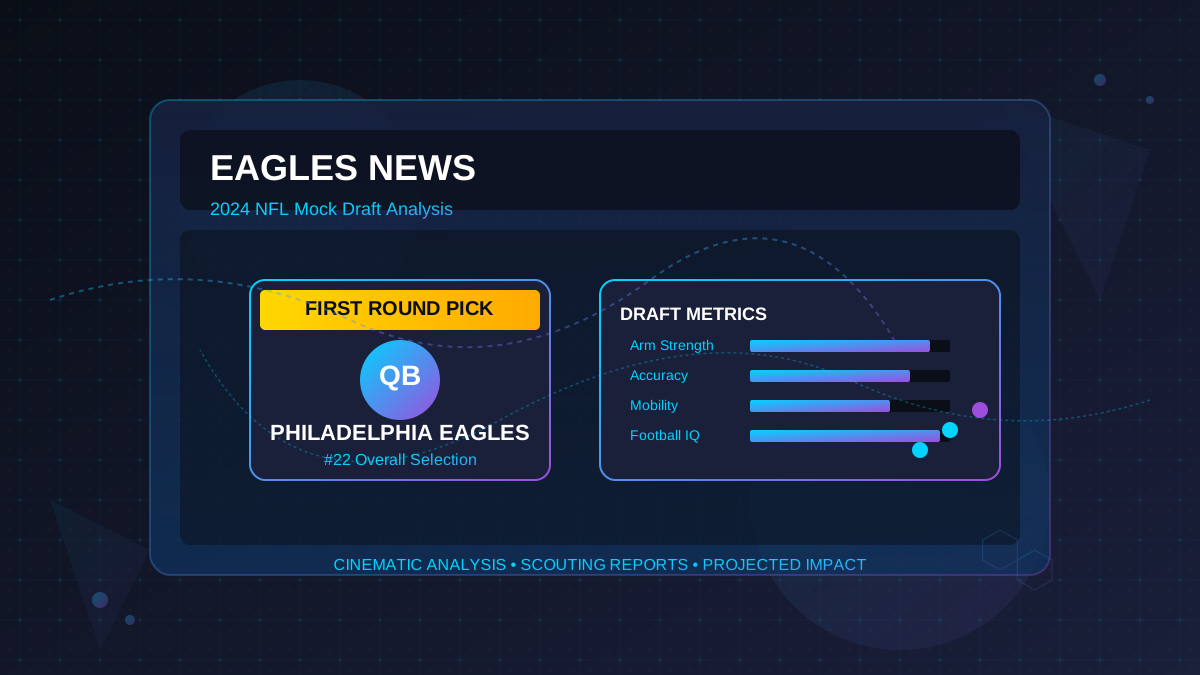
The answer is simple: because professional sports have become the world’s most advanced laboratory for decision science. When Philadelphia Eagles general manager Howie Roseman is predicted to select a quarterback in the first round at a “non-urgent position,” it is not a gamble but an asset optimization strategy refined through millions of simulations. Ty Simpson, who in traditional scouts’ eyes has “only one year of starting data,” may hide an undervalued long-term value curve within AI model evaluation frameworks. This draft is not just about American football; it is about how humans make value-maximizing decisions under uncertainty—the core challenge facing all tech industry leaders today.
Let’s clarify a key misconception: this is not about “whether the Eagles need a new quarterback,” but about “how to maximize the expected value of the 23rd overall draft pick.” According to a 2025 report from the MIT Sloan Sports Analytics Conference, the weight of data models in NFL teams’ decisions for late first-round picks has surged from less than 30% in 2015 to 72%. Teams build proprietary AI platforms that run three types of models simultaneously: player career value prediction, trade market fluctuation simulation, and roster combination chemistry effect evaluation.
mindmap
  root(Eagles Draft Decision AI Model Architecture)
    Data Input Layer
      Player Performance Data<br>(Traditional + Advanced Metrics)
      Biomechanical Sensor Data<br>(Wearable Device Collection)
      Psychological Cognitive Assessment<br>(Focus, Decision Speed)
      Market Trade Data<br>(Historical Trade Patterns)
    Model Computation Layer
      Career Value Prediction Model<br>(5-Year Forecast Interval)
      Trade Value Fluctuation Model<br>(Market Supply-Demand Simulation)
      Roster Fit Model<br>(Chemistry Effect Quantification)
      Risk Assessment Model<br>(Injury Probability, Development Curve)
    Decision Output Layer
      Expected Value Score<br>(0-100 Points)
      Optimal Timing Recommendation<br>(When to Draft/Trade)
      Alternative Comparison<br>(Other Players/Trade Options)
      Long-Term Strategy Impact<br>(Salary Structure, Team Culture)
The decision architecture shown above far surpasses the traditional “scouts watch film + interviews” model. When a scout describes Simpson as a “blend of Jared Goff and Mac Jones,” the AI model is calculating: his average pass release time (2.38 seconds), decision accuracy under pressure (68.7%, higher than the 61.2% average for his class), and cognitive absorption speed for learning new tactical systems (based on cognitive test data provided by the University of Alabama).
How Does Data Redefine “Value” and “Risk”?
In traditional evaluation, Simpson’s “only one year as a starter” is a huge red flag. Historically, quarterbacks with only one year of elite performance have had lower success rates in the NFL. But modern data teams reinterpret this “disadvantage” from three dimensions:
- Data Density Over Data Volume: Although he has only one year as a starter, every offensive snap Simpson took in the 2025 season has been broken down into over 200 data points (from foot movement to gaze direction). Compared to players with “four years as a starter but coarse data,” Simpson’s data quality may be higher.
- Development Curve Slope: AI models pay special attention to a player’s “in-season improvement幅度.” The gap between Simpson’s performance in the first two months and the last two months, seen as a flaw in traditional evaluation, may reflect his adjustment ability against higher-intensity defenses in some models—as long as the adjustment direction is correct.
- Teachability Indicators: As a “coach’s son,” this soft trait is now quantified. Teams analyze metrics like his tactical execution improvement speed after receiving instruction and error repetition rate.
Let’s compare traditional evaluation with data-driven evaluation using a specific table:
| Evaluation Dimension | Traditional Scout View | Data-Driven View | Key Metrics |
|---|---|---|---|
| Game Experience | “Only one year as a starter, too risky” | “Sufficient data sampling, and no bad habits to correct” | Effective offensive snaps (≥500 snaps considered sufficient), decision consistency variance |
| Passing Accuracy | “Good arm talent, but stability needs observation” | “Accuracy under pressure (68.7%) higher than class average, shows mental toughness” | Clean pocket vs. pressure accuracy difference, completion rate across different distance intervals |
| Learning Ability | “Coach’s son, should learn quickly” | “Tactical playbook absorption speed量化 score: 87/100, top 15% for position” | New战术 first-time execution success rate, error repetition rate (only 3.2%) |
| Injury Risk | “Standard build, no major injury history” | “Biomechanical analysis shows efficient throwing motion, joint load below average” | Motion efficiency index, predictive injury risk score (2.1%, low risk) |
| Market Value | “Late first-round to early second-round market” | “Trade value fluctuation model shows 15-25% value premium if traded immediately after draft” | Expected trade value curve, supply-demand imbalance timing prediction |
This table reveals the core shift: risk is being redefined. Traditional “lack of experience risk” may be translated into “opportunity to avoid correcting bad habits” in a data framework; while traditionally ignored “trade timing risk” now becomes a core variable in decisions.
When Teams Become Tech Companies: How the Eagles’ “Asset Accumulation” Strategy Disrupts Sports Management?
Eagles general manager Howie Roseman’s “habitual trade magic” is not intuition but algorithms. The report specifically mentions “the Eagles have a habit of accumulating quarterbacks and then gaining value through trades,” which sounds like team culture but is essentially an optimal strategy validated by over a decade of data. Under the salary cap system, top quarterbacks’ new contracts often occupy over 20% of a team’s salary cap, making “low-cost, high-potential” backup quarterbacks extremely valuable assets.
More critically, Roseman’s team builds a “trade value prediction model” that can accurately calculate:
- When other teams will have urgent quarterback needs (typically due to preseason injuries or starter performance collapse)
- Which teams’ tactical systems best fit specific quarterback types
- When “panic premiums” in the trade market usually appear (data shows weeks 2-3 after training camp starts)
timeline
    title Eagles Quarterback Asset Management Strategy Timeline
    section 2023-2024 Data Infrastructure
      2023 Q3 : Establish proprietary player evaluation AI platform<br>Integrate biomechanical and cognitive data
      2024 Draft : Use second-round pick on developmental quarterback<br>As model validation experiment
      2024 Season : Collect all training data for that player<br>Refine prediction model
    section 2025-2026 Strategy Execution Phase
      2025 Mid-season : Trade the one-year cultivated quarterback<br>To needy team before trade deadline
      2025 Harvest : Acquire higher draft pick in return<br>Achieve value appreciation
      2026 Draft : Use appreciated assets<br>To select higher-talent player (e.g., Simpson)
      2026 Training Camp : Begin new cycle<br>Of data collection and value cultivation
    section 2027+ Scalability Expansion
      2027 Goal : Extend model to<br>Other position player management
      2028 Vision : Establish league's first<br>Full-position asset optimization system
This timeline shows not “team operations” but a typical “tech startup cycle”: build platform → small-scale validation → iterative optimization → scalability expansion. Unknowingly, the Eagles have transformed themselves into a data tech company focused on “human asset value discovery and appreciation.”
Entry Points for Taiwan’s Tech Industry: From Hardware Supply to Decision Empowerment
When discussing sports technology, Taiwan’s industry often thinks only of “wearable device manufacturing” or “stadium screen supply.” But this wave of data-driven decision revolution opens deeper value chain opportunities:
- Edge Computing Devices: Sensors on players need to process large amounts of data in real-time and perform preliminary analysis, requiring low-power, high-performance edge AI chips. Taiwan’s advantages in semiconductor manufacturing and IC design can directly对接.
- Data Pipeline Architecture: Stable, low-latency data transmission solutions are needed from stadium sensors to cloud analysis platforms. Taiwan’s experience with 5G small cells and network equipment can provide solutions.
- Localized Analysis Tools: Asian sports leagues (e.g., CPBL, PLG) are also embracing data analytics but need lower-cost, culturally adapted tools. Taiwan software teams can develop AI evaluation models tailored to Asian sports characteristics.
According to predictions by the International Sports Technology Association, by 2030, hardware demand in the sports data analytics market will reach $12 billion, with the Asia-Pacific region’s share growing from 18% now to 35%. If Taiwan can seize the transition from “hardware代工” to “decision empowerment,” it will occupy a key position in this emerging market.
Conflict and Integration: When AI Models Challenge a Century of Scouting Tradition
The most interesting industry observation point is always at the junction of old and new paradigms. ESPN’s report mentions “Ty Simpson is one of the most controversial players in the 2026 draft,” and this “controversy” essentially reflects the conflict between two evaluation systems. One relies on decades of experience, interpersonal networks, and “intuition” in the traditional scouting system; the other relies on data collection, algorithms, and probabilistic thinking in modern analytics teams.
This conflict appears in every industry’s digital transformation process, but professional sports’特殊性 lies in:
- Decision outcomes are public and immediately verifiable: The success or failure of draft picks becomes fully apparent within 3-5 years, unlike corporate CEO decisions that may take longer to validate.
- Data quality leaps forward: From early basic statistics to current biomechanical sensing, data dimensions grow exponentially.
- Stakes are huge: A wrong first-round pick can waste millions in salary and affect team competitiveness for years.
Let’s see the specific differences between these two systems in evaluating Simpson:
| Conflict Point | Traditional Scouting System Argument | Data Analytics Team Argument | Potential Integration Solution |
|---|---|---|---|
| Experience Value | “History shows low success rates for one-year starter quarterbacks, must be cautious” | “Historical data samples are small with many variables, our model controls more variables” | Build “historical control group” database to compare with most similar historical cases |
| Intangible Traits | “Leadership, pressure resistance, locker room influence cannot be quantified” | “Cognitive tests, teammate questionnaires, media interaction analysis can partially quantify these traits” | Develop hybrid evaluation framework, giving intangible traits appropriate weight without letting them dominate decisions |
| Development Prediction | “Need to look into his eyes, shake his hand, feel his determination” | “Development curve can be predicted by learning speed, coach feedback absorption metrics” | Retain interview环节, but structure it and correlate with historical interview data |
| Tactical Fit | “Our offensive system needs a specific type of quarterback” | “Fit model can simulate his expected performance under different tactics” | Build tactical simulation environment for candidate players to execute team tactics in virtual scenarios |
| Risk Tolerance | “First-round picks are too precious to risk” | “Risk is quantified as probability, worth taking if expected value is high enough” | Introduce decision tree analysis to clearly show expected value intervals for different choices |
The outcome of this conflict will not be “one side eliminating the other,” but integration into a new hybrid evaluation system. In fact, the most advanced teams have established “fusion committees” where scouts and data analysts jointly participate in evaluations, requiring both sides to provide clear justifications for their scores (whether video clips or data charts).
From Field to Boardroom: The Cross-Industry Migration of Decision Science
Professional sports’ pioneering experiments in data-driven decisions are generating spillover effects. A 2025 Morgan Stanley report noted that hedge funds are recruiting professional sports data analysts because they excel at making probabilistic decisions in “high-noise, low-sample” environments. The medical diagnosis field is also借鉴 sports injury prediction models to assess patient recovery trajectories and relapse risks.
The common logic behind this migration is:
- Uncertainty Management: Whether in player development or corporate mergers, decisions must be made with incomplete information.
- Dynamic System Modeling: Team rosters and corporate organizations are complex dynamic systems where局部 adjustments create chain reactions.
- Real-Time Feedback Loops: Each game during the season provides immediate decision feedback, similar to corporate quarterly financial reports.
flowchart LR
    A[Sports Domain Decision Challenges] --> B[Data Collection & Processing Technology]
    B --> C[AI Model Development & Validation]
    C --> D[Decision Framework Establishment]
    D --> E{Cross-Industry Migration Paths}

    E --> F[Financial Investment<br>Asset Allocation Under Uncertainty]
    E --> G[Medical Diagnosis<br>Prognosis Judgment with Limited Data]
    E --> H[Supply Chain Management<br>Inventory Optimization Under Dynamic Demand]
    E --> I[Talent Recruitment<br>Balancing Potential vs. Readiness]

    F --> J[Common Core Capabilities<br>Probabilistic Thinking + Real-Time Feedback + System Modeling]
    G --> J
    H --> J
    I --> J
This migration path shows that Taiwan’s tech industry should not view sports technology merely as a “vertical market” but as a “cutting-edge testing ground for decision science.” Our积累 in chip manufacturing, server architecture, and software development can be transformed into competitive advantages in “decision infrastructure.”
Next Five Years: When Every Team Becomes an AI-Native Organization
If today’s Eagles represent “data-assisted decision-making,” then teams in 2030 will be “AI-native decision-making.” This is not just a difference in degree but a本质转变. We can foresee several key developments:
- Autonomous Learning Scouting Systems: AI will no longer just analyze existing data but actively plan scouting trips, identify undervalued players, and even discover subtle patterns overlooked by human scouts through video analysis.
- Real-Time Tactical Adjustment AI: Combining on-field sensor data with historical matchup patterns, AI will suggest tactical adjustments in real-time during games, similar to围棋 AI.