Why Tech Giants Must Confront This ‘Non-Traditional’ National Emergency
Simple answer: Because the supply and demand chain for drug abuse has fully digitized, from dark web transactions and encrypted communication promotions to subtle content on social media. Tech platforms are no longer neutral tools but key nodes in crisis proliferation. Regulators’ next target is to hold platforms accountable as “digital gatekeepers.”
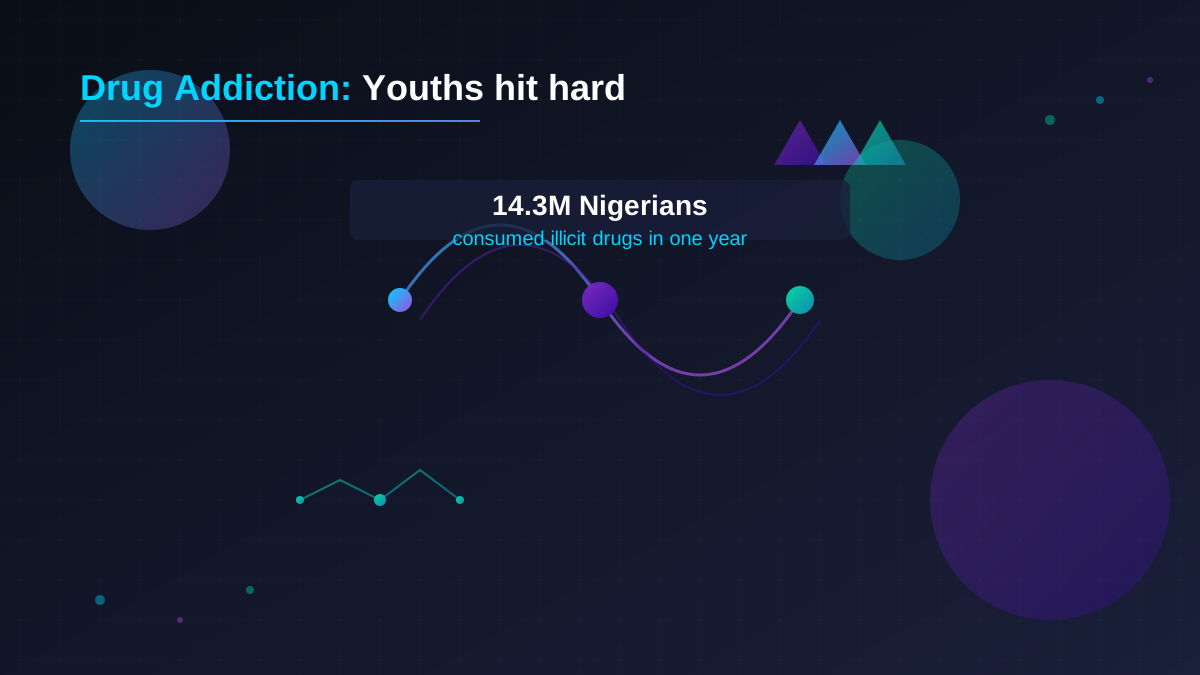
When we see the figure “14.3 million,” we should not view it merely as a statistical shock. It means that in Nigeria, approximately one in every 15 citizens aged 15 to 64 has been exposed to illegal drugs within a year. More critically, the report highlights the cheap model of “a bottle of cola or energy drink plus a pill,” revealing the “lowered threshold” and “normalization” of addictive behaviors. This normalization is inextricably linked to smartphone proliferation, social media algorithm pushes, and the secrecy of encrypted instant messaging.
The tech industry has historically categorized “drug abuse” as the domain of offline law enforcement and medical health departments. But the reality is that coded challenges on TikTok, anonymous trading groups on Telegram, accounts glorifying drug use with “aesthetics” on Instagram, and blockchain payments underpinning dark web markets collectively form an efficient “digitalized supply chain.” This exceeds the scope of traditional content moderation (like violence, hate speech) and enters a grayer, more dynamic realm. Regulators, whether Nigeria’s NDLEA or EU authorities under the Digital Services Act (DSA), will ultimately target platform operators: “Have your algorithms and service designs inadvertently facilitated this harm?”
This is not just a compliance cost issue but a battle for brand reputation and long-term user trust. For companies with vast growth ambitions in African markets, such as Meta (with Facebook, WhatsApp, Instagram), ByteDance (TikTok), and even fintech companies providing payment infrastructure, ignoring this problem is akin to installing a time bomb on their growth engines.
Why Are Existing AI Content Moderation Systems ‘Blind’ to Drug-Related Content?
Simple answer: Because the adversarial evolution speed of drug abuse discourse far outpaces the update frequency of centralized AI models. It heavily relies on localized slang, audio-visual memes, and encrypted contexts, to which mainstream platforms’ global models respond sluggishly.
Current AI moderation systems relied on by major social platforms are essentially a hybrid of “backend centralization” and “keyword triggering.” They may be effective in handling explicit drug names (like “cannabis,” “tramadol”) or direct sales pitches. But this “cat-and-mouse game” has long escalated. Users employ the following strategies to evade detection:
- Localized Evolution of Slang and Code Words: In Nigeria, drugs may have dozens of local slang terms that do not exist in standard moderation lexicons and evolve rapidly over time and regions.
- Semantic Evasion in Audio-Visual Content: A short video showing specific hand gestures, color combinations (like pill colors), or seemingly harmless everyday items (like specific brand drink bottles) carries meaning only within specific communities. Generic AI vision models cannot understand this subcultural semantics.
- The ‘Black Box’ of End-to-End Encryption: Communication apps like WhatsApp and Signal have encryption designs that prevent platform-side content scanning. Transaction negotiations occur securely here, only exposing risks at the final offline transaction stage.
This exposes a fundamental contradiction in current AI governance: There is a vast semantic gap between globally scaled AI models and highly localized, fragmented social harms. To effectively respond, platforms must abandon the “one-model-fits-all” mindset and shift towards more flexible, localized moderation strategies.
The table below compares the gaps between traditional moderation methods and future required capabilities:
| Moderation Dimension | Traditional AI Moderation (Current State) | Shortcomings Against Drug Abuse Content | Future Required Capability Direction |
|---|---|---|---|
| Text Detection | Relies on global sensitive word libraries, NLP sentiment analysis | Cannot identify rapidly evolving local slang, subtle code names | Establish dynamic, crowdsourced-updated local lexicons; incorporate contextual conversation analysis |
| Image/Video Detection | Object recognition (identifying specific pills, plants),违规标志 detection | Cannot understand cultural memes, suggestive gestures or scenes | Multimodal AI, combining behavioral sequence analysis and community graph analysis to identify “suspicious patterns” not just “suspicious objects” |
| Transaction Behavior Detection | Primarily detects product listings on e-commerce platforms | Completely unable to reach negotiations in encrypted communications and dark web transactions | Collaborate with financial institutions to analyze suspicious small-amount, high-frequency payment patterns (like the “500 Naira” transactions in the report) |
| Response Speed | Model updates on a weekly or monthly basis | Far slower than the evolution speed of jargon and methods (on a daily basis) | Establish edge learning mechanisms, allowing local moderation nodes to quickly absorb new features and issue warnings |
mindmap
  root(AI Moderation Dilemma for<br>Drug Abuse Content)
    (Semantic Gap)
      Global Models vs. Local Slang
      Static Lexicons vs. Dynamic Evolution
      Explicit Content vs. Subtle Memes
    (Technical Black Box)
      End-to-End Encrypted Communication
      Dark Web and Decentralized Storage
      Privacy Protection Regulation Limits
    (Business and Ethical Conflicts)
      Soaring Moderation Costs
      Misjudgments and Free Speech Controversies
      Regulatory Differences Across Jurisdictions
    (Future Solution Pathways)
      Federated Edge AI Learning
        <br>(Localized Model Updates)
      Multi-Stakeholder Data Alliances
        <br>(Securely Sharing Patterns with Health, Law Enforcement)
      Privacy-Preserving Computation Tech
        <br>(e.g., Federated Learning, Homomorphic Encryption)
From Passive Moderation to Active Prevention: Where Is the New Blue Ocean for Digital Health Tech?
Simple answer: The market will expand from “platform content filtering” outward towards “personalized prevention and intervention.” Wearable devices integrating physiological sensors, behavior AI-based risk assessment apps, and immersive treatment experiences will constitute a new market worth tens of billions of dollars.
The flip side of the crisis is a massive market opportunity. When public health systems are overwhelmed, tech-driven digital health solutions find their utility. This is not just a moral appeal but clear business logic. According to a Global Market Insights report, the digital addiction treatment market is projected to expand at a CAGR of over 20% between 2025 and 2032. Nigeria’s crisis is merely an accelerator.
Future products will unfold across layers:
- Primary Prevention Layer (Targeting Broad Youth): This is no longer simple “anti-drug awareness apps.” Future tools will be smarter and more personalized. Imagine an application that analyzes a user’s interaction patterns on social media, content browsing tendencies, and combines physiological data from Apple Watch or Fitbit (like heart rate variability, sleep quality) to assess their psychological stress and addiction risk index via AI models. When risk escalates, it pushes personalized mindfulness exercises, counseling resource links, or sends anonymous alerts to designated emergency contacts.
- Intervention and Treatment Layer (Targeting Those Who Have Tried or Are Addicted): The key here is “lowering the barrier to seeking help” and “increasing treatment adherence.” Anonymous AI chatbots can provide 24/7 initial assessment and support; augmented reality (AR) applications can simulate scenarios to practice resisting peer pressure; and gamified apps combining cognitive behavioral therapy (CBT) can help users track withdrawal progress and manage cravings. More importantly, these tools generate valuable anonymized aggregate data, helping researchers better understand the dynamics of addictive behaviors.
- Recovery and Social Reintegration Layer: Technology can help break the “addict” label. Online platforms for vocational skills training, matching algorithms for supportive communities, and verifiable digital credentials (e.g., blockchain-based) to prove recovery progress can assist individuals in reconnecting with society.
The table below outlines potential participants and product forms in this emerging market:
| Market Layer | Target Users | Core Technology and Product Forms | Potential Key Participants |
|---|---|---|---|
| Prevention and Early Identification | Broad youth, university students, high-stress groups | AI risk assessment apps integrating wearable device data, social media mood analysis plugins, campus mental health platforms | Apple (HealthKit API), Google (Fitbit), meditation app developers like Calm/Headspace, educational tech companies |
| Clinical Intervention Assistance | Diagnosed addicts, psychological counselors | Therapeutic apps based on CBT/ACT, VR exposure therapy software, symptom tracking dashboards for doctor-patient communication | Professional digital therapy companies (e.g., Pear Therapeutics), hospital information system providers, medical device companies |
| Social Support and Recovery | Individuals in recovery, family supporters | Anonymous peer support community platforms, online vocational training courses, recovery progress management tools | Social media companies (creating safe communities), workplace platforms like LinkedIn, digital transformation of non-profits |
| Public Health and Law Enforcement | Government agencies, research units | Big data epidemic surveillance dashboards, dark web transaction network analysis tools, policy simulation platforms | Big data analytics companies like Palantir, cloud service providers (AWS, Azure, GCP), cybersecurity companies |
The Hardware War Reignites: Why Are Edge Computing and Sensors the Next Critical Battleground?
Simple answer: Because demands for real-time processing, privacy, and offline usability push computing and analytical capabilities to the device side. Smart hardware capable of quickly and discreetly detecting substance composition or physiological anomalies will become a hotspot in consumer tech and professional fields.
The report’s mention of drugs cheaper than “a loaf of bread” highlights the extreme importance of on-site rapid detection. This is not just a law enforcement need but a personal safety imperative. Future tech battles will extend from the cloud and screens to physical world sensors and microchips.
- Consumer-Grade Drug Safety Detection Devices: This could be a device resembling an e-cigarette or keychain fob. Users place a微量 chemical sample on a disposable test strip; the device analyzes composition via built-in spectral sensors (like near-infrared spectroscopy) or electrochemical sensors within seconds using edge AI models, displaying results locally (e.g., “Fentanyl analog detected”) without internet connection, ensuring privacy. Such products will face strict accuracy certification challenges, but market demand is clear.
- Wearable Device Monitoring of ‘Behavioral Biomarkers’: Apple Watch’s fall detection has proven hardware sensor potential. The next step is monitoring subtler “behavioral biomarkers.” For example, via accelerometer and gyroscope data, AI can identify abnormal hand tremors or gait associated with drug influence; via microphone (with user consent) analyzing subtle changes in speech rate and tone. These analyses primarily occur on-device, uploading only anonymized aggregate insights to balance utility and privacy.
- Smart Passive Detection Systems in Public Spaces: Non-invasive sensor systems might be deployed at school or entertainment venue entrances. For instance, analyzing spectra of volatile organic compounds in the air or using millimeter-wave radar to sense abnormal physiological states (like extreme excitement or drowsiness) for early warning. This will spark serious privacy and civil liberties debates but may be trialed in certain high-risk environments.
timeline
    title Drug Abuse Prevention Technology Development Path
    section 2024-2026 Passive Defense Period
        Platform Content Moderation Upgrades : Keyword expansion<br>Image AI pill recognition
        Preliminary Digital Prevention Tools : Static education apps<br>Basic mental health resource links
    section 2027-2029 Active Sensing Period
        Wearable Device Integrated Monitoring : Apple Watch/Fitbit<br>incorporates stress and behavioral risk AI models
        Portable Detection Hardware Emerges : Consumer-grade spectral detection pens<br>High-precision handheld devices for law enforcement
    section 2030+ Ecosystem Period
        Full-Stack Health Data Platforms : Personalized health AI assistants<br>integrating medical, behavioral, social data
        Immersive Therapy Widespread : VR cognitive therapy becomes<br>a standard treatment option
        Regulatory Tech Matures : Globally collaborative anonymous threat<br>intelligence sharing networks established
How Will Regulatory Iron Fists Reshape the Tech Industry’s Rules of the Game?
Simple answer: Regulation will escalate from requiring “content removal” to demanding “proof of system effectiveness.” Tech companies will need to audit and vouch for their algorithm design choices, risk assessment models, and harm reduction measures’ efficacy, making compliance costs a core part of competitiveness.
Nigerian authorities have labeled this a “national emergency,” meaning unconventional regulatory measures will be on the table. For tech companies, this signals a shift in regulatory paradigms:
- From “Notice-and-Takedown” to “Risk Assessment-and-Mitigation”: Similar to the EU DSA’s requirements for “systemic risks,” governments may mandate large platforms to conduct annual assessments of their services’ “systemic risk” in fueling drug abuse in specific regions (like Nigeria) and propose concrete mitigation plans. This moves beyond handling single违规 posts to scrutinizing entire product designs, recommendation algorithms, and business models.
- Algorithm Accountability and Transparency: Regulators may require platforms to explain why certain drug-related content or communities are recommended to teenage users. This touches tech companies’ core trade secrets—algorithms. A possible compromise is through “regulatory sandboxes,” allowing regulators to review algorithm logic under confidentiality or requiring third-party audits.
- Mandatory Data Sharing Cooperation: While protecting user privacy, regulators may legislate requiring platforms to securely share anonymized, aggregated trend data with public health departments, such as sudden spikes in searches for specific drug slang in a region. This requires establishing strict technical frameworks (like differential privacy, federated learning) and legal frameworks.
- ‘Safety by Design’ Becomes Mandatory: Future regulations may mandate that new features or algorithms undergo “safety impact assessments” before launch, particularly for services popular among youth. This shifts responsibility upstream, forcing companies to consider potential misuse during the R&D phase rather than as an afterthought.