Bitcoin’s Safe-Haven Narrative: What’s Different This Time?
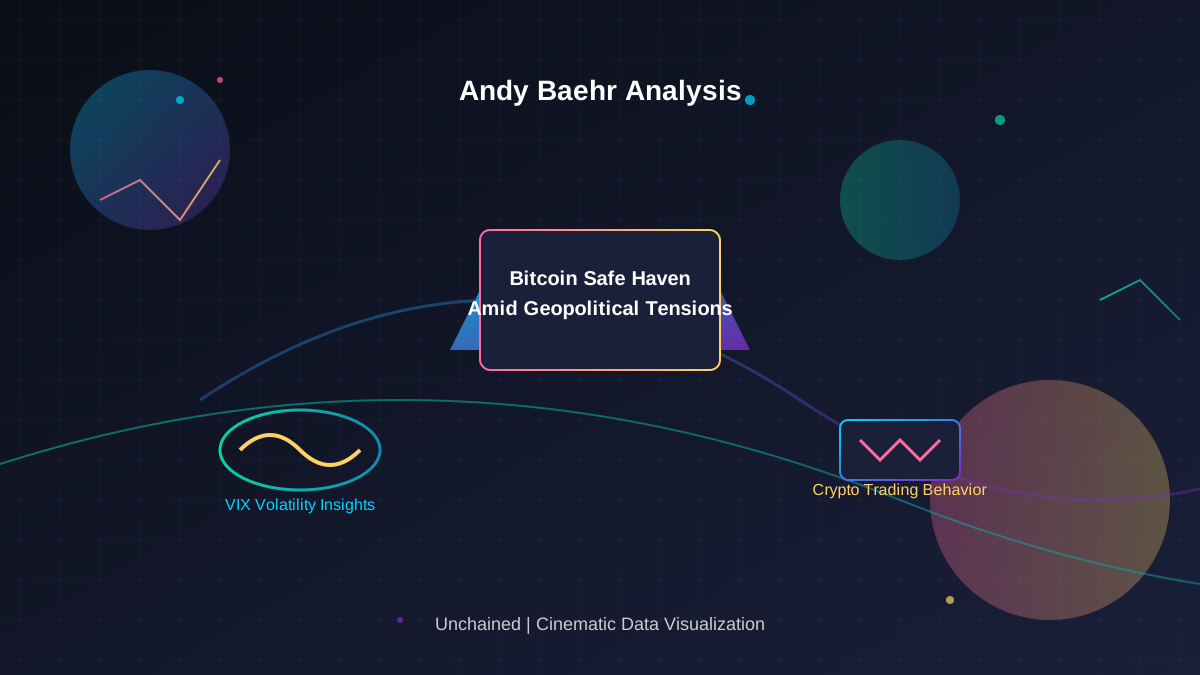
Direct Answer: Bitcoin’s approximately 4% rise during recent geopolitical conflicts is not merely speculative hype. It reflects a structural shift: some global capital is beginning to view it as an independent “non-sovereign risk hedging tool,” particularly as the safe-haven functions of the US dollar and traditional bond markets are disrupted by complex macro factors (such as massive debt and sticky inflation). This marks a critical divergence from its past positioning as a purely “risk asset.”
Historically, Bitcoin was often categorized as a high-beta risk asset that moved in tandem with tech stocks. However, since the approval of spot ETFs in 2024, which greatly increased institutional holding transparency, its asset attributes have become more complex. Its recent counter-trend strength during traditional market turmoil due to conflicts provides a strong comparative experiment. The key is that this rise occurred against a backdrop of a strong US Dollar Index (DXY) and highly volatile US Treasury yields. Under traditional frameworks, a strong dollar and high interest rates typically pressure interest-free, dollar-denominated crypto assets, but the opposite occurred.
This suggests that the logic driving capital inflows may extend beyond the traditional “interest rate-risk appetite” model. Some international capital might be viewing Bitcoin as a direct hedge against “geopolitical premiums.” When conflicts affect the operation or security of traditional financial systems in specific regions, Bitcoin’s global, censorship-resistant, and peer-to-peer settlement characteristics offer an alternative path for value storage and transfer. This demand does not replace gold but forms a new spectrum: gold (physical, historical consensus) — Bitcoin (digital, programmatic consensus) — US dollar cash (liquidity, legal authority).
The table below compares the performance and logic of different safe-haven assets during recent geopolitical tensions:
| Asset Class | Recent Performance (Example Period) | Core Hedging Logic | Potential Weaknesses/Disruptive Factors |
|---|---|---|---|
| Bitcoin | Rose ~4% post-conflict | Non-sovereign, globally liquid, censorship-resistant digital value storage | Regulatory uncertainty, high volatility, short-term correlation with US stocks persists |
| Gold | Significantly rose, hitting new highs | Millennia of historical consensus, physical asset, no counterparty risk | Storage and transportation costs, heavily influenced by real interest rate expectations |
| US Dollar (DXY) | Remained strong | Global reserve currency, ultimate liquidity provider | Affected by US fiscal conditions and monetary policy credibility |
| Swiss Franc | Appreciated steadily | Political neutrality, financial stability, low debt | Exchange rate intervention risks, relatively smaller market depth |
| US Long-Term Treasuries | Mixed performance (disrupted by inflation expectations) | Sovereign credit, fixed income, traditional safe haven | Severely affected by fiscal deficits, sticky inflation, and interest rate paths |
This evolution in asset attributes directly impacts strategic planning in the technology and finance industries. For tech giants like Apple, which hold massive cash reserves, balance sheet management strategies must incorporate new variables. While Apple is unlikely to invest heavily in Bitcoin in the short term, the possibility of its Apple Pay and hardware wallet (Secure Enclave) ecosystem integrating digital asset custody and trading functions in the future is increasing. This is not about speculation but about providing global users with comprehensive financial infrastructure services.
mindmap
  root(Bitcoin Safe-Haven Attribute Driving Logic)
    (Macro Structural Shifts)
      (Sovereign Debt Levels at Historic Highs)
      (Deglobalization and Supply Chain Fragmentation)
      (Limited Effectiveness of Traditional Interest Rate Tools Against Stagflation)
    (Capital Flow Evolution)
      (Institutional Investor<br>Diversified Allocation Needs)
        (Hedge Funds)
        (Family Offices)
        (Asset Management Companies)
      (International Capital<br>Seeking Non-Politically Linked Assets)
        (Emerging Market Affluent Class)
        (Multinational Corporate Treasury Pools)
    (Technical Infrastructure Maturation)
      (Spot ETFs Provide Compliant Channels)
      (Institutional-Grade Custody and Security Solutions)
      (On-Chain Settlement Efficiency Improvements)
VIX Index Surge: Panic Spills Over from Wall Street, Why is the Crypto Market “Abnormally Calm”?
Direct Answer: The recent rise in the VIX index (also known as the fear index) shows traditional stock market investors are actively seeking downside protection (e.g., buying put options). This hedging behavior typically drains risk liquidity from the entire market, but the crypto market exhibits a contradictory state of “low actual volatility amid high expected volatility.” The main reasons are that the crypto market has undergone a deep deleveraging cycle, derivative open interest structures are healthier, and large amounts of capital are parked in stablecoins on the sidelines, forming a natural volatility buffer.
The essence of the VIX index is a weighted average of the implied volatility of S&P 500 index options, reflecting market “expected” volatility, not realized volatility. When the VIX spikes sharply, it often means large institutions (like banks, insurance companies) are buying insurance for their massive traditional asset portfolios. This process creates a chain reaction: brokers, to hedge the risk of selling put options, dynamically sell stocks in the spot market, exacerbating selling pressure and forming a “volatility spiral.” This liquidity contraction effect would quickly transmit to marginal high-risk markets like cryptocurrencies in the past.
However, this cycle shows significant differences. According to Glassnode data, the ratio of cryptocurrency market futures open interest to market capitalization has fallen over 60% from its 2021 peak, indicating significantly reduced leverage. More importantly, total stablecoin supply and on-chain activity have simultaneously hit record highs. This is like a reservoir filled with “dry powder”—capital ready to deploy but not yet committed. Investor sentiment has shifted from “fear-driven selling” to “cautious观望.”
This structural change has lowered the “beta coefficient” of the crypto market relative to traditional financial market volatility. The composition of market participants is also changing: more long-term holders (LTH) and institutions hold physical Bitcoin through spot ETFs, reducing forced selling pressure from margin calls. Event-driven trading has become more prevalent in the crypto market, with traders no longer simply following US stock market openings but focusing more on on-chain data, protocol upgrades, and macro policy events themselves.
timeline
title Market Volatility Transmission Mechanism Evolution Comparison
    section Past Pattern (Pre-2021)
      Traditional Stock Market Panic(VIX↑) : Broker Dynamic Hedging<br>Sells Stocks
      Global Risk Asset Liquidity Tightens : Highly Leveraged Crypto Investors<br>Face Margin Calls
      Crypto Market Experiences<br>Liquidity Crisis and Plunge : Forced Liquidations Exacerbate Selling Pressure<br>Forming a Death Spiral
    section Current Pattern (2026 Observation)
      Traditional Stock Market Panic(VIX↑) : Institutions Buy Downside Protection<br>Localized Liquidity Contraction
      Crypto Market Leverage Already Reduced : Stablecoin Reservoir Buffers<br>Spot ETFs Provide Buying Support
      Crypto Market Exhibits<br>High Resilience and Range-Bound Oscillation : Event-Driven Trading Dominates<br>Temporary Decoupling from Traditional Asset Correlations
Stablecoin Activity Hits Record Highs: Is Capital Poised to Strike, or Widespread Anxiety About the Future?
Direct Answer: Stablecoin total activity (measured by adjusted transfer value) breaking historical highs is a signal with dual significance. On one hand, it shows massive capital is parked at the entrance of the crypto ecosystem, awaiting deployment opportunities, proving the market’s appeal and infrastructure maturity. On the other hand, it also reveals widespread market hesitation—investors lack confidence in one-sided directional bets, preferring to hold on-chain cash equivalents, which itself is a vote on the uncertainty of macroeconomic and policy prospects.
Stablecoins, especially USDT and USDC, have become the settlement layer and primary liquidity source for the crypto economy. Their surging activity is first and foremost a technical victory. It means blockchains (mainly Ethereum and its L2s, Solana, Tron, etc.) can efficiently and cost-effectively handle massive value transfers, which was unimaginable a few years ago. This paves the way for more complex financial applications, such as real-time treasury management, cross-border trade payments, and programmable payroll.
However, from a market sentiment perspective, this resembles “active waiting.” We can analyze it from the following dimensions:
- Flattening Yield Curve: In DeFi (decentralized finance), the annualized yield from depositing stablecoins into lending protocols or providing liquidity has generally fallen from double digits in 2021 to single digits or lower. This reduces the attractiveness of merely “idle yield generation,” yet capital has not massively exited, indicating holders’ primary goal is maintaining liquidity and principal safety, not pursuing yield.
- Multi-Chain Deployment Strategy: Capital is not static. On-chain data shows stablecoins rapidly moving between networks like Ethereum, Arbitrum, Optimism, Base, and Solana, seeking short-term arbitrage opportunities (e.g., cross-bridge interest rate differentials, new protocol incentive mining). This is a “guerrilla warfare” style of capital allocation, reflecting the dominance of professional traders and market makers.
- Hedge Fund and Market Maker Toolbox: For institutional participants, holding large amounts of stablecoins is fundamental for executing various strategies. Whether providing liquidity for ETF authorized participants (APs) to create/redeem baskets or serving as margin in cash-and-carry arbitrage and volatility trading, stablecoins are core tools. Their high activity directly confirms the vibrancy of institutional activity.
The table below lists the main participants behind high stablecoin activity and their motivations:
| Participant Type | Primary Motivation for Holding/Using Stablecoins | Impact on the Market |
|---|---|---|
| Institutional Traders and Hedge Funds | Foundational capital for executing arbitrage, market-making, and derivative hedging strategies. | Provide market liquidity, smooth price volatility, but may exacerbate short-term technical fluctuations. |
| ETF Authorized Participants (APs) | Used for physical creation/redemption of Bitcoin ETF shares, arbitraging between spot and futures markets. | Introduce traditional financial market pricing efficiency mechanisms into the crypto market, acting as a bridge between the two worlds. |
| Retail Investors | As a safe haven during market turbulence or a transitional position while waiting for specific token buying opportunities. | Constitute the market’s “potential buying power,” whose collective behavior may form significant support or resistance zones. |
| DeFi Protocols and DAO Treasuries | As operational funds, paired assets for liquidity pools, or for paying various fees. | Are the “lifeblood” of DeFi economic activity; their flow directly reflects capital热度 across sectors. |
| Cross-Border Payment and Trade Users | Utilizing their fast, low-cost特性 for international remittances and settlements. | Demonstrate the practical value of crypto technology, though such activities account for a relatively small proportion. |
AI Giants’ Capital Expenditure Frenzy: Could It Be the Crypto Market’s Next “Computing Power Anchor”?
Direct Answer: The annual tens of billions in AI capital expenditure by giants like Meta, Google, Microsoft, and Amazon flows primarily to wafer fabs (like TSMC), GPUs (like NVIDIA), and data centers in the short term. This seems unrelated to the crypto market, but long-term, the two will interact profoundly at three strategic intersections: “computing power commodification,” “energy demand,” and “decentralized verification,” potentially reshaping the industry landscapes of crypto mining and cloud computing.
AI training and inference require unprecedented computing power, driving the极致 pursuit of high-performance computing (HPC) and specialized hardware (like ASICs). Bitcoin mining, in essence, is the world’s largest and most competitive “computing power bidding market,” where miners’ sensitivity to energy efficiency and chip performance is unparalleled. History has proven that mining chip iteration cycles and energy efficiency improvements often lead the general server market. In the future, we may see a convergence: specific computing units optimized for AI (like TPUs/NPUs for matrix operations) might be redeployed in their later lifecycle to crypto networks whose consensus mechanisms require similar computations.
A more direct connection lies in energy. AI data centers are massive energy consumers, while Bitcoin miners are the world’s most flexible energy buyers, able to utilize excess electricity anywhere, anytime (including wind, solar, and natural gas flaring). At the grid level, Bitcoin mining can serve as an “interruptible load,” helping balance the grid and providing stable baseline revenue for intermittent renewable energy projects, thereby promoting their construction. This complements AI data centers that require 7x24 uninterrupted operation. In the future, we might see the emergence of “AI-Bitcoin hybrid campuses,” sharing grid access and cooling infrastructure, dynamically allocating energy based on electricity prices and computational task priorities.
Finally, the verifiability and trustworthiness issues of AI models themselves may open new doors for crypto technology. How to prove that an AI’s output is untampered and its training data complies with regulations? Cryptographic technologies like zero-knowledge proofs (ZKPs) could become key. A “AI execution record layer” or “data provenance verification network” guaranteed by blockchain might emerge. This would not be hype about “AI coins” but genuine technological integration,开辟出超越金融的应用场景 for the crypto economy.
According to International Energy Agency (IEA) reports, the total electricity consumption of data centers, cryptocurrency, and AI is projected to double by 2026 compared to 2022. The intertwining of these three forces will be one of the most值得关注的 narratives in the technology and energy industries over the next decade.
Industry Significance and Future Outlook: Who Will Be the Winners and Losers in the New Landscape?
This market restructuring, driven by geopolitics, institutional behavior, and technical infrastructure, will redistribute profits and influence along the industry value chain.
Potential Winners:
- Compliant and Diversified Crypto Asset Management Companies: Those capable of providing institutional clients with comprehensive services including spot,