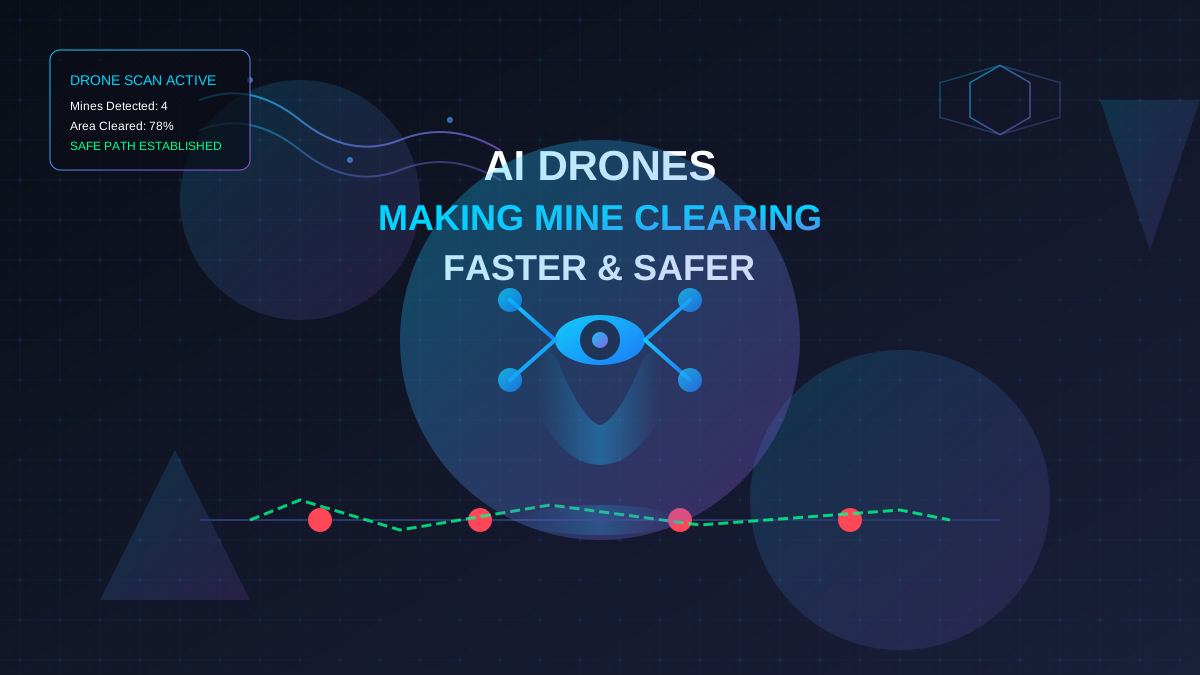
While global tech media are still chasing consumer AI chatbots or the next smartphone, the multi-week test conducted by the UK military in Essex County quietly reveals a more hardcore AI application scenario with direct life-saving potential. The core of the project codenamed “GARA” lies in using drone swarms equipped with multispectral sensors and edge computing units to scan vast areas, and through AI models, identify and mark landmines and unexploded ordnance (UXO) in real-time. The industrial significance of this test’s success far exceeds the optimization of a single military mission.
It marks a key turning point: AI-driven automation systems are aggressively moving from the “software layer” of processing information (such as text, images) to the “hardware task layer” that requires physical perception, movement, and decision-making. Mine-clearing, an extremely dangerous, highly experience-dependent, and slow-progress field, has become the perfect validation ground. The standard for success is extremely cruel and binary—failure means casualties. The preliminary success of GARA is equivalent to issuing a clear roadmap to global defense contractors, tech companies, and even humanitarian organizations: the next AI value explosion point lies in solving those “high-risk, high-repetition, high-expertise threshold” physical world tasks.
Why is Traditional Mine-Clearing an “Efficiency Black Hole” and a “Human Life Consumption War”?
To understand the weight of this revolution, one must first see how heavy the status quo it aims to overthrow is. Traditional mine-clearing is a huge consumption of time, resources, and human lives. Sappers need to wear heavy protective gear and, in areas that may be mined, proceed at a near-crawling speed, using probes, metal detectors, or trained dogs for centimeter-level inspection. This process is not only slow—clearing one square kilometer of a complex minefield may take several years—but also exposes personnel to long-term extreme psychological stress and physical risk.
More heartbreakingly, post-war demining work is often delayed for decades due to resource and technical limitations, continuing to take the lives of civilians, especially children. According to the International Campaign to Ban Landmines (ICBL) report, since the outbreak of the Russia-Ukraine war in 2022, Ukraine has become the country with the most severe landmine contamination globally, with an estimated 174,000 square kilometers of land (about 30% of the national territory) contaminated with various landmines and unexploded ordnance, possibly totaling millions. This crisis scale makes efficiency improvement no longer an “optimization option” but a “survival necessity.”
The table below clearly contrasts the core differences between traditional manual mine-clearing and AI drone-assisted mine-clearing:
| Comparison Dimension | Traditional Manual Mine-Clearing | AI Drone-Assisted Mine-Clearing (e.g., GARA System) |
|---|---|---|
| Detection Speed | Extremely slow, relies on personnel foot detailed inspection | Extremely fast, drones can rapidly cover large areas |
| Personnel Risk | Extremely high, personnel must directly enter threat areas | Significantly reduced, personnel can operate from a safe distance |
| Operational Range | Limited, restricted by physical strength and safety considerations | Vast, can systematically cover several square kilometers |
| Data Level | Low, mainly relies on on-site experience and paper marking | High, real-time generation of digital threat maps and databases |
| Environmental Adaptability | Greatly limited by weather and terrain | Stronger, drones can adapt to various terrains, some sensors unaffected by weather |
| Initial Investment Cost | Relatively low (personal equipment) | High (drones, sensors, AI system development) |
| Long-Term Cost and Scalability | High (continuous human resources, time, and risk costs) | As scale expands, marginal cost decreases, can be rapidly replicated and deployed |
Deconstructing the GARA System: How Does the “Iron Triangle” of AI, Sensors, and Drones Operate?
The success of the GARA project is not due to a single showy AI algorithm, but the maturity and integration of three major technologies: sensor fusion, edge AI inference, and autonomous drone coordination. This is a typical systems engineering victory.
Answer Capsule: The essence of the GARA system is an “aerial autonomous sensing network.” Drones serve as mobile platforms, carrying multispectral imagers, synthetic aperture radar (SAR), or lightweight LiDAR to collect raw data; onboard or near-end computing units run trained AI models to analyze data in real-time, identifying anomaly features; finally, high-confidence threat locations are marked on a digital map and transmitted back to the command center. The entire process compresses the “detection-analysis-decision” loop from several hours or even days to within minutes.
Sensor Fusion: Making the Land “Reveal” Its Secrets
A single type of sensor is inadequate for complex mine-clearing tasks. Metal detectors react to all metals, including harmless shell casings or iron cans; optical images struggle to penetrate vegetation or identify cleverly camouflaged targets. The key to advanced systems like GARA lies in “fusion”:
- Optical/Multispectral Images: Identify surface disturbances, abnormal vegetation growth suppression (due to underground objects), or specific man-made object shapes and colors.
- Thermal Imaging: Detect surface temperature anomalies. Certain materials (like metal, explosives) have different heat capacities than surrounding soil, which may manifest during day-night temperature differences.
- Radar/LiDAR: Provide precise terrain elevation data, identifying minor ground elevations or depressions, which may be signs of burial.
- (Possible) Non-Metal Detection Technologies: Such as lightweight versions of ground-penetrating radar (GPR), or sensors detecting explosive chemical vapors.
The AI model’s task is to correlate and cross-validate these heterogeneous data streams. For example, a minor ground elevation (LiDAR data), combined with sparse vegetation at that point (multispectral data), and a weak but present metal reaction (radar or specific spectrum data), this “feature combination” would be judged by AI as having a greatly increased probability of being an anti-personnel landmine. This significantly reduces the false positive rate.
flowchart TD
    A[Drone Mission Launch] --> B[Synchronous Multi-Source Sensor Data Collection]
    B --> C[Data Preprocessing and Fusion]
    C --> D{AI Model Inference Analysis<br>Feature Extraction and Pattern Recognition}

    D -->|High Confidence Threat| E[Real-Time Marking on Digital Map]
    D -->|Low Confidence/Needs Review| F[Mark as Area Requiring Confirmation]
    D -->|Judged as Safe| G[Mark as Scanned Safe Zone]

    E --> H[Generate Mission Report and Threat List]
    F --> I[Plan Secondary Detailed Inspection Mission<br>(e.g., Lower Altitude, Finer Sensor Scanning)]
    G --> H

    H --> J[Transmit to Command Center and Sapper Units]
    I --> B

    J --> K[Sappers Obtain Complete Threat Map<br>Formulate Safe and Efficient On-Site Handling Plan]
Edge AI: Making Real-Time Judgments in Flight
Transmitting massive amounts of sensor data back to remote servers for processing faces challenges of delay and communication bandwidth, and in battlefield environments, communication links may be interrupted. Therefore, deploying AI models on the drones themselves or accompanying ground control stations (edge end) is crucial. This requires models to be lightweight and efficient while maintaining high accuracy.
This drives two industry trends: first, a significant increase in demand for AI inference frameworks optimized for specific hardware (such as NVIDIA Jetson series, Qualcomm RB5 platforms, etc.); second, neural network compression techniques (like pruning, quantization, knowledge distillation) are rapidly moving from academic research to military and industrial-level applications. What runs in the GARA system is likely an extremely compressed, specialized convolutional neural network (CNN) or vision transformer (ViT) model focused on “landmine and unexploded ordnance recognition.”
Who Will Be Disrupted? Industry Chain Reshuffle from Defense Contractors to Humanitarian NGOs
The ripple effects of this technology will impact a large and traditional industry ecosystem.
Answer Capsule: The most directly impacted are traditional mine-clearing equipment manufacturers and pure human service providers. Their business models are built on expensive special equipment and highly specialized human training. The emergence of AI drone systems will automate the “wide-area preliminary reconnaissance” link, which has the highest value and risk, forcing them to transform into “integrated service providers” or focus on the “final safe removal” last mile. Simultaneously, this opens a brand new high-end market door for drone manufacturers, sensor companies, and AI software developers.
Competition and Cooperation Between Old and New Players
We can foresee the industry landscape in the coming years presenting the following dynamics:
| Participant Type | Challenges Faced | Potential Opportunities and Transformation Directions |
|---|---|---|
| Traditional Defense and Demining Engineering Contractors (e.g., traditional military-industrial enterprises) | Core business eroded by automated solutions; need to quickly supplement software and AI capabilities. | Leverage existing customer relationships and domain knowledge to lead systems integration, become “general contractors.” Acquire or invest in startups with key technologies. |
| Drone System Manufacturers | Need to develop platforms meeting military specifications (durability, reliability, communication security) and capable of integrating multiple sensors. | Leap from consumer or industrial markets into high-value defense and government procurement supply chains. Form alliances with AI software companies. |
| AI and Machine Vision Software Companies | Need deep understanding of extremely specialized domain knowledge (ammunition science, geology) to train reliable models. | Productize core AI capabilities into specific domain solutions, obtaining stable and profitable defense or government contracts. |
| Sensor Hardware Suppliers | Need to make sensors lighter, more power-efficient, higher-performing, and provide easy-to-integrate data interfaces. | As drone reconnaissance platforms popularize, shipment volumes and unit prices of high-end sensors are expected to increase simultaneously. |
| Humanitarian Demining Organizations (e.g., NGOs) | Initially may lack funds and technical capabilities to procure and operate high-tech systems. | Long-term, decreasing technology costs will enable lower-cost, safer task execution. Can seek cooperation with tech companies or accept technology donations. |
This change will also give birth to new business models. We may see the emergence of “Mine-Clearing as a Service” (MCaaS), where tech companies do not sell hardware but provide subscription services including drones, AI analysis, and regular reports. Or, similar to satellite imagery companies, specialized data providers offering “threat environment scanning data.”
Technology Spread and Asymmetric Tactics Under Geopolitics
The spread path of this technology is worth attention. NATO countries and their allies (such as Japan, Australia) will be the first adoption customers. However, its technology threshold is rapidly lowering. Open-source AI model frameworks, increasingly mature commercial drone platforms (like modified DJI industrial models), and purchasable sensors mean non-state actors or small and medium countries may also acquire similar capabilities in the near future.
This has implications for Taiwan’s defense strategy. Facing potential landing warfare threats, rapid mining and mine-clearing capabilities in beach and shallow depth areas are key. Developing or introducing similar AI drone mine-clearing systems can not only enhance post-war recovery capabilities but also form an “asymmetric” deterrence: making potential opponents aware that their laid obstacles can be cleared quickly and at low cost, thereby weakening the effectiveness of their obstacle tactics. Taiwan’s industrial advantages in information and communication, semiconductors, and precision manufacturing are an excellent foundation for developing such “smart defense” systems.
Ahead Obstacles: Three Major Challenges in Technology, Ethics, and Procurement
Despite bright prospects, from field test to large-scale deployment, there are still several high walls to cross.
Answer Capsule: The biggest technical challenge is the AI model’s “battlefield adaptability” and the system’s “anti-interference survivability.” Ethically, the decision authority boundaries of autonomous systems in the reconnaissance-targeting loop must be clarified. At the practical level, rigid defense procurement processes and inherent cultural resistance to new technology may slow deployment speed more than technical difficulties.
Technical Bottlenecks: When AI Encounters “Unknown Unknowns”
- Generalization Ability: Can a model trained in Essex, UK, be directly applied to Ukraine’s black soil plains, the Middle East’s deserts, or Southeast Asia’s rainforests? Different soil compositions, humidity, and vegetation types greatly affect sensor signals and surface features. AI models need strong transfer learning ability, or a massive training dataset covering various global environments must be established—the latter is a massive project.
- Adversarial Attacks and Camouflage: Opponents will inevitably develop countermeasures, such as using non-metal material landmines, more effective camouflage nets, or scattering large amounts of metal fragments as decoys, attempting to “deceive” AI models, causing fatigue or misjudgment.
- System Resilience: In battlefield environments, communication may be interfered with or blocked, GPS signals may be unreliable. Drones must possess a certain degree of autonomous navigation and mission continuation ability, able to complete scanning of predetermined areas and return even when disconnected. This places higher demands on flight control systems and edge computing power.
Gray Areas of Ethics and Responsibility
Although the current system is limited to “detection and marking,” the logical extension of the technology forces early consideration: if drones can find landmines, could future drones equipped with robotic arms or small explosive devices directly perform “autonomous mine-clearing”? This touches the sensitive red line of “Lethal Autonomous Weapon Systems” (LAWS). The international community must engage in dialogue between technological practicality and moral risk regarding such “sub-lethal” autonomous military applications, establishing new norms and engagement rules.
The Procurement Culture Gap
Defense department procurement is known for caution, lengthiness, and risk aversion. They tend to procure mature equipment verified over decades. Systems like GARA, with software and AI at their core and rapid iteration, are mismatched with the traditional “ten-year development, twenty-year service” weapon procurement model. Promoting “Agile Acquisition,” allowing continuous software updates and capability upgrades during service, will be key for this type of system to truly exert its potential on the battlefield.