Why Are “More Outlets” Becoming a Necessity in the Wireless Era?
Answer Capsule: Because the “wireless” aspect of devices is limited to data transmission, while power supply remains firmly bound by cables. More critically, the expansion of the smart home ecosystem is not about replacement but accumulation. Each new device, from smart speakers to environmental sensors, requires a dedicated power outlet, leading to exponential growth in socket demand, not reduction.
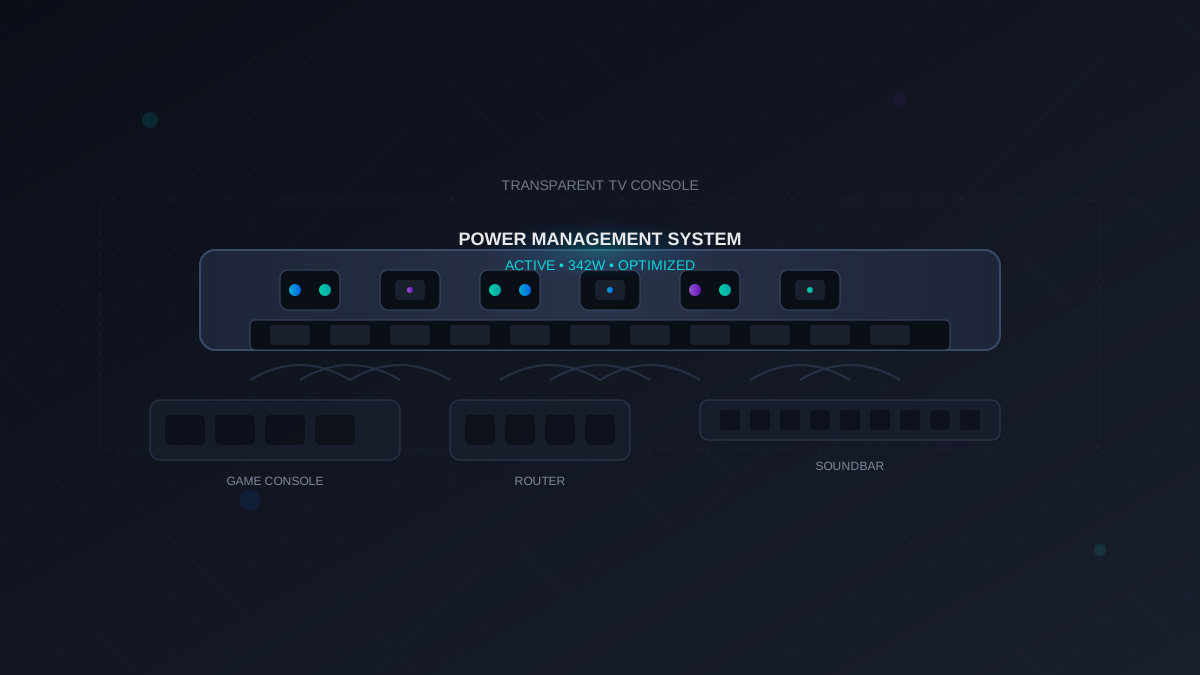
Look behind the TV cabinet in any modern home, and you’ll see an archaeological layer of technological evolution: old gaming console adapters, power supplies for streaming devices, plugs for soundbars, and perhaps a spare port for a router or NAS. This is the core issue: Technology pursues seamless and wireless experiences, but at the infrastructure level, it is frantically accumulating wired burdens. According to a report by the U.S. Energy Information Administration (EIA), the number of plug-in devices in a typical American household has increased by over 300% in the past decade, while the number of wall outlets in residences has grown by less than 10%. This massive supply-demand gap is entirely filled by power strips.
The specifications of Meh.com’s Clear Power strip itself are a list of market demands: 8 AC outlets, 2 USB-A ports, 1 USB-C port. This configuration precisely targets the current “hybrid power supply” transition period. The inclusion of a USB-C port is particularly indicative; it is no longer an “additional feature” but a “necessary interface.” This means power strip manufacturers must keep up with the latest charging protocols for laptops, phones, and tablets, forcing their technology update cycles to align with mainstream consumer electronics standards.
The table below compares the gap between traditional power strips and modern smart demands:
| Feature Dimension | Traditional Power Strip (2010s) | Modern Transition Product (e.g., Clear Power) | Future Smart Energy Hub (2028+) |
|---|---|---|---|
| Core Function | Outlet expansion, basic surge protection | Outlet expansion, multi-protocol fast charging, high-end surge protection | AI energy distribution, power usage monitoring, grid interaction |
| Data Capability | None | None | Built-in Wi-Fi/Bluetooth, transmits power usage data |
| User Interaction | Physical switch | Physical switch | App control, voice assistant integration, automation scenarios |
| Price Range | $5 - $15 | $15 - $40 | $60 - $200+ |
| Industry Role | Low-margin consumer goods | Consumer tech accessory | Smart home infrastructure |
mindmap
  root(Power Strip Industry Transformation Drivers)
    (Market Demand Contradiction)
      Device wirelessization vs. power supply wiredization
      Smart device accumulation rather than replacement
      Lag in residential outlet construction
    (Technical Specification Upgrades)
      USB-C PD becomes standard
      Surge protection rating (e.g., 2160J) becomes a selling point
      Compact high-density outlet design
    (Smart Ecosystem Integration)
      Becomes an invisible node in smart homes
      Entry point for collecting power usage data
      First step towards home energy management
    (Business Model Evolution)
      From one-time purchase to service subscription (e.g., energy reports)
      Linked to electricity bill optimization
      Becomes a hardware entry point for IoT platform providers
Surge Protection from Insurance to Standard: Who is Driving This?
Answer Capsule: The driving force comes from the rapid increase in the value of the devices themselves. When the total value of the equipment behind your TV cabinet easily exceeds $5,000, a $19.99 two-pack surge protector is no longer an accessory but the most cost-effective insurance. Semiconductor process miniaturization makes modern electronics more sensitive to voltage fluctuations, turning “power cleanliness” from an industrial concern into a consumer-grade necessity.
“2160J” is not marketing jargon; it is a quantifiable measure of protection capability. A surge from a lightning strike or grid instability can carry energy of several thousand joules. The surge absorption components (like MOVs) inside the power strip sacrifice themselves to divert excess energy; a higher rated joule number indicates stronger protection and longer lifespan. The industry is witnessing a shift: Surge protection specifications are becoming standard across all product lines, much like waterproof ratings in smartphones.
The underlying industry logic is responsibility transfer. Device manufacturers (like Apple, Samsung) often explicitly state in their warranty terms that damage caused by power issues is not covered. This无形中 shifts the responsibility of “ensuring power quality” to users and the third-party accessory market. Thus, power strips with safety certifications like UL and CE and clear surge protection ratings have transformed from an option into a necessary risk management tool.
According to data from the Consumer Technology Association (CTA), in 2025, 71% of cases of consumer electronic device damage due to power-related issues occurred in environments without professional surge protection. This has spawned a sizable “device protection” accessory market, with growth rates even surpassing some mainstream consumer electronics categories.
timeline
    title Evolution of Consumer-Grade Power Protection Technology
    section Pre-2000s
        Basic fuse protection : Only overload and short-circuit protection
        No concept of surge protection
    section 2000-2010s
        Basic MOV surge protection : Low joule rating (below ~500J)
        Becomes a selling point for high-end products
    section 2010-2020s
        High-end surge protection popularization : Joule rating becomes standard (1000J+)
        USB charging port integration
    section Post-2020s
        Smart protection : Combines circuit monitoring and alerts
        Beginning of data-driven energy management
        Becomes a smart home node
Is the Addition of USB-C Ports Just for Charging?
Answer Capsule: No, USB-C, especially ports supporting the Power Delivery (PD) protocol, is a key bridge for power strips transitioning from “dumb” devices to “smart” devices. It is a bidirectional communication channel, giving the power strip the opportunity to know what device is being powered, how much power it needs, and when it needs it.
When you plug a PD-supported laptop into the USB-C port of the Clear Power strip, a quick “negotiation” occurs between the two. The laptop says: “I can accept up to 65W.” The chip inside the strip responds: “This port can provide up to 45W.” They eventually operate at the highest power both can accept. This process seems simple but contains revolutionary potential: Power supply shifts from a one-way broadcast to a two-way dialogue.
The next step in evolution is clear: If a power strip can identify devices, it can perform strategic energy management. For example, powering only the router and security cameras at night, suspending standby power for entertainment devices; or automatically reducing the power of an electric vehicle charger to a minimum during high electricity price afternoons. This requires power strips to have more powerful processing chips, network connectivity, and corresponding software ecosystems. Currently, startups like Span.IO and Lumin are driving similar revolutions at the home electrical panel level, and this trend will inevitably permeate down to the power strips in every room.
The competitiveness of future smart power strips will be reflected in their “negotiation capability” and “scheduling intelligence.” This will be achieved through built-in AI chips or cloud-based AI models. The table below envisions key functions future smart power strips may possess and their underlying technological support:
| Smart Function | Technical Implementation | User Value | Potential Challenges |
|---|---|---|---|
| Device Identification & Power Matching | USB PD protocol extensions, device fingerprint database | Optimizes charging efficiency, extends battery life | Fragmentation of brand protocols, privacy concerns |
| Power Usage Habit Learning & Scheduling | Edge AI chips, local machine learning | Automatic energy saving, utilizes off-peak electricity rates | Requires initial learning period, algorithm transparency |
| Grid Interaction (Demand Response) | Wi-Fi/Thread/Zigbee connectivity, open APIs | Participates in grid balancing for rebates | Relies on utility cooperation, regional energy policies |
| Real-Time Power Safety Monitoring | High-precision current/voltage sensors, anomaly pattern detection | Prevents fires, warns of faulty devices | Sensor cost, false alarm rate management |
| Energy Consumption Visualization & Reporting | Data uploaded to cloud, mobile app charts | Identifies energy consumption black holes, promotes energy-saving behavior | Acceptance of data subscription business models |
How Do Platforms Like Meh.com Reshape the Fate of Hardware Products?
Answer Capsule: Meh.com and the “daily deal” e-commerce model it represents act as the ultimate market filter. Through minimalist product descriptions, direct price impact, and instant community discussion, they complete a micro-market test within 24-48 hours. Whether a product sells out directly reflects the alignment of its specifications, pricing, and real market demand.
This model has a particularly profound impact on “boring but necessary” products like power strips. Manufacturers can no longer rely on flashy feature lists and complex packaging to convince distributors to stock. They must present the most precise product definition: How many AC outlets? What is the USB-C power output? What is the surge protection rating? Is the form factor suitable for behind TV cabinets? These are scrutinized nakedly on Meh.com’s product pages and community comments.
This forces manufacturers toward “data-driven product development.” They can quickly deduce winning formulas from these platforms’ sales data and discussions. For example, we can observe the success of “2-Pack” bundle sales, which hits users’ need for consistent solutions in different rooms (living room, study) while reinforcing the psychological anchor of “great value.” This direct pressure from consumers is forcing the entire power accessory industry to accelerate iteration, concentrating resources on features users are truly willing to pay for.
More importantly, such platforms become springboards for emerging brands to challenge traditional giants (like Belkin, APC). If a new brand can sell out a well-designed, high-value power strip on Meh.com and receive positive reviews, the market visibility and trust endorsement gained far exceed battling countless competitors on large retail shelves.
Conclusion: Electricity, the Next Frontier Awaiting AI and Datafication
We’ve talked about smart homes for so long that our gaze always falls on shiny screens, clever speakers, and automated curtains. However, the hot sales of an ordinary power strip on Meh.com remind us of a more fundamental fact: All this intelligence is built on an ancient, analog, and often overlooked foundation—electricity.
The transformation of power management accessories is the last mile, and the most fundamental mile, of the smart home revolution. It is undergoing a three-stage leap from “more outlets” to “more protocols,” and soon to “more intelligence.” In the future, we will no longer “buy a power strip” but “deploy a home edge energy node.” It will work silently, coordinating the energy needs of all devices in the home, conversing with the grid, maximizing efficiency and safety, and ultimately transforming from a cost center into an asset that generates savings and returns.
When power strips start thinking, our homes truly become smart. This silent revolution beginning in the tangled wires behind TV cabinets will have an impact far beyond our imagination today.
FAQ
Why can a seemingly ordinary power strip promotion reflect technology industry trends? Because it highlights that amid the contradiction of device wirelessization and smartification, physical power demand is increasing rather than decreasing, forcing basic accessories to integrate USB-C, surge protection, and even future AI energy management functions, becoming the silent hub of smart ecosystems.
How will the market for surge protector power strips evolve in the future? It will transform from passive device protection to active smart energy hubs, integrating Wi-Fi, power usage measurement, AI scheduling, and even interacting with the home grid. Unit prices and technical barriers will significantly increase, making them key infrastructure for smart homes.
What role does USB-C PD play in power accessories? USB-C PD is already standard for a new generation of power accessories. It is not just a charging protocol but a data channel for power negotiation between devices and power sources, paving the way for future AI-driven energy distribution.
How do e-commerce platforms like Meh.com influence hardware product development? Through direct consumer feedback and time-limited promotions, they become validation grounds for new product concepts, quickly filtering out real market demands and accelerating the popularization of specifications like multiple ports, high power, and compact design.
How will AI change the way we use power strips? AI will learn user habits to automatically manage outlet switching, allocate charging power to extend battery life, and power high-consumption devices during low electricity price periods, achieving fully automated, invisible energy management.
Further Reading
- U.S. Energy Information Administration (EIA) - “Residential Energy Consumption Survey” report, detailing changes in household device numbers and electricity usage patterns: https://www.eia.gov/consumption/residential/
- USB-IF Official Organization - USB Power Delivery (USB PD) specification documents, understanding technical details of next-generation charging and power supply protocols: https://www.usb.org/document-library/usb-power-delivery
- Consumer Technology Association (CTA) - “Technology and Home Energy Management” white paper, exploring how consumer electronics can participate in home energy saving: https://www.cta.tech/Resources/Reports