Introduction: When ‘What to Watch’ Becomes More Headache-Inducing Than ‘What’s Available’
Remember the last time you collapsed on the couch but spent over twenty minutes scrolling through Netflix and Disney+ catalogs, only to possibly turn off the TV? This isn’t your problem; it’s the ‘paradox of choice’ dilemma created by the entire streaming industry. According to industry data, in 2025, users spent an average of 20 minutes searching for their next show to watch, more than double the time from 2019. The explosive growth in content has ironically made ‘discovery’ the most frustrating part of the experience.
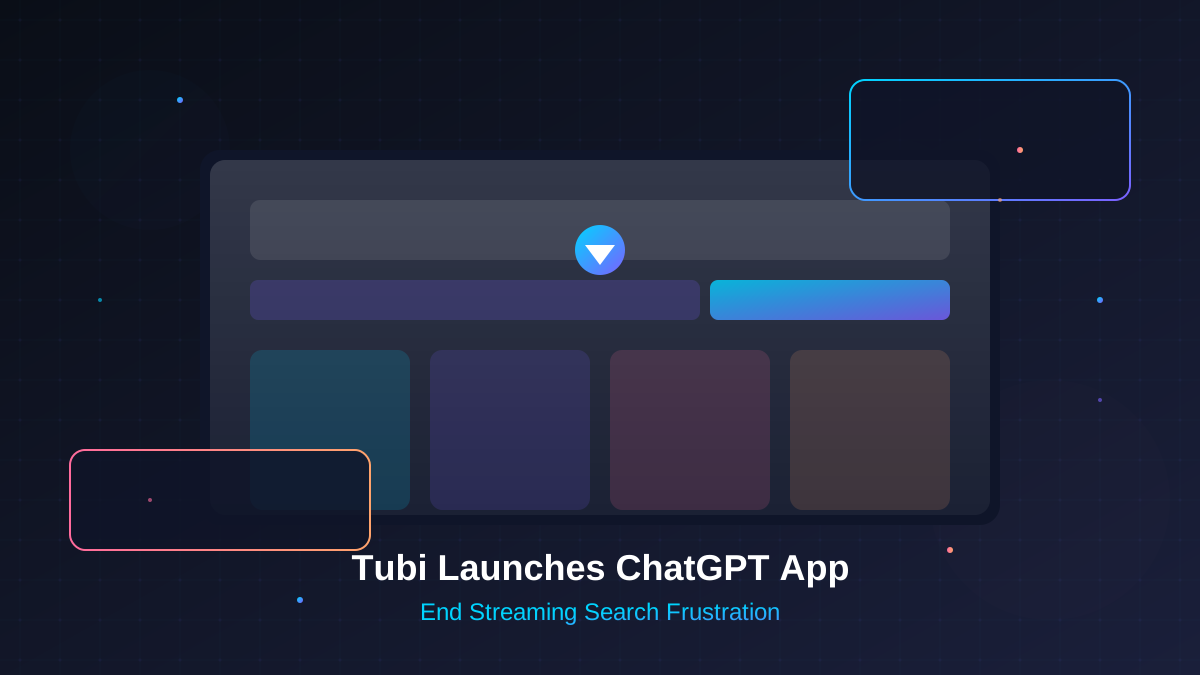
At this critical juncture, Tubi, the free ad-supported streaming television (FAST) service under the Fox Corporation, made a bold and highly symbolic move: it no longer tries to bring users back to the Tubi app to solve this problem but instead packages its ‘recommendation engine’ as a native app delivered to the ChatGPT store.
Users simply type ‘@Tubi’ in the ChatGPT dialog box, then describe in natural language—for example, ‘give me a heartwarming family comedy for a rainy day’ or ‘find an obscure sci-fi film with a twist ending’—and the AI will directly provide recommendations with links to watch on Tubi.
This may seem like just a feature integration, but in my view, this is the first salvo in the streaming media war entering the ‘post-app era.’ The industry logic and strategic intent behind it are far deeper than the surface-level technical collaboration suggests.
Why Has ‘Discovery’ Become the Ultimate Battlefield in the Streaming Industry?
The Brutal Arithmetic of the Attention-Scarce Era
To understand the profound implications of Tubi’s move, we must first see the current battlefield situation. After a decade of fierce competition, the streaming industry has moved from the early ‘content arms race’ into the deep waters of ‘user attention争夺.’ Major platforms have poured hundreds of billions into充实片库, only to leave users paralyzed by choice. More致命的是, the attention structure of the younger generation has completely changed.
Over 34% of Tubi’s users are aged 18 to 34. What is this demographic’s usage context? It’s simultaneously scrolling through TikTok on their phones, replying to Instagram messages, and playing streaming content on TV. Their attention is highly fragmented and multitasking. Tubi CEO Anjali Sud一语道破其策略核心: ‘We bet that the future of television should be as simple and personalized as Instagram.’
The subtext of this statement is: traditional, closed, platform-centric browsing and search modes have失效 for this user group. If the process of ‘discovering content’ isn’t intuitive enough, fast enough, or贴合当下情境 enough, user流失 happens in an instant.
The Failure of Self-Built AI and the Strategic Pivot
Tubi didn’t suddenly realize the importance of AI recommendations. As early as 2023, it尝试推出自建的 AI discovery tool ‘Rabbit AI,’ allowing users to get recommendations via Q&A within the platform. However, this service was quietly shut down the following year. This失败的经验 is极其宝贵, illustrating two key points:
- The data and traffic of a single platform are insufficient to train a sufficiently intelligent general-purpose conversational AI.
- Asking users to open another specific app for a particular feature本身就是一种体验摩擦.
It was this挫败 that prompted Tubi’s strategy to shift彻底 from ‘Build’ to ‘Embed.’ Rather than spending huge sums to build a standalone AI interface that might go无人问津, it’s better to directly进驻 the conversational platform that already has 900 million weekly active users—ChatGPT. This is a classic ‘go where the fish are’ pragmatic logic.
The table below compares the本质差异 between Tubi’s old and new AI strategies:
| Dimension | Old Strategy: Self-Built Rabbit AI (2023) | New Strategy: Integrated ChatGPT App (2026) |
|---|---|---|
| Strategic Core | Build and Control | Embed and Integrate |
| User Reach | Relies on Tubi’s own traffic (~100M月活) | Leverages ChatGPT ecosystem traffic (900M周活) |
| Usage Barrier | Users need to actively open Tubi App and find the feature | Users naturally trigger it in ChatGPT conversations |
| AI Capability | Relies on Tubi’s own data and models | Grafts ChatGPT’s general language understanding |
| Cost Structure | High R&D and maintenance costs | Relatively lower integration and API costs |
| Risk | High (product failure risk borne alone) | Medium-Low (depends on external platform, but策略灵活) |
This pivot is not just a tactical adjustment but a预判 of the industry’s future landscape: future services will become increasingly ‘invisible’; the key to success lies not in how often your app icon is clicked but in how deeply and intelligently your service integrates into users’ Digital Life Stream.
How Does Tubi’s ChatGPT Integration Rewrite the Competitive Rules for Streaming Platforms?
Paradigm Shift from ‘Catalog Browsing’ to ‘Intent直达’
Traditional streaming platform interfaces, no matter how beautifully designed, are本质上 products of ‘catalog thinking’: categorizing content by genre, theme, popularity, editorial picks, etc., letting users search like looking up cards in a library. Search functions rely on keyword matching, unable to understand that ‘a movie to make me cry’ and ‘a touching tearjerker movie’ might be the same intent.
What Tubi achieves through ChatGPT is a paradigm shift of ‘intent直达.’ Users express模糊的, situational, highly personal ’needs,’ and the AI’s task is to interpret the underlying ‘intent’ and directly provide the most匹配 results. This skips all intermediate browsing and filtering steps.
graph LR
    A[Traditional Streaming Discovery Path] --> B[Open Platform App]
    B --> C[Browse Homepage/Categories]
    C --> D{Decide to Search?}
    D -- Yes --> E[Enter Keywords]
    D -- No --> F[Infinite Scrolling Browsing]
    E --> G[Get Keyword-Matched List]
    F --> H[May Give Up Due to Choice Fatigue]
    G --> I[Manually Select to Watch]

    J[Tubi + ChatGPT Path] --> K[In Any ChatGPT Conversation]
    K --> L[Type @Tubi + Natural Language Request]
    L --> M[AI Parses Context and Intent]
    M --> N[Directly Get Recommendation and Link]
    N --> O[One-Click Jump to Watch]

    subgraph “Experience Friction Comparison”
        A --> P[High Friction: Multi-step, High Cognitive Load]
        J --> Q[Low Friction: Intuitive, Contextual, Seamless]
    end
The industry significance of this转变 lies in redefining ‘platform advantage.’ In the past, platform advantage was体现在 exclusive content, user interface, algorithm recommendations. In the future, platform advantage may be more体现在 ‘depth and intelligence of integration with external AI ecosystems.’ Whoever can more流畅地 ’translate’ their content library into a service that large language models (LLMs) can understand and accurately调用 will seize the initiative in the attention争夺战.
Potential Impact on Subscription (SVOD) Giants: Cracks in the Walled Garden
This development sends a strong signal to subscription giants like Netflix, Disney+, Amazon Prime Video. These giants have long operated ecosystems known as ‘Walled Gardens’: users pay to enter, and all experiences (including search, recommendations) are completed within the walls. They also invest in AI, but mainly to optimize recommendation algorithms within the walls (e.g., Netflix’s famous personalized posters and排序).
Tubi’s move is like opening a window in the garden’s wall. It tells users: you don’t have to get lost in the garden; you can stand on a more open balcony (ChatGPT), directly tell the butler (AI) what you want, and I can hand you the most suitable flower from the garden.
What impact will this have?
- Shift in Discovery Funnel: Some users, especially young tech尝鲜者, may develop the habit of ‘asking ChatGPT first, then going to the platform to watch.’ This makes ChatGPT某种程度上 a ‘meta-search入口’ for streaming content, weakening各平台首页 as the primary discovery channel.
- Increased Competition Dimension: Giants now face an additional competition dimension besides competing with each other: whose content library can be more effectively indexed and recommended by external AI? This involves complex technical integration, data structuring, and API design.
- Strategic Dilemma: Giants face a choice: follow the integration, risking ceding some user experience control to OpenAI? Or坚守封闭生态, betting their own AI experience is sufficient to retain users? This is not an easy answer.
The table below analyzes possible strategy options and pros/cons for mainstream streaming platforms facing this trend:
| Platform Type | Representative Platforms | Potential Benefits of Following Integration | Potential Risks of Following Integration | Likely Strategic Orientation |
|---|---|---|---|---|
| Free Ad-Supported (FAST/AVOD) | Tubi, Pluto TV, YouTube | Maximize reach,提升广告库存填充与价值 | Deepened dependence on external platforms, profits may be shared | Actively Embrace,视为用户增长核心 |
| Subscription Giants (SVOD) | Netflix, Disney+ | Reach new user groups, optimize discovery experience | Weaken brand direct触达, may affect subscription conversion paths | Cautiously Test Waters,可能以有限内容或特定区域先行 |
| Hybrid Model | Hulu, Peacock, Max | Simultaneously promote ad and subscription businesses, more comprehensive data collection | Complex business logic, high integration technical difficulty | Strategic Cooperation,区分免费内容与付费墙内容的AI存取 |
| Hardware-Bound Ecosystem | Apple TV+ | Strengthen Apple’s overall ecosystem (e.g., deep integration with Siri) | If limited to own ecosystem, reach is limited | Ecosystem Priority,深度整合自家装置与语音助理 |
Evolution of Advertising Models: From ‘Audience Targeting’ to ‘Dual Targeting of Context and Intent’
As an ad-supported platform, every innovation by Tubi ultimately needs to serve广告变现. This ChatGPT integration may push its advertising technology (Ad Tech) capabilities to new heights.
Combining Tubi Moments with AI Intent Parsing
Tubi has already deeply integrated AI into its advertising technology stack, using large language models and deep learning to parse user intent. Its flagship product ‘Tubi Moments’ can automatically识别影片场景中的情绪, atmosphere, and visual elements (e.g., a scene of clinking glasses for a drink) and mark them as sellable ad inventory. This实现了 ‘Contextual Advertising’ automation and规模化.
Now, imagine combining this capability with user intent data from ChatGPT integration:
- Intent Side: User describes in ChatGPT ‘want to find a crime film shot in New York with紧张节奏.’ This expresses not only content preference but also implies the user’s current emotional state (seeking刺激) and geographic interest.
- Context Side: Tubi’s AI识别出符合条件的影片中,恰好有主角在时代广场追逐的场景 (Tubi Moments标记).
- Ad Matching: The system can精准地投放 ads from the New York tourism bureau, sports shoe brands, or energy drinks in that scene’s ad slot.
This upgrades from traditional ‘audience demographic targeting’ to dual targeting of ‘intent + context.’ Ad relevance and expected effectiveness will大幅提升, thereby推高广告单价 (CPM) and brand ROI.
mindmap
  root(Tubi AI Advertising Value Chain Enhancement)
    (Expanded Intent Data Sources)
      ChatGPT Natural Language Queries
        Parse Real-Time Viewing Mood
        Parse Potential Interest Topics
        Parse Viewing Context Preferences
    (Deepened Context Recognition Technology)
      Tubi Moments Scene Marking
        Visual Element Recognition (Objects, Scenes)
        Emotion and Atmosphere Analysis (Joy, Tension)
        Audio Content Analysis (Dialogue, Music)
    (Precise Matching and Delivery)
      Dynamic Ad Insertion (DAI)
        Select Ad Category Based on Intent
        Match Specific Ad Creative Based on Scene
        Real-Time Bidding (RTB) Efficiency提升
    (Effect Measurement and Optimization)
      View Completion Rate Correlation Analysis
      Brand Lift Effect Surveys
      Subsequent Behavior Conversion Tracking
According to Tubi’s公开资料, its model training is based on 1 billion hours of monthly viewing data. After integrating ChatGPT, high-value intent data from conversational interfaces will become another powerful fuel for optimizing its ad matching models. This builds a competitive moat difficult for纯订阅制 platforms and traditional TV广告 to match—a dynamic, context-aware advertising engine based on massive interactive data.
Industry Future Landscape: The ‘App-Less’ Future of Streaming Media?
Tubi’s move should not be seen as a single event but as a strong trend signal. It points to a possible future: streaming media services become increasingly ‘invisible,’ more like an always-on ‘Utility.’
Staged Development Path Projection
I believe the integration of streaming industry and generative AI will大致经历 three stages:
- 辅助发现阶段 (Now - 2027): The current stage Tubi is in. AI mainly serves as an external辅助搜索 and recommendation tool; the platform core experience remains within its own app. Competition焦点 is ‘integration smoothness and recommendation accuracy.’
- 深度整合与服化阶段 (2027 - 2030): AI is no longer just a recommendation入口 but the core driving personalized experiences. Possible features include: AI对话自动生成个人化频道, unified AI assistants for跨平台内容, real-time recommendations of related video clips based on chat content. Parts of platform backend services will彻底 ‘API化’ for various AI智慧体 (Agent)调用.
- 分散式与智慧体主导阶段 (Post-2030): Users may no longer need to remember which platforms they subscribe to. Personal AI智慧体 will dynamically manage subscription portfolios, navigate across platform content libraries, and even perform跨平台比价 and临时授权 for single影片 based on user preferences, budget, and current needs. Streaming platforms