What key turning points in FinTech evolution does this certification reveal?
The answer: FinTech innovation is transitioning from ‘process digitization’ to a deep integration phase of ‘decision intelligence’ and ‘architectural modularity’. Over the past decade, FinTech focused on moving paper-based processes online, but core credit assessment and risk decisions still heavily relied on rule engines and historical data. The recognition of Pennant’s pennApps Studio is crucial because it demonstrates how generative AI can be deeply embedded into the entire value chain—from customer engagement, application, review, disbursement to post-loan management—and how modular design allows financial institutions to quickly assemble, test, and deploy new loan products. This means innovation speed is shortening from units of ‘months’ or even ‘years’ to ‘weeks’ or ‘days’. According to McKinsey’s 2025 report, leading banks using similar platforms can reduce time-to-market for new loan products by 70% and lower operational costs by 20-30%.
This shift is driven by three pressures: first, soaring demand from consumer and business clients for personalized, real-time credit experiences; second, the development of RegTech requiring more transparent, traceable decision processes; third, competitive threats from tech giants and agile startups crossing industry boundaries. Platforms like pennApps Studio provide an ‘arsenal’ allowing traditional financial institutions to quickly arm themselves under these pressures.
Evolution of FinTech Innovation Evaluation Dimensions
The table below illustrates how the industry’s focus on evaluating FinTech solutions has shifted:
| Evaluation Dimension | Traditional Focus (2015-2020) | Current Focus (2021-2026) | Key Enabling Technologies |
|---|---|---|---|
| Core Value | Process efficiency, launch speed | Business agility, personalized experience | Microservices, API economy |
| Risk Management | Rule-based, statistical models | Predictive and adaptive AI, scenario simulation | Machine learning, generative AI |
| Architecture Philosophy | Monolithic, packaged software | Composable, Platform as a Service (PaaS) | Cloud-native, containerization |
| Integration Capability | Point-to-point interfaces | Ecosystem collaboration, embedded finance | Open APIs, industry clouds |
| Data Utilization | Historical transaction data analysis | Multimodal real-time data decision-making | Edge computing, image/speech recognition |
How do composable digital lending platforms redraw the competitive map of the financial industry?
Composable architecture will break internal barriers to financial product innovation, shifting competition from ‘scale wars’ to ‘speed wars’ and ’ecosystem wars’. Traditional large banks rely on their vast customer base and capital, but their internal systems are rigid, often requiring months of cross-departmental coordination to launch a new loan product. Platforms like pennApps Studio allow business units to select needed review modules, pricing engines, and compliance checks as if picking features from an app store, quickly launching loan schemes for specific customer segments (e.g., freelancers, small and medium-sized e-commerce businesses).
This will lead to a polarized industry development: on one end, institutions mastering advanced platform technology can conduct ‘micro-market’ saturation attacks, offering tailor-made products for extremely niche segments; on the other end, slow-to-react institutions will see their market share gradually eroded. According to International Data Corporation (IDC) predictions, by 2027, over 60% of global banks will invest in composable lending technology platforms as part of their core modernization strategy.
More critically, such platforms are the ideal foundation for achieving ‘Embedded Finance’. In the future, loan services will be seamlessly embedded in e-commerce platforms, accounting software, or supply chain management systems. Financial institutions with powerful, flexible backend platforms can become invisible yet indispensable credit providers in these ecosystems.
mindmap
  root(Competitive Impact of<br>Composable Lending Platforms)
    (Shift in Competitive Dimensions)
      Scale and capital advantages
      Innovation speed and agility
      Ecosystem integration breadth
    (Changes in Market Structure)
      Leaders: Platform-driven<br>universal banks
      Challengers: Agile banks/startups<br>focusing on verticals
      Followers: Regional banks<br>relying on legacy systems
      Ecosystem Partners: Non-financial enterprises<br>(embedded finance)
    (Reshaping of Key Capabilities)
      Product assembly and<br>rapid iteration capability
      API management and<br>ecosystem collaboration capability
      Operational capability for<br>data and AI models
Generative AI is not just chatbots; how does it completely restructure lending risk management?
Generative AI is evolving from a front-end customer service role to becoming a ‘co-pilot’ in risk decision-making, enabling dynamic, contextualized risk pricing. Most people equate generative AI with customer service chatbots, but in professional lending, its transformative power is deeper. For example, in SME lending, generative AI can analyze a business owner’s bank statements, public market information, and even supply chain partner conditions, automatically generating a dynamic risk assessment report and potential warning scenarios, not just providing a score. It can also instantly generate compliant loan document variants or simulate portfolio performance under economic downturn scenarios.
This shifts risk management from ‘reactive’ to ‘proactive foresight’. Traditional models rely on historical default data but often fail for emerging industries or non-traditional income earners (e.g., participants in the creator economy). Generative AI can synthesize more unstructured data (e.g., business descriptions, market reviews) for reasoning, offering a more comprehensive perspective. However, this also brings new challenges: the ‘black box’ nature of models and decision explainability will become regulatory focal points. Future leading risk platforms must have built-in ‘AI governance’ modules ensuring every AI recommendation is traceable and auditable.
Application and Impact of Generative AI in the Lending Lifecycle
| Lending Stage | Traditional AI/Automation Application | Generative AI Enhanced Application | Expected Benefit Improvement |
|---|---|---|---|
| Marketing and Customer Acquisition | Customer segmentation, programmatic advertising | Generating personalized marketing copy and product proposals | Conversion rate increase 15-25% |
| Application and Review | Optical character recognition, rule-based review | Automatically generating document checklists, interactive questioning | Review time shortened 40-60% |
| Credit Assessment | Credit scoring models | Generating multi-scenario risk narratives, interpreting non-traditional data | Reduction in new-type bad debts 10-20% |
| Documentation and Disbursement | Templated document generation | Dynamically generating compliant contract terms, automating disbursement instructions | Manual errors reduced 95%+ |
| Post-Loan Management and Collections | Repayment reminders, customer tiering | Generating personalized communication strategies, negotiation scenario simulations | Collection costs reduced 30% |
For the Apple ecosystem and consumer tech sector, what does this wave of FinTech innovation imply?
The deep intelligence of financial services will accelerate their integration with consumer electronics ecosystems, paving the way for ‘financial services as device features’. Apple has already ventured into finance through Apple Card, Apple Pay, and later ‘buy now, pay later’ services. The maturation of platforms like Pennant’s means the technical barriers to building complex financial products are lowering. In the future, if Apple or other consumer tech giants want to launch more advanced loan or investment products (e.g., financing schemes for high-value device purchases, or insurance products based on user health data), they will more easily integrate backend platform capabilities.
This may give rise to a new generation of ‘context-aware finance’. Imagine your iPhone or Apple Watch, upon detecting you’ve started regular exercise and achieved health goals, automatically offering you better health insurance rates or fitness equipment loans through built-in or partnered financial services. The technical pillars behind this are precisely composable financial service platforms and AI responsible for generating personalized terms. For Apple, this is not just an expansion of service revenue but a key strategy to enhance device stickiness and ecosystem value.
Furthermore, this opens avenues for commercial applications of AR/VR devices. When completing high-value transactions in virtual environments (e.g., purchasing virtual real estate or digital collectibles), instant, embedded financing services will become a necessary experience. Advances in platform technology significantly reduce the technical difficulty of realizing such sci-fi scenarios.
timeline
    title Evolution of FinTech and Consumer Tech Integration
    section 2010s
        Mobile payment proliferation : Smartphones become payment tools
        Wallet app rise : Integrating card and ticket management
    section Early 2020s
        Buy now, pay later emergence : Embedded credit in e-commerce scenarios
        Open banking development : Data sharing initiation
    section Mid-2020s to Present
        Generative AI intervention : Personalized financial assistants appear
        Platformization and composability : Financial function modularization
    section Future (2026+)
        Context-aware finance : Device and behavior-triggered financial services
        Metaverse finance : Native credit and contracts within VR/AR
What strategic decision points are Taiwanese banks and tech players facing?
Taiwan’s financial industry is at a crossroads between ‘deepening digitization’ and ’leaping into intelligence’; decisions on partner selection and technology architecture will determine market position for the next five to ten years. Taiwan has a high density of banks and tech talent, but its pace in core banking system modernization and deep AI application remains relatively cautious. Pennant’s recognition in the Indian market shows tech suppliers from emerging markets are rapidly rising through leapfrog innovation. Taiwanese players should not only focus on large European and American software vendors but also evaluate innovative solutions from India, Southeast Asia, and other regions.
For Taiwanese banks, especially medium-sized banks and credit unions, directly procuring or partnering with platforms like pennApps Studio could be a shortcut to accelerate transformation. This allows them to quickly acquire technological capabilities on par with international leaders despite limited resources. For Taiwanese information service providers (e.g., SIs or software companies), this is a clear warning: the value of pure system integration is diminishing; they must move up the value chain, mastering platform design capabilities and domain-specific AI models to avoid marginalization.
Specifically, Taiwanese players should immediately initiate three assessments: first, the ‘composability’ gaps in existing core systems; second, internal data governance and AI readiness; third, the feasibility and compliance pathways for interfacing with international innovation platforms. The cost of hesitation will grow higher as customer experience benchmarks are continuously raised by agile competitors.
Comparison of Technology Transformation Paths for Taiwan’s Financial Industry
| Strategic Path | In-house Development | Collaboration with Local SI | Introducing International Innovation Platform (e.g., Pennant) | Hybrid Cloud and Multi-Platform Strategy |
|---|---|---|---|---|
| Initial Investment | Very high | Medium-high | Medium (subscription/licensing fees) | High |
| Time Cost | Long (3-5 years) | Medium-long (2-4 years) | Short (6-18 months) | Medium-long (2-3 years) |
| Technology Control | Full control | Partial control, dependent on partner | Lower, but gains advanced features | Distributed, requires strong integration |
| Innovation Speed | Slow, depends on own team | Medium, depends on partner capability | Fast, iterates with platform updates | Fast, but integration complexity |
| Long-term Risk | Technical debt accumulation, talent attrition | Partner technology lock-in | Vendor lock-in, cultural adaptation | Architecture complexity and maintenance costs |
| Suitable For | Very large financial holdings with strong tech subsidiaries | Those preferring local collaboration, with specific customization needs | Medium-to-large banks seeking to quickly catch up to international standards | Those with ample tech budgets, aiming to become regional platforms |
Conclusion: Certification is not the end, but the starting gun for industry restructuring
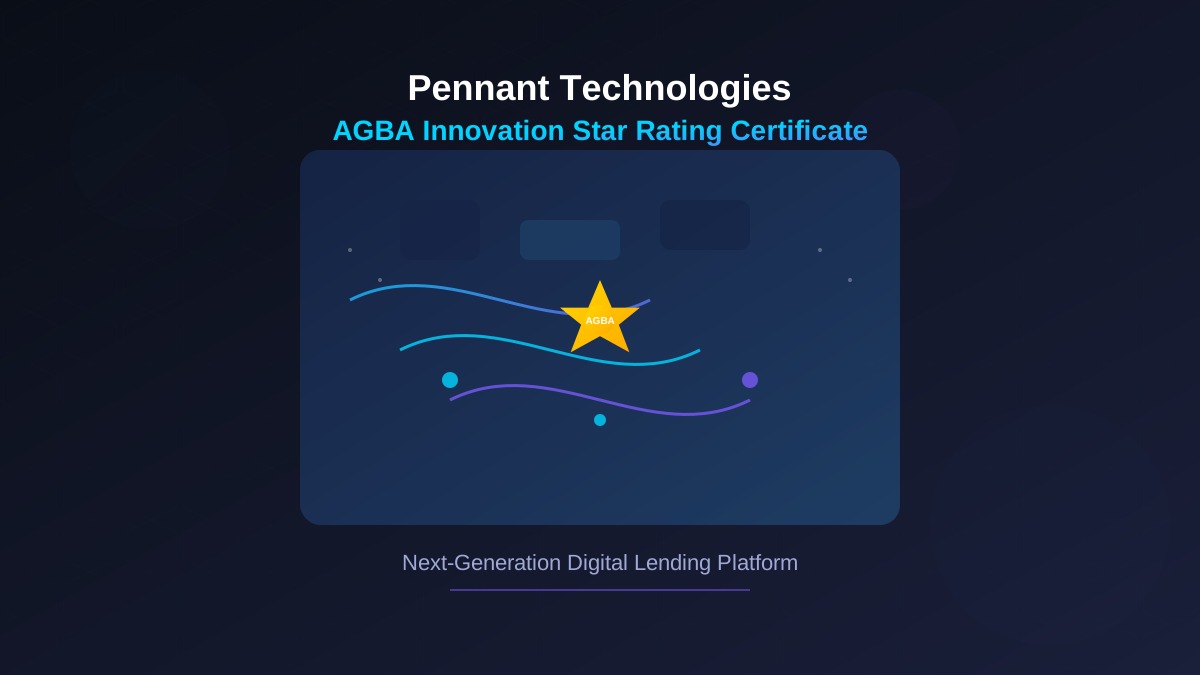
Pennant Technologies receiving AGBA certification is a concrete milestone, marking FinTech’s entry into an industrialized production phase based on ‘intelligent modules’. This is no longer just about a single company’s success but foreshadows a broader trend: the productivity and innovation models of financial services will be fundamentally altered. Banks will transform from ‘financial factories’ into ‘FinTech integrators’, with core capabilities in selecting, combining, and operating the best intelligent modules and seamlessly delivering them to any customer touchpoint.
For all industry participants—from global banking giants, local financial institutions, to tech suppliers and regulators—the future must now be thought of with a new framework. Organizations that can quickly embrace composable architecture, responsibly deploy generative AI, and actively build open ecosystems will define new rules in the next round of competition. The starting gun for this transformation has sounded; the price of hesitation will be future irrelevance.
FAQ
What does the AGBA Innovation Star certification mean for Pennant Technologies? This certification, supported by Indian government-related bodies, is an official endorsement of market-ready, scalable technology solutions, confirming Pennant’s AI-driven lending platform possesses practical industry impact and innovation leadership.
What is the core competitiveness of the pennApps Studio platform? Its core lies in ‘composability’ architecture and deeply integrated generative AI capabilities, allowing financial institutions to quickly build and adjust loan products like assembling building blocks, achieving end-to-end intelligent automation from review to collections.
What impact will this development have on traditional banking players? Traditional banks will face accelerated transformation pressure, needing to adopt similar intelligent platforms to enhance efficiency and customer experience, otherwise they may lag behind tech-embracing competitors in product innovation speed and risk management precision.
What key role does generative AI play in the digital lending process? Generative AI can automatically generate loan documents, instantly respond to customer inquiries, conduct more nuanced borrower behavior analysis, and simulate risk scenarios, significantly reducing manual work and decision biases.
What can Taiwanese FinTech startups or banks learn from this? They should focus on investing in modular, API-first technology architectures and actively explore generative AI application scenarios within compliance frameworks to create more agile, personalized financial service experiences.