Why “No News” Is the Most Important Industry News
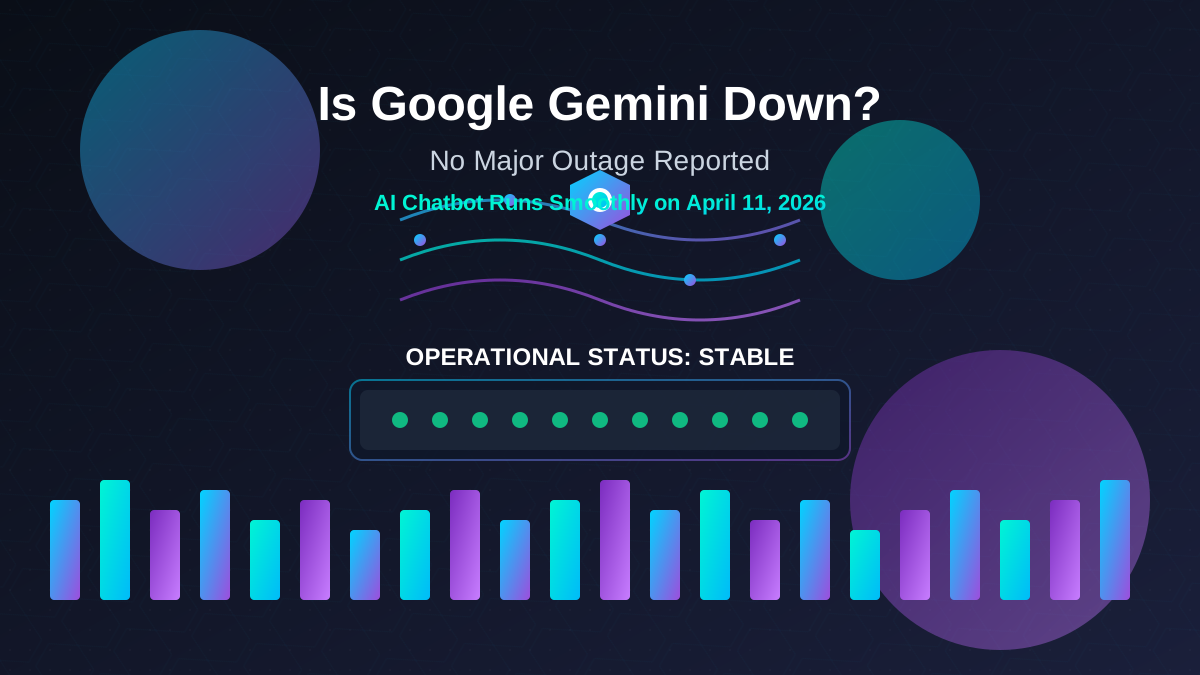
Direct Answer: Three years into the explosive growth of AI, market expectations regarding service disruptions have shifted from “When will it break?” to “It actually didn’t break?” Gemini’s stable performance on an ordinary Saturday is not accidental; it is a signal of the initial success of Google’s strategy to “infrastructuralize” AI services. This signifies that AI is transitioning from a cutting-edge technological product to a core service expected to be available at all times, much like electricity or the internet.
When we are no longer amazed by ChatGPT or Gemini’s ability to generate a poem, but instead demand they never fail when handling corporate quarterly reports, providing real-time translation for cross-border meetings, or controlling smart factory production lines, the industry’s rules of the game have fundamentally changed. According to Gartner’s forecast at the end of 2025, by 2027, over 60% of enterprises will prioritize “Service Level Agreement (SLA) achievement rate” and “historical uptime” over “latest model version” when selecting AI vendors. This is a fundamental shift: from pursuing the cutting edge to pursuing reliability.
Google understands this well. Its core search service has long maintained over 99.9% availability. This obsession with “never going down” is being replicated with Gemini. The brief 40-minute outage on April 10 was less of a failure and more of a successful stress release and rapid recovery drill. In distributed systems, completely avoiding failures is impossible; the key lies in the scope of impact, detection speed, and recovery capability. By containing this outage to a localized and brief scope through its globally distributed data centers and intelligent traffic routing, Google demonstrated the resilience of its cloud-native AI architecture.
The implication for the industry is that the competitive threshold for AI services has been significantly raised. Startups might emerge with a clever model architecture, but providing global-scale, enterprise-grade stable service requires infrastructure investments in the tens of billions of dollars and decades of operational experience. This is a game where Google and Microsoft (via Azure OpenAI Services) hold a stronger advantage.
AI Service Stability: From Technical Challenge to Business Moat
Direct Answer: Stability is no longer merely an engineering problem but a core business strategy. It directly translates into customer trust, contract value, and market share. For Gemini, which processes tens of billions of queries monthly, every 0.1% improvement in availability means enhanced user experience for millions and avoidance of potential revenue loss.
Let’s speak with data. Analysis of historical data from third-party monitoring platforms shows a significant downward trend in the cumulative monthly downtime of major AI chatbots from 2024 to early 2026:
| Service Name | 2024 Avg. Monthly Downtime | 2025 Avg. Monthly Downtime | 2026 Q1 Avg. Monthly Downtime | Key Stability Initiatives |
|---|---|---|---|---|
| Google Gemini | ~120 minutes | ~45 minutes | <15 minutes | Global TPU Pod expansion, multi-region real-time failover |
| OpenAI ChatGPT | ~180 minutes | ~60 minutes | ~25 minutes | Deep optimization of Microsoft Azure infrastructure, model sharding |
| Anthropic Claude | ~150 minutes | ~70 minutes | ~35 minutes | Self-built controlled data centers, gradual deployment processes |
| xAI Grok | N/A (not widely available) | ~200 minutes | ~80 minutes | Reliance on X platform infrastructure, priority on rapid iteration |
Table 1: Evolution Trend of Mainstream AI Chatbot Service Stability (Based on Public Monitoring Data Estimates)
From the table, it is clear that Google Gemini has shown the most significant improvement in stability. This is not accidental but the result of its “AI-as-a-Service” (AIaaS) strategy deeply integrating with existing cloud resources. Google Cloud has over 35 regions and 106 availability zones globally, providing Gemini with unparalleled fault isolation and traffic migration capabilities. When an issue arises in one region, user requests can be seamlessly routed to another healthy region within milliseconds.
More crucially, the economic model. Maintaining high availability is extremely costly, involving redundant computing resources, backup network bandwidth, and complex monitoring systems. This creates a powerful economies-of-scale effect: the larger the usage, the lower the unit cost, and the greater the ability to invest in cutting-edge technologies that enhance stability (such as predictive scaling). This builds a formidable moat that is difficult for new entrants to cross. According to industry analysis cited by MIT Technology Review, increasing the inference service availability of large language models from 99% to 99.9% requires a several-fold increase in marginal investment, but this 0.9% gap can determine whether a Fortune 500 company chooses you or your competitor.
mindmap
  root(AI Service Stability<br>Business Value Chain)
    (Customer Trust & Retention)
      (Reduced Workflow Disruption)
      (Increased Decision-Making Dependence)
      (Lower Switching Intention)
    (Revenue & Contract Assurance)
      (Enterprise SLA Contracts)
      (Continuity of Usage-Based Billing)
      (Avoidance of Service Credit Compensation)
    (Market Competitive Positioning)
      (Differentiation Advantage)
      (Entry into High-Barrier Markets<br>(Finance, Healthcare))
      (Brand Technical Prowess Symbol)
    (Operational Cost Optimization)
      (Economies of Scale Allocation)
      (Automated Operations Reducing Labor)
      (Predictive Maintenance Reducing Unexpected Expenses)
The Revelation of Brief Outages: The Complexity and Transparency Challenges of AI Systems
Direct Answer: The 40-minute outage on April 10 was like a precise industry X-ray. It exposed not weakness but the awe-inspiring complexity of modern AI systems. The root cause could stem from model load balancing, distributed cache invalidation, or transient overload of an underlying hardware cluster. Such brief, self-healing outages will become the “new normal” for AI services, and vendors’ post-incident transparency will impact reputation more than the outage itself.
Unlike traditional software services, generative AI service chains are extremely long: from user input preprocessing, prompt engineering, model inference (possibly involving thousands of chips working in concert), output generation, safety and policy filtering, to the final response. Minor delays or errors in any link can be amplified. For example, automatic scaling to handle sudden traffic spikes might cause delays for that batch of requests if newly launched TPU/GPU instances need to load hundreds of gigabytes of model parameters.
This brings new operational challenges. In response, leading cloud vendors have developed a monitoring and observability system tailored for AI:
sequenceDiagram
    participant U as End User
    participant LB as Global Load Balancer
    participant G as Gemini API Gateway
    participant M as Model Orchestration Layer
    participant TPU as TPU Inference Cluster
    participant C as Cache & Memory Layer
    participant Log as Observability Platform

    U->>LB: Send Query Request
    LB->>G: Route to Nearest Healthy Region
    G->>M: Perform Request Preprocessing & Routing
    M->>TPU: Dispatch to Suitable Model Instance
    TPU->>C: Retrieve Context/Knowledge
    C-->>TPU: Return Required Data
    TPU->>TPU: Perform Model Inference
    TPU->>G: Return Generated Result
    G->>U: Respond to User
    Note over G,TPU: Full-Link Metrics<br>(Latency, Error Rate, Token Usage) Real-Time Reporting
    G->>Log: Send Logs & Metrics
    TPU->>Log: Send Hardware & Model Metrics
    Log->>Log: Real-Time Analysis, Anomaly Detection, Trigger Alerts
Diagram: Simplified Gemini Service Request Chain and Observability Data Flow
However, complexity should not be an excuse for opacity. Currently, most AI service providers’ post-mortem reports remain overly simplistic, lacking technical details. This poses risks for enterprise clients relying on their APIs for application development. In the future, we may see “health dashboards” and “incident report libraries” similar to those for cloud services become standard for AI services, and even the emergence of independent third-party AI service performance and security audit institutions.
This brief outage also reminds us that monopoly by a single model is risky. Savvy enterprise users are already adopting multi-model strategies, routing different tasks to different AI services or automatically failing over when primary service degradation is detected. This is fostering an emerging market for “AI gateways” or “model routing layers,” whose core value is enhancing application-layer resilience to underlying AI service instability.
Ecosystem Integration: Google’s Invisible Ace and Apple’s Potential Wild Card
Direct Answer: Gemini’s stability is not just a victory for a single service but a manifestation of the synergistic value of the Google ecosystem. When AI is seamlessly embedded into Search, Gmail, Docs, and Android, its stability becomes the stability of the entire digital life and workflow. This deep bundling is an advantage difficult for pure AI companies like OpenAI to replicate and signals that the next phase of competition will be ecosystem versus ecosystem warfare.
Google’s strategy is to make AI omnipresent yet invisible. The smart compose suggestions you get while drafting emails in Gmail, the real-time meeting summaries generated in Google Meet, or conversing with Gemini Live via voice on Android—in these scenarios, users may not even realize they are using “Gemini.” This deep integration brings two key advantages: 1) Continuous Data Feedback Loop: Interaction data from real-world scenarios continuously improves the model, making it more practical and less prone to hallucinations. 2) Unparalleled User Reach: Billions of existing devices and accounts provide Gemini with a zero-cost user onboarding path.
However, there is a heavyweight potential player yet to fully enter this ecosystem battle: Apple. The rumored “Apple GPT” or, more likely, AI capabilities integrated in a new form into iOS, Siri, and various native applications, could be a game-changing variable. Apple has absolute control over hardware (Apple Silicon), operating systems, and privacy frameworks. If it can launch an AI experience centered on on-device inference, supplemented by the cloud, and highly focused on privacy, it will pose a distinctly different challenge to the current cloud-centric competitive landscape.
| Competitive Dimension | Google (Gemini) | Microsoft/OpenAI (ChatGPT/Copilot) | Potential Competitor (Apple) |
|---|---|---|---|
| Core Advantage | Search, Global Android Ecosystem, Cloud Infrastructure | Enterprise Market Penetration, Developer Ecosystem, GitHub/Office Integration | Hardware Integration, Privacy Protection, Premium Consumer User Loyalty |
| Integration Depth | Very Deep (Search, Workspace, Android) | Deep (Windows, Office 365, Azure) | Unknown, but Potentially Very Deep (Full Hardware Line, iOS, macOS) |
| Business Model | Advertising, Cloud Subscriptions, Workspace Subscriptions | Azure Cloud Consumption, Copilot Subscriptions, API Fees | Hardware Premium, Service Subscriptions (e.g., Apple One) |
| Stability Strategy | Global Cloud Multi-Region Redundancy | Leveraging Azure Global Backbone | May Emphasize Reliability & Offline Capability of On-Device Inference |
| Main Challenge | Innovator’s Dilemma, Brand Trust (Privacy) | Dependence on OpenAI, Cost Control | Late Start in AI Foundational Research, Cloud Scale |
Table 2: Strategic Analysis of Major AI Ecosystem Competitors
In the next two years, we may see further market differentiation: Google and Microsoft competing for the enterprise and developer cloud AI market, while Apple potentially carves out a new lane in the premium consumer AI market centered on personal devices and privacy. Gemini’s stable operation is a necessary condition for Google to consolidate its leading position in its existing lane.
Conclusion: The Industry Turning Point from “Feature Race” to “Trust Race”
April 11, 2026, a calm Saturday, Gemini service as usual. This seemingly non-newsworthy event is actually a strong industry signal. It marks the end of the wild west era of generative AI and the establishment of a new order dominated by infrastructure scale, operational excellence, and ecosystem strength.
For technology practitioners and observers, the focus should shift from “How many parameters does the next model have?” to “Which service can guarantee me 99.99% uptime?” For enterprise decision-makers, the framework for evaluating AI vendors must include their infrastructure blueprint, incident response history, and ecosystem integration roadmap. And for end-users, we will witness AI evolve from a “tool” that requires active access to an “intelligence layer” that works continuously in the background, imperceptible yet reliable.
The next time you hear about an AI service experiencing another brief outage, consider a different perspective: this is not proof of system fragility but an inevitable process of a complex, massive system continuously evolving and adapting to real-world pressures. The true winners are not systems that never fail (they don’t exist), but organizations that learn the fastest from each failure and make the system more resilient. Google Gemini’s stable performance on an ordinary day is its silent declaration of commitment to this long “trust race.” The competition has just entered its most critical chapter.